The AMC Javelin Was the Pony Car Detroit Underestimated
American Motors had a tenth of the budget and no business beating Chevrolet at its own championship, and the Javelin went and did it anyway.
American Motors had a tenth of the budget and no business beating Chevrolet at its own championship, and the Javelin went and did it anyway.
American Motors never had the money to fight Ford, Chevrolet, and Chrysler on level terms. It had a fraction of General Motors' engineering budget, a dealer body that had spent a decade selling sensible Ramblers to sensible people, and a brand image to match. Then it put the AMC Javelin on those showroom floors for 1968, and the smallest American automaker turned out to have built one of the best looking pony cars of the entire era.
The Javelin ran from 1968 to 1974 across two generations that look almost nothing alike. It won Trans-Am championships against factory Chevrolet and Ford efforts. It became the first pony car any American police agency bought as a regular highway patrol cruiser. And it still trades for less than a comparable Mustang or Camaro, which is an insult or an opportunity depending on which end of the deal you are standing on.
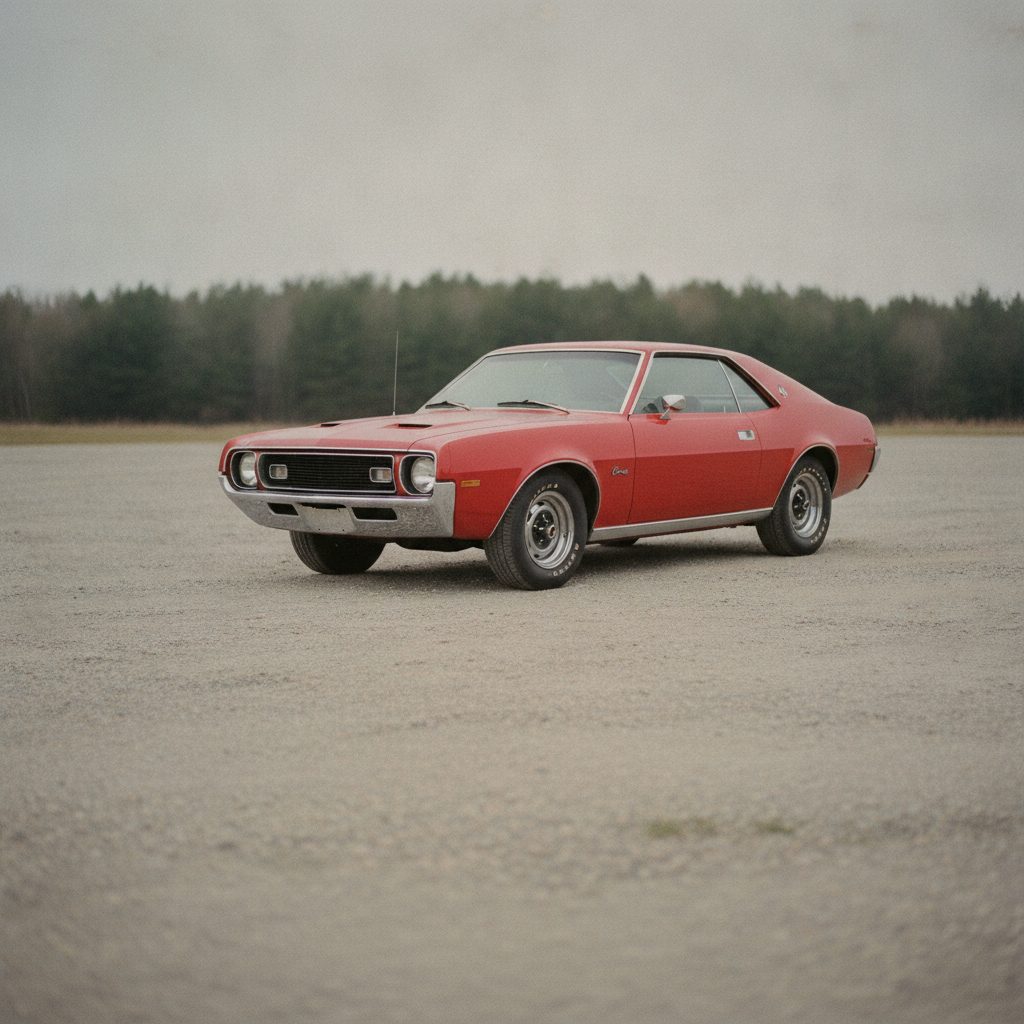
AMC's first swing at the sporty market was the Marlin, a fastback grafted onto a big sedan platform, and it fooled nobody. For 1968 the company started clean. Dick Teague's design studio drew a proper pony car: a 109 inch wheelbase, long hood, short deck, and a semi-fastback roofline with a delicate curve through the rear quarter that still looks expensive today. It was a strict four seat two door hardtop. AMC never built a factory Javelin convertible, which is part of why the survivors that do exist are all coupes.
Two trims opened the run, base and SST. The engine ladder started with the 232 cubic inch straight six at 145 to 155 horsepower and climbed through a 290 V8 at 225, a 343 at 235 to 280, and for buyers who wanted the real thing, a 390 V8 rated at 315. Ticking the Go Package added front disc brakes, heavy duty suspension, dual exhaust with chrome outlets, and performance rubber on styled wheels, and later versions folded in a ram air setup and extra cooling.
It worked. AMC moved 55,125 Javelins in that first 1968 model year, well past what a company that size had any right to expect, then 40,675 more in 1969. Midway through 1969 the paint chart got the Big Bad colors, a set of near fluorescent blue, orange, and green shades with body colored bumpers, which is still the single most AMC thing the company ever did. For 1970 the V8s were reshuffled, with a 304 in place of the 290, a 360 replacing the 343, and the 390 lifted to 325 horsepower.
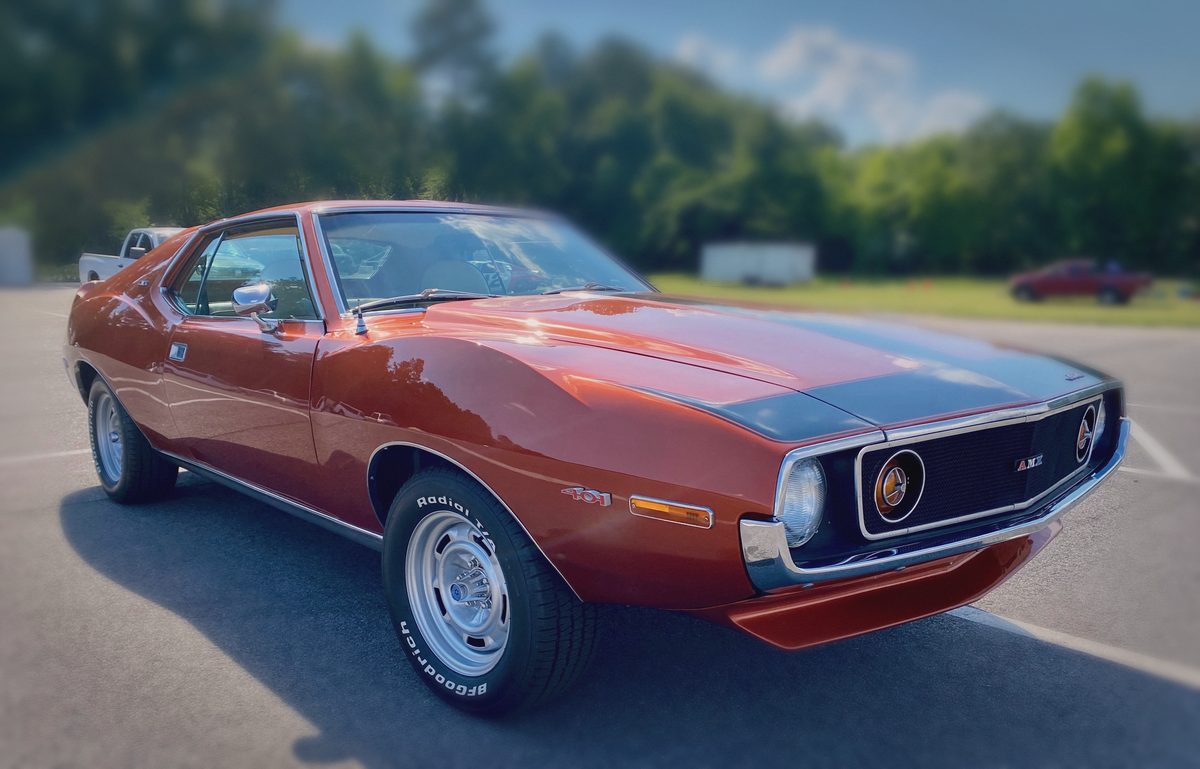
The 1971 restyle is the one people either love on sight or never forgive. The wheelbase grew an inch to 110, the roof gained a tunneled backlight with a built in ducktail, and the front fenders swelled into pronounced humps over each wheel. Nothing else in the segment looked remotely like it. Photographed next to a 1971 Mustang or Camaro, the Javelin reads as the wilder, more confident shape, which was a strange position for AMC to find itself in.
This is also where the naming gets confusing, and it is the single thing most buyers get wrong. Through 1970 the AMX was a separate car, a two seat Javelin shortened by a foot on its own 97 inch wheelbase. From 1971 the two seater was gone and AMX became the top performance trim of the four seat Javelin instead. So a 1969 AMX and a 1972 Javelin AMX are genuinely different machines that happen to share a badge. We covered the short wheelbase original in AMC's two seat gamble, and both cars live on the AMC hub.
The 401 cubic inch V8 arrived for 1971 at 330 horsepower gross, the biggest engine AMC ever put in a passenger car and the one that makes a Javelin worth chasing today. From 1972 the industry switched to SAE net ratings and the numbers on paper fell off a cliff, though the hardware underneath changed far less than the brochures suggested. The SST name was dropped, leaving base Javelin and Javelin AMX. AMC built 30,902 Javelins for 1973, of which 5,707 were AMX models, and 27,696 for the final 1974 season with roughly fifteen percent of those wearing AMX trim. There was also a Pierre Cardin interior option in 1972 and 1973, 4,152 cars trimmed in pleated multicolor stripes that ran up the doors and across the headliner, and it is exactly as remarkable in person as that sounds.
The racing story is the part that should have made this car famous. Roger Penske and Mark Donohue had just won the Trans-Am title for Chevrolet, and for 1970 they walked away from the biggest manufacturer in the world to run Javelins for the smallest. AMC paid what it could and got a works effort out of it.
The road car benefited directly. For 1970 AMC sold 2,501 Mark Donohue edition SST Javelins carrying the ducktail rear spoiler Donohue helped develop, built in that quantity specifically to satisfy the homologation minimum for the series. Alongside them ran roughly one hundred Trans Am edition cars in red, white, and blue. The results followed: the Javelin took the Trans-Am crown in 1971 with Donohue and again in 1972 with George Follmer, then won the title once more in 1976. No other pony car outside the big three ever did that.
AMC built the only pony car that beat the Camaro at its own championship, and it is still the one nobody hangs on the wall.
There is a footnote worth keeping too. The Alabama Highway Patrol bought 132 Javelins across 1971 and 1972, making it the first time any United States law enforcement organization ran pony cars as regular highway patrol cars. Chrysler and Ford had the police contracts sewn up for decades. AMC got there first with a two door fastback.
Start with the engines, because AMC did something the big three never did. Rather than run separate small block and big block families with different blocks, bellhousings, and mounts, AMC kept a single V8 architecture with shared external dimensions. The 304, 360, and 401 are close relatives that swap in and out of the same engine bay. A 401 is physically no larger than a Chevrolet small block, which is why so many surviving Javelins have quietly acquired one. If that distinction is unfamiliar, our explainer on big block versus small block covers why it mattered everywhere else.
What you give up is the aftermarket. Mechanical parts are well served by a dedicated network of AMC specialists, and you can build a 401 without much drama. Body panels, trim, glass, and interior soft goods are the problem, particularly for 1971 to 1974 cars whose bulged fenders are difficult to repair and effectively impossible to buy new. AMC stopped existing in 1987 when Chrysler absorbed it, so there is no factory anything. What you gain is a car nobody else at the show has, and a story that beats most of the cars parked around it. AMC's other overlooked bruiser gets the same treatment in our piece on the 1970 Rebel Machine.
Direction first, since values move: Javelins still ask meaningfully less than equivalent condition Mustangs, Camaros, and Challengers, and the gap has narrowed slowly rather than closing. The premium sits with documented 401 Go Package cars, 1970 Mark Donohue editions, and the Trans Am edition cars. A clean base or SST with a 304 remains one of the more affordable ways into a genuine period pony car.
Rust is the first thing to crawl under. Check rear quarters above and behind the wheel openings, the trunk floor and spare well, floor pans, frame rails, and the cowl where the vents dump water into the plenum. On second generation cars, look hard at the fender humps and the panel below the rear glass. Then verify what the car claims to be. On 1971 to 1974 Javelins the VIN encodes the model year, the transmission, the series, the body style, and the engine, and that engine character is what separates a real 401 car from a well built tribute. Go Package cars should show the correct disc brake hardware and exhaust, not just a badge. Interior trim is the quiet budget killer, and original Pierre Cardin fabric is effectively unobtainable, so buy the best interior you can find rather than planning to fix one.
Photograph of the 1972 Javelin AMX 401 Go-Package car above by Christopher Ziemnowicz, used under CC BY 4.0 and edited here for tone and depth of field.
Values track condition and drivetrain more than year. Documented 401 Go Package cars, 1970 Mark Donohue editions, and Trans Am edition cars sit at the top, while a solid base or SST with a small V8 remains one of the cheaper routes into a real pony car. Javelins still trade below equivalent Mustangs and Camaros.
The quick ones were genuinely quick. A 390 Go Package car from 1970 or a 401 from 1971 ran with contemporary big engine Mustangs and Camaros, helped by a chassis that Penske and Donohue proved could handle a road course. Six cylinder and 304 cars are pleasant cruisers rather than performance cars.
From 1968 to 1970 the AMX was its own model, a two seat car built on a Javelin shortened to a 97 inch wheelbase. From 1971 the two seater ended and AMX became the top performance trim level of the four seat Javelin. So a 1969 AMX and a 1972 Javelin AMX are different cars sharing one badge.
Rust leads: rear quarters, trunk floor, floor pans, and the cowl plenum. Body panels, glass, and interior trim are scarce, especially the 1971 to 1974 fender humps. Mechanical parts and V8 rebuilds are well supported by AMC specialists, so the expensive problems are almost always sheet metal and upholstery rather than engines.
The muscle world, every morning. Auctions, builds, reveals. Free.