The 1969 Camaro Z28 Was a Race Car With a Warranty
Chevrolet built a 302 small block to satisfy a rulebook, then sold 20,302 of them to people who never saw a road course.
Chevrolet built a 302 small block to satisfy a rulebook, then sold 20,302 of them to people who never saw a road course.

Chevrolet did not build the Z/28 because customers asked for it. The car exists because the Sports Car Club of America wrote a displacement ceiling into the Trans-Am rulebook, and Chevrolet went looking for a legal way to beat everyone inside it. The 1969 Camaro Z28 is what came out the other end of that process: a homologation special, sold through ordinary dealerships, with an ordinary new car warranty, to 20,302 buyers who mostly never turned a competitive lap in their lives.
That origin explains everything odd about the car. It explains why you could not order an automatic. It explains why the engine is a displacement nobody else in Chevrolet's catalog used. It explains the steep axle ratio and the lumpy idle. Every one of those traits is a side effect of a car engineered to satisfy a sanctioning body first and a customer second. Three model years in, the first generation Camaro had turned into something genuinely strange, and 1969 is the year it peaked.
The Trans-Am series ran a five liter limit, which works out to roughly 305 cubic inches. Chevrolet's small block catalog at the time offered a 327 and a 350, and both were over the line. Rather than destroke an existing engine, Chevrolet combined parts it already owned to land just under the number.
The result measured 302 cubic inches, close enough to the ceiling to leave nothing on the table. Homologation rules also required Chevrolet to actually sell the thing to the public in meaningful numbers, which is the only reason a road racing engine ended up in a car you could finance. The racing effort paid off exactly as intended. Roger Penske's Sunoco team, with Mark Donohue driving, took the Trans-Am title for Chevrolet in 1968 and repeated in 1969, and the 1969 championship came with a lasting argument about how closely the team's cars followed the letter of the regulations.
The engineering trick is elegant. Chevrolet took the 327 block with its four inch bore and dropped in the three inch stroke crankshaft from the 283. Four inches of bore against three inches of stroke gives 302 cubic inches, and it gives it in the shape that matters for a road course: a big bore for valve area, a short stroke for piston speed, and a willingness to keep pulling long after a torque engine has given up.
Chevrolet did not stop at the geometry. The DZ 302 got a forged steel crankshaft, forged rods and pistons, solid lifters and a Holley carburetor on 11.0:1 compression. That is a competition specification sold with a warranty, and it is the reason the engine sounds and behaves nothing like the 350 in the car parked next to it. If you want the wider argument about why a short stroke high winding engine feels so different from the torque monsters of the same era, we covered it in our piece on big block versus small block engines.
On paper the DZ 302 made 290 horsepower at 5,800 rpm and 290 lb-ft of torque at 4,200 rpm. Nobody serious believed the horsepower figure in 1969 and nobody believes it now. An 11.0:1 solid lifter engine with that camshaft and that induction does not stop making power at 5,800 rpm, and the racing versions of the same architecture were producing figures in a completely different neighborhood.
The underrating was deliberate and it was industry wide. Insurance underwriters had started pricing policies off advertised horsepower, and a low number on the window sticker kept a young buyer's premium survivable. There was also an internal General Motors limit on power to weight that a truthful number would have embarrassed. The published 290 was a number chosen for a filing cabinet, not for a dynamometer.
Chevrolet rated the DZ 302 at 290 horsepower, and almost nobody in 1969 believed it, starting with the engineers who wrote the number down.
Ordering the Z28 option was not like ticking a stripe package. It came with a Muncie four speed manual, new for 1969 with a standard Hurst shifter, bolted to a 12-bolt rear axle carrying 3.73 gears. There was no automatic transmission available at any price. Power front disc brakes were part of the deal, along with the stiffer suspension, quicker steering and the twin rally stripes that became the car's signature.
The option list on top of that is where 1969 gets interesting. A dual four barrel cross ram intake was available as a dealer installed part, which is about as close to a factory race manifold as a warranty will stretch. Four wheel disc brakes were offered under RPO JL8 at $500.30, and only 206 cars were built with them, making that code one of the genuinely rare boxes on a 1969 order form. The ZL2 cowl induction hood arrived the same year. Pricing on the base package varies by source, with the Z28 option commonly listed around $458 on a sport coupe that started near $2,726, though other references put the package above $500, so treat any single figure as approximate.
This is the argument that never dies, and it dies quickly once you understand that the two cars were built for different jobs. The SS was the straight line car, available with the 396 big block, and it does exactly what a big block muscle car should do: it hits hard from idle, it is happy in a quarter mile, and it will beat the Z/28 in most stoplight situations without trying.
The Z/28 gives that up on purpose. It trades low end torque for a chassis that survives a road course and an engine that rewards being wound out. On a drag strip the SS 396 is the better tool. On anything with corners, or on any road where you actually shift, the Z/28 is a completely different and more interesting machine. Neither is better in the abstract. They answer different questions, and the collector market has spent fifty years pricing them accordingly.
Here is the part that costs people money. A 1969 Camaro VIN does not encode the Z/28. The VIN tells you Chevrolet, Camaro, whether the car left the factory with a six or a V8, the body style, the model year and the assembly plant. It does not tell you which V8, and it does not tell you which option package. This is the same trap that catches buyers of the 1970 Chevelle SS, where the VIN is equally silent, and it is why documentation rather than a number plate decides what a car is. Our VIN engine decoder spells out exactly what a pre-1972 General Motors VIN can and cannot prove.
The cowl tag helps, with a serious caveat that most guides skip. On Norwood built cars from roughly the second week of December 1968 onward, X33 indicates a Z/28 ordered with the Style Trim or Rally Sport options, and X77 indicates a Z/28 without them. Cars built earlier than that will not carry an X code at all, and cars assembled at the Van Nuys plant never got X codes in the first place. A missing X code on a Van Nuys car proves nothing. A guide that tells you to walk away from any Z/28 without an X33 is going to talk you out of real cars.
So you go to the engine. A genuine car wears the DZ suffix stamped on the pad at the front of the block on the passenger side, and the stamping should agree with the car's serial number and its build date. Cowl tags get swapped, so confirm the tag's rivets and finish look factory. Best of all is paperwork: a build sheet, the original Protect-O-Plate, or a documented ownership history. On a car this heavily reproduced, the folder is worth more than the stripes.
Values sit well above where they were a decade ago, and the spread between an honest driver and a documented, numbers matching, correctly optioned car is enormous. The market pays for provenance far more than it pays for paint. A beautifully restored clone will always trade at a fraction of a verified DZ car, and the gap has widened as buyers have gotten better at checking.
Within the real cars, the premiums stack in a predictable order. Documentation first, then rare options, with JL8 four wheel discs and a genuine cross ram setup carrying real weight because so few cars had them. Original drivetrain matters more than cosmetic perfection, because paint is repeatable and a matching block is not. Budget for an inspection by a first generation Camaro specialist. It is the cheapest money in the transaction.
Values depend almost entirely on documentation. A verified, numbers matching Z/28 with a build sheet trades far above a restored car with no paperwork, and a clone sits lower still. Rare factory options such as JL8 four wheel discs add meaningful money. Get any car inspected by a first generation Camaro specialist before agreeing on a price.
Chevrolet advertised 290 horsepower at 5,800 rpm and 290 lb-ft at 4,200 rpm. The figure was widely understood to be conservative. An 11.0:1 solid lifter engine with a forged rotating assembly and that camshaft profile made considerably more, and the low rating existed largely to keep insurance premiums and internal corporate limits manageable.
The VIN does not encode it. Check for the DZ suffix stamped on the engine block pad and confirm it matches the car's serial and build date. On Norwood cars built from December 1968 onward, cowl tag codes X33 or X77 indicate a Z/28, but Van Nuys cars never carried X codes. Build sheets and documented history settle it.
They were built for different jobs. The SS 396 is the big block straight line car and will generally win a drag race. The Z/28 sacrifices low end torque for a road racing chassis and a high revving 302 that rewards shifting. On a track with corners the Z/28 is the better car. Neither is superior in every situation.
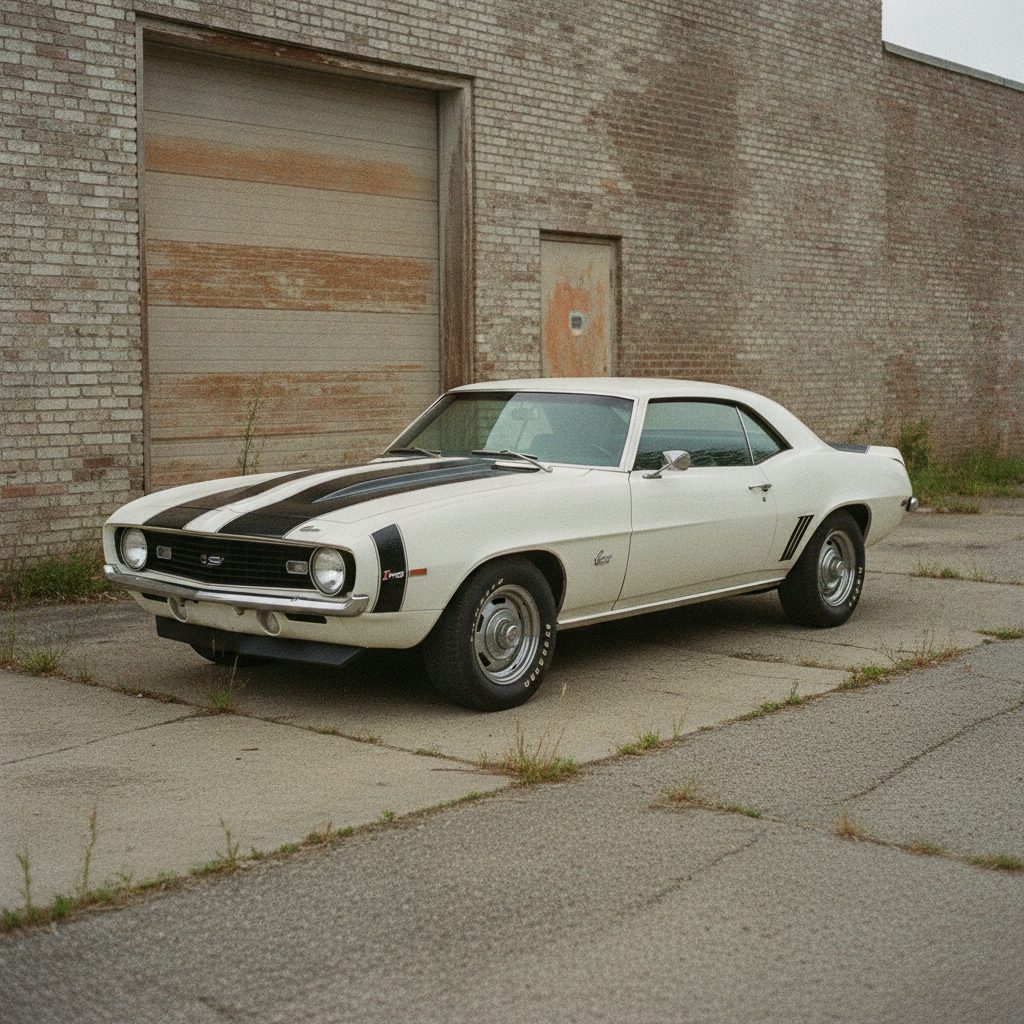
Cover illustration produced in house for Big Block Magazine. It is a representative 1969 Camaro Z/28 in Dover White with the correct 1969 sheet metal, not a photograph of a specific car.
The muscle world, every morning. Auctions, builds, reveals. Free.