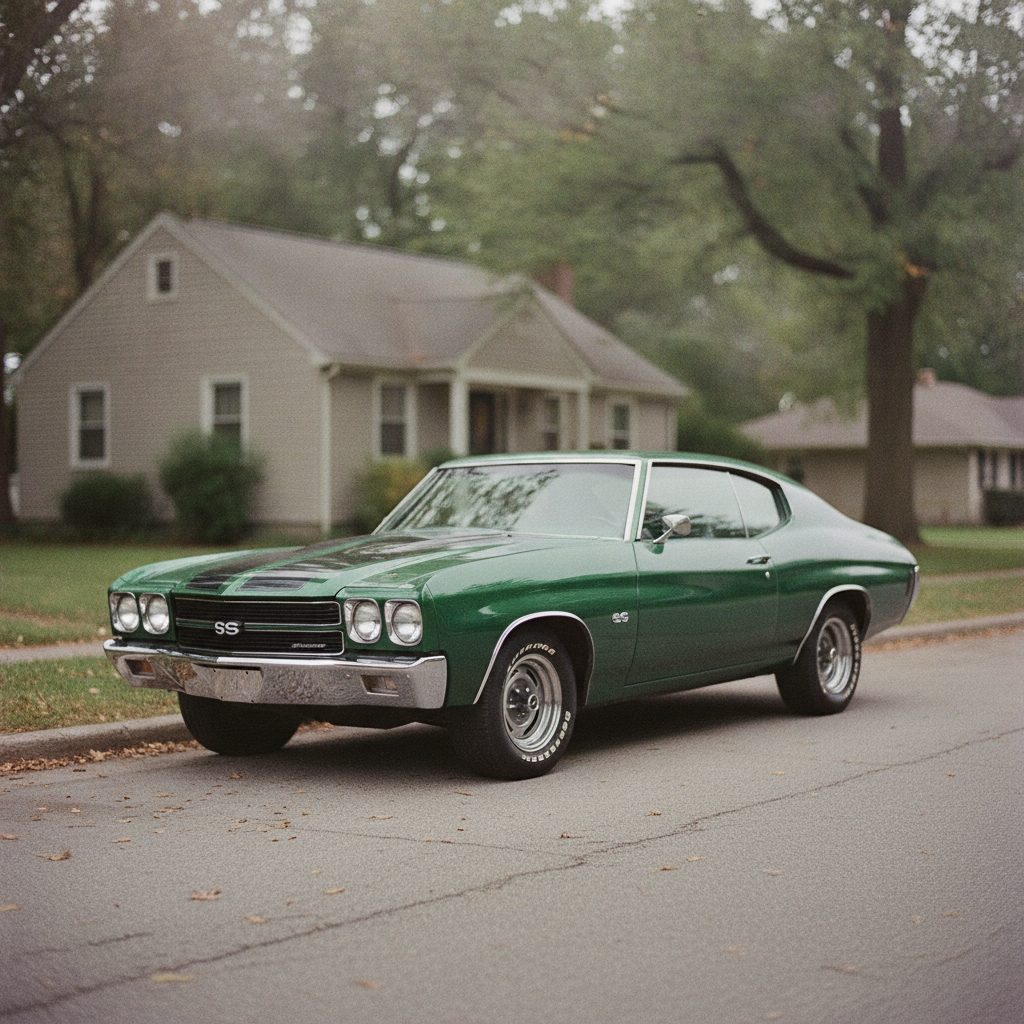
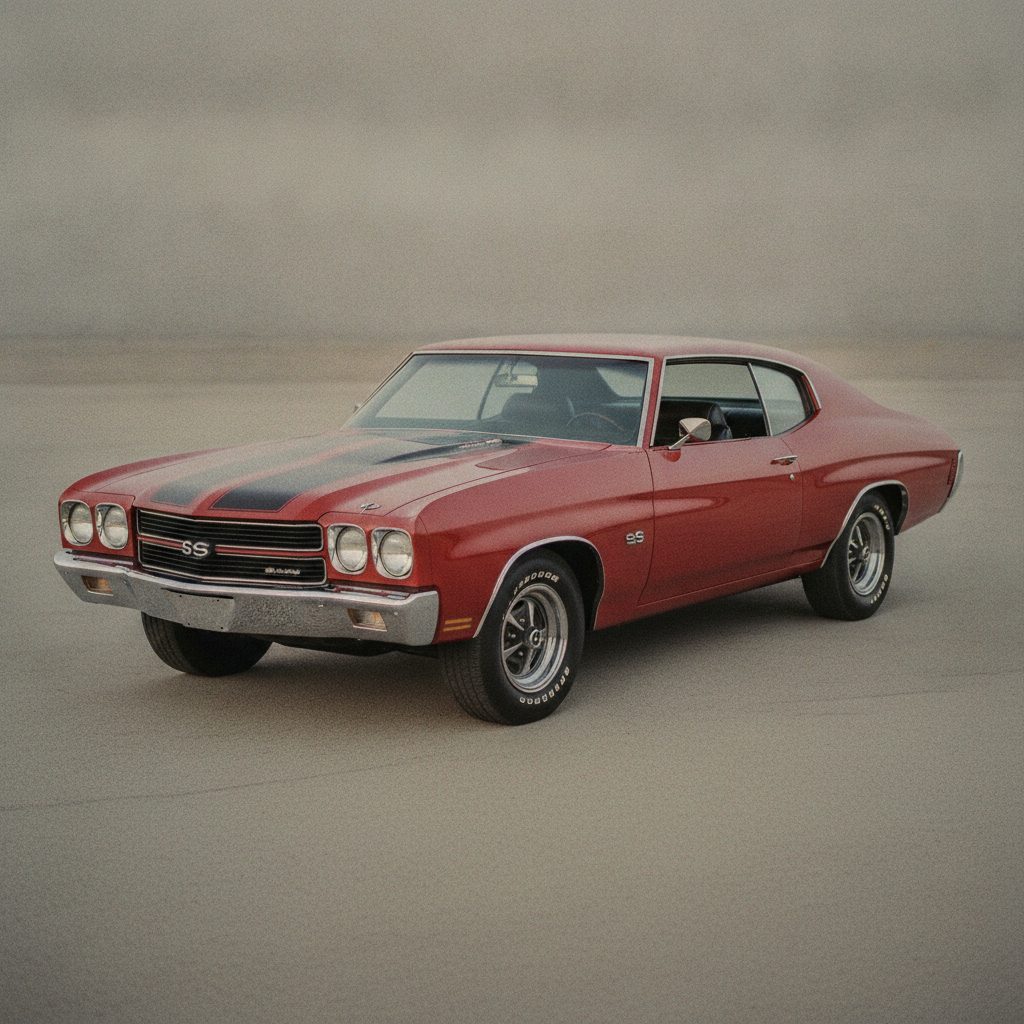
The 1970 Chevelle SS and the Rule That Broke
Chevrolet spent a decade capped at 400 cubic inches, then let the 454 loose in an intermediate and built the high-water mark of the whole era.
Chevrolet spent a decade capped at 400 cubic inches, then let the 454 loose in an intermediate and built the high-water mark of the whole era.
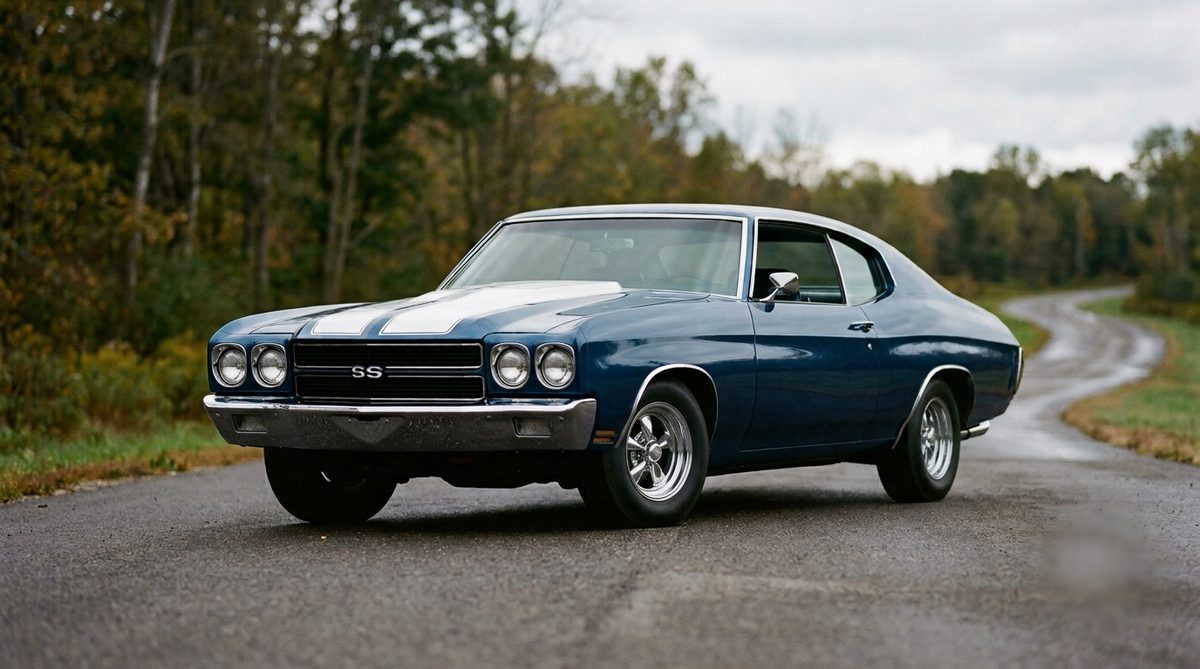
General Motors spent most of the 1960s building its mid-size cars with one hand tied behind its back. A corporate rule capped engine displacement in the intermediates at 400 cubic inches, which is the entire reason the Chevelle spent years bringing a 396 to fights with 440 Mopars and 428 Fords. For 1970 that rule went away. The 1970 Chevelle SS arrived with a 454 sitting where the 396 used to be, and almost everything anyone says about the peak of the muscle car era traces back to that single decision.
It helped enormously that the car itself was at its best that year. The 1970 Chevelle wore fresh sheet metal, a harder crease down the body side, and the split grille with four round headlights tucked into the outer fenders that still reads as the definitive Chevelle face. Add twin stripes and a cowl induction hood and you get the silhouette that ended up taped to more bedroom walls than almost anything else Detroit ever shipped. The mechanical story and the styling story peaked in the same twelve months, which is rarer than it sounds.
The displacement cap was internal policy, not law. GM leadership had decided that intermediate-size cars should not exceed 400 cubic inches, a rule aimed at keeping the divisions from embarrassing each other and at keeping insurance underwriters calm. Chevrolet worked around it the way everyone did, by squeezing more out of the 396 and by leaning on axle ratios. Pontiac had already found the loophole with the GTO in 1964 by making the big engine an option package rather than a model, but the ceiling itself stayed put for years.
When the policy was relaxed for the 1970 model year, every division ran through the door at once. Oldsmobile put the 455 in the 442, Buick built the GSX around its own 455, Pontiac dropped the 455 into the GTO, and Chevrolet gave the Chevelle the 454. If you want to understand why 1970 keeps showing up at the top of every list, that is the reason. Four divisions uncorked their largest engines in their best-looking cars in the same season, and it happened exactly once.
The timing was cruel. Insurance surcharges on big-engine cars were already biting, federal emissions rules were tightening, and compression ratios were about to fall off a cliff to accommodate low-lead fuel. The window that opened in 1970 was closing while the cars were still on the showroom floor. That is why the 1970 Chevelle SS is not just a good year in a long run. It is the top of the arc, with the descent visible from where it stands.
First thing to get straight: SS was never a separate model. It was an option package layered onto a Malibu, which is why so many arguments about authenticity get heated later. For 1970 Chevrolet offered it on the Malibu sport coupe, the Malibu convertible, and the El Camino. Two option codes did the work. RPO Z25 bought you the SS 396. RPO Z15 bought you the SS 454.
The SS 396 came with an asterisk that Chevrolet chose not to print. The engine had been bored out to 402 cubic inches, but the badging stayed at 396 because the name had equity and nobody at Chevrolet wanted to explain the change. In standard tune it was rated at 350 horsepower. The hotter solid-lifter L78 version, rated at 375 horsepower, carried over in small numbers. Volume-wise the SS 396 was the car most buyers actually drove home, outselling the 454 cars by a wide margin.
The Z15 package cost $503.45 and brought the 454 with it. In base form that meant the LS5, a hydraulic-lifter big block rated at 360 horsepower and built to be lived with. It is a genuinely pleasant engine, torque-rich and unbothered, and plenty of people who have driven both will tell you it is the better street car. Then there was the other one. For another $263.30, the LS6 turned the same package into something else entirely.
The LS6 was rated at 450 horsepower at 5,600 rpm and 500 lb-ft of torque at 3,600 rpm. It ran 11.25:1 compression, a solid-lifter camshaft, four-bolt main bearing caps, a forged crankshaft, an aluminum high-rise intake manifold, and a 780 to 800 cfm Holley on top. Behind it you could order the M22 heavy-duty four-speed that earned the Rock Crusher nickname for the noise its straight-cut gears made, or the Turbo 400 automatic, with a 12-bolt rear axle either way. The cowl induction hood was an extra-cost option, RPO ZL2, and it was functional: a vacuum-operated flap at the rear of the hood opened under throttle to feed the engine from the high-pressure area at the base of the windshield.
Those horsepower figures are SAE gross ratings, taken from an engine on a stand without accessories, exhaust, or air cleaner, so they are not comparable to anything published after 1971. That caveat gets trotted out constantly, usually by people trying to deflate the LS6, and it misses the point. The number that matters is the torque. Five hundred lb-ft at 3,600 rpm in a car weighing under two tons is the entire personality of the thing, and no rating standard changes what that feels like from the driver's seat. Our longer look at the engine itself is over in the LS6 454 deep dive.
Chevrolet built 4,475 LS6 Chevelles, then never built another factory engine quite like it.
There is a fourth engine in this story, and it is the source of most of the bad information online. The LS7 was a 465 horsepower, 610 lb-ft version of the 454 that appeared in Chevrolet literature and got as far as being talked about as a 1970 Chevelle option. It was never installed in a production car at the factory. Some LS7 hardware, including intake manifolds, made it out to the public through a handful of Chevrolet dealers as over-the-counter performance parts, and Chevrolet Performance later sold an LS7 crate engine rated at a 500 horsepower minimum.
So when a listing claims a factory LS7 Chevelle, the claim is wrong before you read the rest of it. This matters practically, because a car with genuinely rare hardware and a story that does not survive a five-minute check is a car with a documentation problem, not a hardware bargain. The LS6 is the top of the factory ladder for 1970. Nothing sat above it in a showroom.
Here is the part the for-sale listings never explain, and it is the single most important thing to understand about this car. Because SS was an option package and not a series, the vehicle identification number on a 1970 Chevelle does not encode it. The series digits identify a Malibu sport coupe and nothing more. There is no character anywhere in that VIN that says SS, and there is no character that says 454. A perfectly genuine LS6 car and a six-cylinder Malibu can carry VINs that look structurally identical.
What does prove a car is paperwork and metal. The build sheet, if it survived under the seat springs or above the glove box liner, lists the option codes. The Protect-O-Plate that came with the owner's manual carries coded build information. Dealer invoices, original window stickers, and unbroken ownership history all count. On the mechanical side, the partial VIN and the engine suffix code stamped on the block pad at the front of the passenger-side cylinder head deck should agree with the car and with the engine it is claimed to be. Cross-reference the suffix against a published decoding guide rather than trusting a seller's summary.
Physical tells are worth knowing but prove nothing on their own. Cowl induction hood, blacked-out grille, SS wheels, the round-gauge instrument cluster, the black-accented rear panel: every one of those parts is available new and has been bolted onto Malibus for fifty years. Clones are not a scandal in the Chevelle world, they are simply the majority. The scandal is a clone sold as an original, and the only defense is documentation. If you are still building a shortlist across the whole field, our classic muscle car field guide covers how the other makes handle verification, and the Mopar method is considerably easier.
Values here separate cleanly along documentation lines rather than cosmetic ones. Fully documented LS6 cars occupy the top bracket by a wide margin and behave more like blue-chip collectibles than driver-quality muscle, with convertibles and unusual color combinations pushing higher still. LS5 cars trade well below that and have quietly become the sensible way into a real SS 454. SS 396 cars are more accessible again, and a solid, honest, well-documented SS 396 is a considerably better ownership proposition than a thin LS6 story. Well-built clones sell on their merits as cars, which is a healthy market, provided everyone is honest about what they are.
When you go to look at one, spend your time underneath. These cars rust in the rear frame rails above the axle, in the trunk floor and drop-offs, in the lower quarters behind the wheel openings, and around the rear window channel. Body panels are available and cheap in the scheme of things, so surface condition is the least useful signal on the car. Structure and paperwork are where the money is. For the broader picture of what a big block actually buys you over a small block, we covered that argument in big block versus small block, and there is more Chevelle coverage on the Chevelle hub.
Value depends almost entirely on which engine and how well it is documented. Fully verified LS6 454 cars sit in a bracket well above everything else, LS5 454 cars trade meaningfully lower, and SS 396 cars are more accessible again. Undocumented cars and clones sell as drivers regardless of how well they present.
You cannot tell from the VIN. SS was an option package, so the VIN identifies a Malibu and carries no SS or engine code. Proof comes from the build sheet, the Protect-O-Plate, original invoices, and the partial VIN plus suffix code stamped on the engine block pad. Every visual cue can be bolted on.
The Malibu sport coupe started around $2,809. The Z15 SS 454 package added $503.45 on top of that, and stepping from the standard LS5 up to the 450 horsepower LS6 cost another $263.30. Options like the cowl induction hood, the M22 four-speed, and power front discs pushed real-world window stickers higher.
1970, and it is not especially close. It combines the restyled body with quad headlights, the first year GM allowed a 454 in an intermediate, and the highest factory rating the car ever received. Compression dropped for 1971, the LS6 rating fell to 425 horsepower, and the engine was gone shortly after.
The muscle world, every morning. Auctions, builds, reveals. Free.