The 1970 Dodge Charger Was the Last Great Wedge
New loop bumper, the only year for the Six Pack, and a Hemi count you can hold in two hands.
New loop bumper, the only year for the Six Pack, and a Hemi count you can hold in two hands.
The 1970 Dodge Charger is the one everybody thinks they can picture and almost nobody can date. It is the third and final year of the second-generation body, the year Dodge wrapped the nose in one enormous chrome loop, the only year you could order a Charger with three two-barrel carburetors, and the year the Hemi order book effectively closed. Total build was 46,315 cars by the most widely cited count, down from 89,199 the year before. The shape was at its peak and the market had already moved on.
That gap between how famous the car is and how few got sold is the whole story of 1970. Dodge spent the year adding chrome and colors to a body it was about to replace, while the buyers who would have signed for a big-block coupe were next door ordering the new Challenger instead.
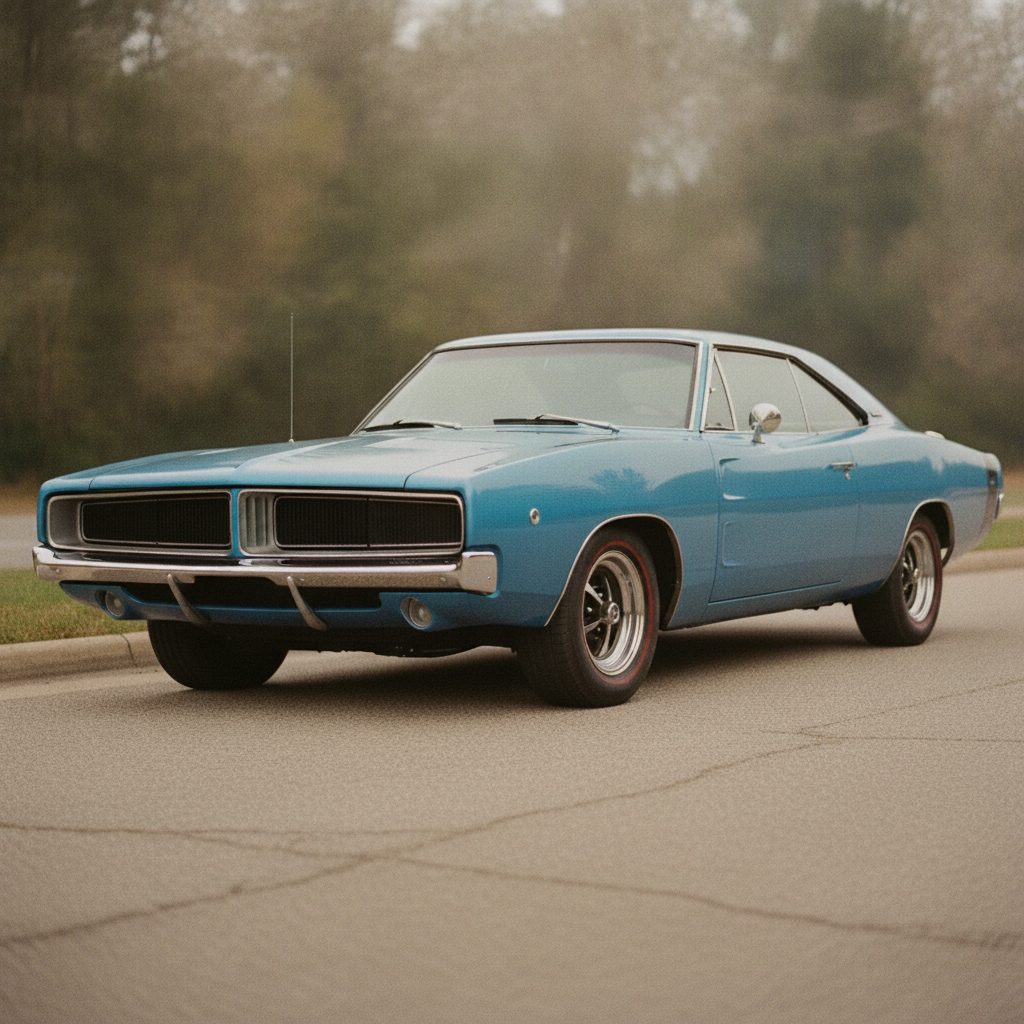
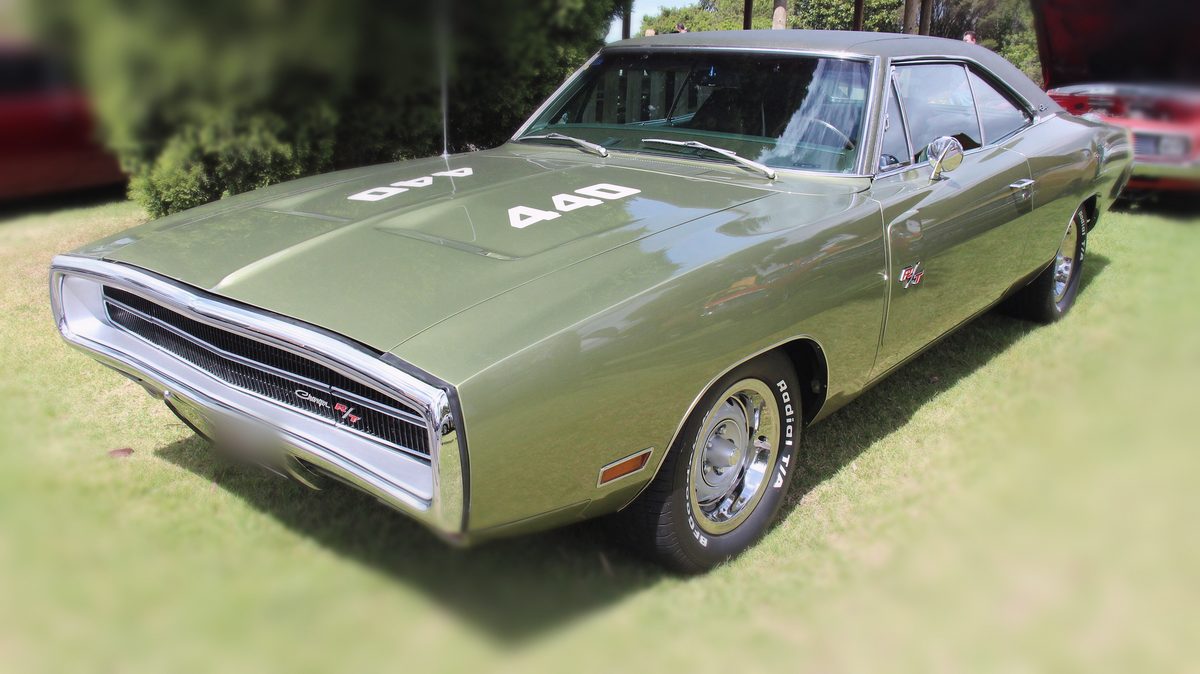
The tell is the front bumper. For 1970 Dodge dropped a single full-width chrome loop around the whole grille opening, and the grille itself lost the vertical split that ran down the middle of the 1969 car. If you are looking at a photograph and the grille reads as one wide dark rectangle inside a chrome ring, you are looking at a 1970. If it is divided in the center, it is a 1969. That bumper also made the car exactly one inch longer than the year before, which is the least useful piece of trivia in this article and the one you will remember.
Underneath the trim there was a genuine improvement. The hidden headlight doors switched from vacuum operation to electric, quietly removing the most annoying failure point on an early second-gen car. Anyone who has hunted for a vacuum reservoir canister to get a 1968's headlights to open again understands why that matters. The tail lamp panel was revised on the 500 and R/T, the wraparound rear stripe was gone, and R/T models picked up simulated rear-facing scoops carrying the R/T logo, mounted on the front doors over the body scallops. For what came before, our guide to the 1969 Dodge Charger walks that year trim by trim, and the rest of the model line lives on the Charger hub.
One option is pure 1970 and worth knowing on sight: a hood treatment that spelled out 440 or HEMI in block letters of silver reflective tape on either side of the hood scallops, with the scallop inserts painted black. It appeared for this year only. The car photographed above wears the 440 version, which is why the same three digits read forward on one side of the hood and backward on the other.
Three cars wore the badge in 1970 and only one of them is what people mean when they say Charger. The base car, model code XH29, opened at $3,001 with the 225 slant six and $3,108 with the 318. The Charger 500, code XP29, sat in the middle at $3,139 and $3,246. The R/T, code XS29, was $3,711 and came standard with the 440 Magnum. Be aware the totals do not reconcile across sources: the widely quoted 46,315 sits below the published trim-level tallies, which sum nearer 49,768. Treat any single figure as approximate.
Here is where 1970 catches people out. The Charger 500 of 1970 has nothing to do with the Charger 500 of 1969 beyond the name. The 1969 car was a flush-window, flat-grille homologation special built so Dodge could go superspeedway racing, and it led directly to the winged Charger Daytona. The 1970 Charger 500 was a trim level. Nearly two-thirds of the year's production wore 500 badges, the standard engine was the 318, the 383 in two-barrel and four-barrel form was the upgrade, and you could not order a 440 or a Hemi in one at all. Buy a 1970 Charger 500 expecting an aero car and you have bought a nicely trimmed cruiser.
The SE package, option code A47 at $161.65, went on top of either the 500 or the R/T. It bought leather and vinyl front buckets, wood grain dash inserts, a sports steering wheel, a pedal dress-up kit, the light group with turn signal indicators set into the hood, and deep dish wheel covers. Only 15.5 percent of 1970 R/T buyers ticked it, which works out to 1,452 cars, so an R/T SE is a genuinely uncommon combination rather than a marketing phrase.
The full 1970 ladder, in factory gross ratings, ran like this. The 225 slant six made 145 hp and 215 lb-ft. The 318 two-barrel made 230 hp and 320 lb-ft. The 383 two-barrel made 290 hp and 390 lb-ft, and the four-barrel version made 335 hp and 425 lb-ft. The 440 Magnum four-barrel, standard in the R/T, made 375 hp and 480 lb-ft. The 440 Six Pack made 390 hp and 490 lb-ft. The 426 Hemi made 425 hp and 490 lb-ft.
Treat every one of those figures as an advertisement rather than a measurement. Gross ratings came off an engine dyno with no accessories, exhaust, air cleaner or transmission attached. The 440 Magnum and the Hemi are quoted at the same 490 lb-ft, which tells you almost nothing about how differently the two behave: a Hemi's usable advantage arrives high in the rev range, where the 440 has already done its work. Our Hemi explainer covers why that head design breathes the way it does.
Transmissions were a three-speed manual, a four-speed manual, or the three-speed TorqueFlite automatic. Four-speed R/T cars got a Hurst shifter, and 1970 added the pistol grip handle that Mopar people now hunt specifically. Any four-speed 1970 Charger carries a premium over the same car with an automatic, and a pistol grip four-speed carries a premium over that.
The 440 Six Pack, three two-barrel Holleys on an aluminum intake, was available in a Charger for 1970 and no other year. It is the reason a lot of collectors care about this model year at all. The production figures are the part that surprises people: Dodge built 116 Charger R/T Six Pack cars, against 112 with the 426 Hemi. The engine that was supposed to be the sensible alternative to the Hemi outsold it by four cars.
Put that next to the 10,337 R/Ts built and the picture is clear. The overwhelming majority took the standard 440 Magnum, and the two headline engines together account for well under three percent of the run. Any 1970 Charger claiming either deserves the full documentation treatment described below before money changes hands.
It was only available that year.
That is Tim Wellborn of the Wellborn Musclecar Museum in Alexander City, Alabama, talking to Hagerty about the 1970 Six Pack and why it sits directly behind the Hemi in the market. Scarcity in this model year is not a marketing story. It is arithmetic.
1970 is the year the paint chart went loud. Go Mango, Sublime, Butterscotch, Panther Pink, Top Banana, Green Go, Plum Crazy and Hemi Orange all arrived, and for roughly $15 a buyer could have almost any Chrysler product sprayed in one. Those colors now do real work on value. The 1970 Charger Registry puts Plum Crazy on 12.8 percent of the year's R/Ts, about 1,199 cars, and the rarer shades get thinner from there. Wellborn keeps a Panther Pink Six Pack at the museum that is one of two built.
Interior specification matters more than newcomers expect. A white interior on a dark or bright exterior carries a real premium over the same car in black, and a color-and-trim combination that photographs well will outrun a duller car with better paperwork more often than purists like to admit. A factory sunroof is the rarest box on the sheet and close to unobtainable on a big-block car.
Good news, and it separates the Charger from a lot of its rivals: the VIN actually tells you what the car is. A Chevelle SS leaves no proof in its VIN at all. A 1970 Charger does. The plate sits on the left side of the dashboard instrument panel. It opens with X for the Charger line, then a letter for price class, then 29 for the two-door hardtop body. XH29 is a base Charger, XP29 is a Charger 500, XS29 is a Charger R/T. The fifth character is the engine, the sixth is the model year, and the seventh is the assembly plant.
The engine letters for 1970 are G for the 318, L for the 383 two-barrel, N for the 383 four-barrel, U for the 440 Magnum four-barrel, V for the 440 Six Pack and R for the 426 Hemi. Read that list carefully, because this is where published guides trip up. Chrysler used a different set in 1968 and 1969, when J was the Hemi, K and L were the 440s and G and H were the 383s. Guides that cover all three model years in one article routinely print the older letters, so a 1970 car checked against a 1968 chart will look wrong when it is right, or right when it is wrong. For a 1970, Hemi is R and Six Pack is V. We built a year-aware VIN engine decoder precisely because of this trap: it asks for the model year first, then shows you what the same letter meant in every other year.
After the VIN, work the paperwork. The fender tag is usually on the driver's side inner fender, and on 1969 and 1970 cars it carries the VIN rather than the order number. The VIN serial is stamped on the passenger side of the block near the distributor at frost plug level and on the transmission housing, and on 1970 cars the body stampings match the VIN too. A build sheet is sometimes still tucked behind the rear seat. A car with the correct VIN, a matching fender tag and a body stamping that agrees with both is documented. A Six Pack or Hemi claim resting on a story is not.
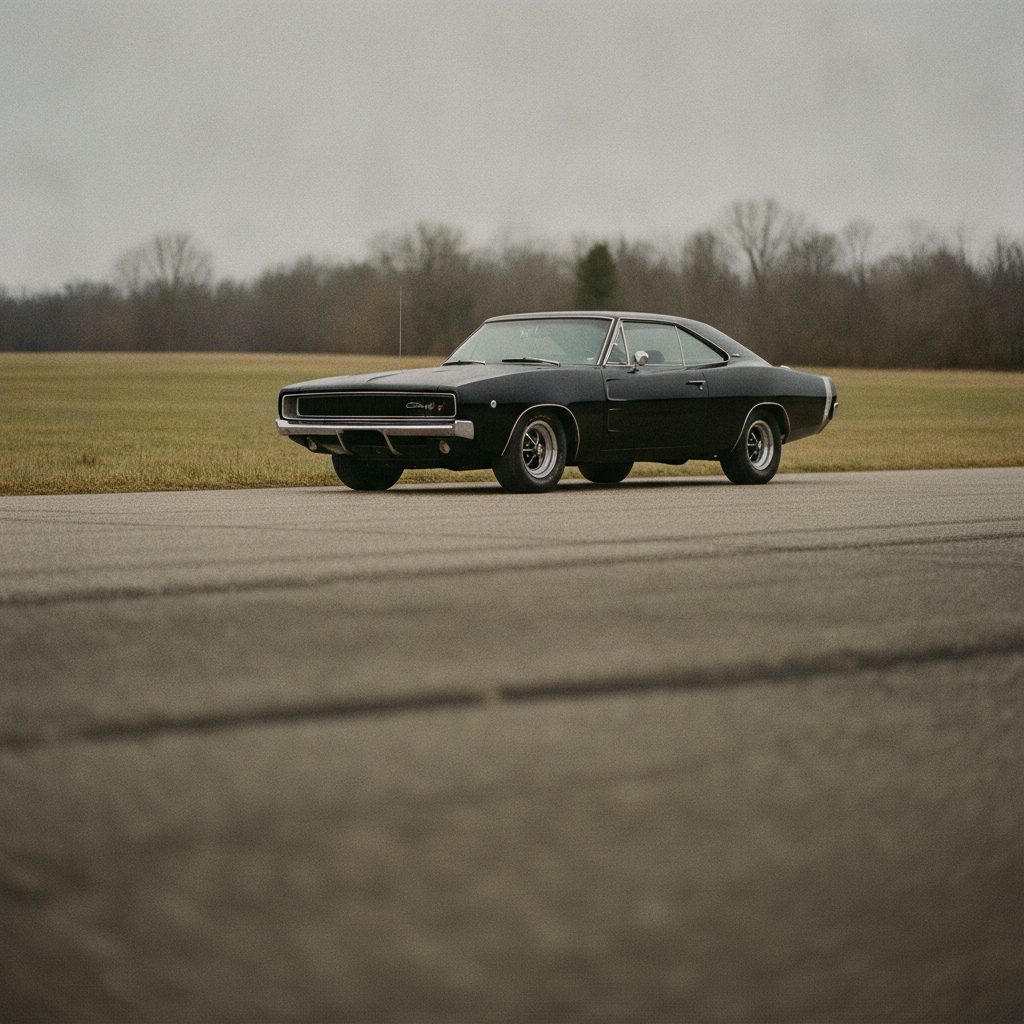
Three Chargers carry the model's fame and each is a different year, which is exactly why nobody can date the car on sight. The black coupe with the blower through the hood, the one people search for constantly, is a 1970 Charger R/T. The General Lee is a 1969, and the villains' car in Bullitt is a 1968. Same basic body, three separate model years, three completely different front ends once you know to look at the bumper and the grille split.
Worth saying plainly: the supercharger on the screen car is fiction. No Charger left the factory blown, and the Hemi cars that did wore a plain oval air cleaner under a stock hood. If the film sent you looking for one, the car you actually want is a documented 440 Magnum R/T.
Mechanically these cars are simple and stout, and the aftermarket has reproduced effectively all of the sheet metal, so the question is never whether a part exists. It is how much of the original car is left. Check the trunk floor and floor pans first, because the windshield and the rear window under the chrome both leaked from new and rubber trunk mats held the water in place. Look at the metal around the hood hinges, where bubbling usually means something worse underneath. Then look hard at the rear quarter panels, the single most likely place to find an amateur repair.
Two pieces of ownership advice worth taking. If the car still has four-wheel drums, budget for a front disc conversion before you drive it in modern traffic, because B-body drums are genuinely alarming at speed. And do the math before you buy a project: on a 383 or 440 car a full restoration will put you underwater faster than almost any decision available to you, and a previously restored car with a recognized name attached to the work is nearly always cheaper. The exception is the rough Hemi or Six Pack car with real paperwork, where the engine alone justifies the bill.
None of which changes the reason to want one. The 1970 Dodge Charger is the final version of a shape that has not needed explaining since it arrived, sold in the smallest numbers of the three years, in the loudest colors Chrysler ever mixed, with a carburetor setup you could only get that once. It was the last great wedge and it did not know it yet.
It depends almost entirely on trim, engine and documentation. A base or 500 car with a 318 or 383 sits at the affordable end of the second-generation market, a documented 440 Magnum R/T sits well above it, and a verified Six Pack or Hemi car is in another category entirely. Color and interior combination move the number more than mileage does.
The base Charger opened at $3,001 with the slant six and $3,108 with the 318. The Charger 500 was $3,139 and $3,246. The Charger R/T listed at $3,711 with the 440 Magnum standard. The SE package added $161.65, and a High Impact color cost roughly $15 on top of whatever else was on the order sheet.
Period road tests put 440 Magnum R/T cars in the mid 14 second bracket for the quarter mile, with Six Pack and Hemi cars a few tenths quicker in the right hands. Straight line speed was never the issue. Stopping and turning were, which is why front discs and modern tires transform how one of these drives today.
Look at the nose. The 1970 has one full-width chrome loop bumper around an undivided grille, while the 1969 has a split grille without the loop. The 1970 also dropped the rear stripe, added R/T door scoops, switched the headlight doors to electric, and was the only year offering the 440 Six Pack.
Lead photograph: a genuine 1970 Dodge Charger R/T by Sicnag, licensed CC BY 2.0 via Wikimedia Commons. Cropped, graded and depth-of-field treated in house to Big Block Magazine's visual standard. Production and specification figures cross-checked against Hagerty's second-generation Charger buyer's guide, the 440 Magnum Network production records, and period Dodge model data; the Tim Wellborn quotation is from Hagerty.
The muscle world, every morning. Auctions, builds, reveals. Free.