Big Block Chevy Firing Order, and the One Engine That Breaks It
The big block Chevy firing order is 1-8-4-3-6-5-7-2 with the rotor turning clockwise, on every Rat from the 396 to the 502, with one modern exception.
The big block Chevy firing order is 1-8-4-3-6-5-7-2 with the rotor turning clockwise, on every Rat from the 396 to the 502, with one modern exception.
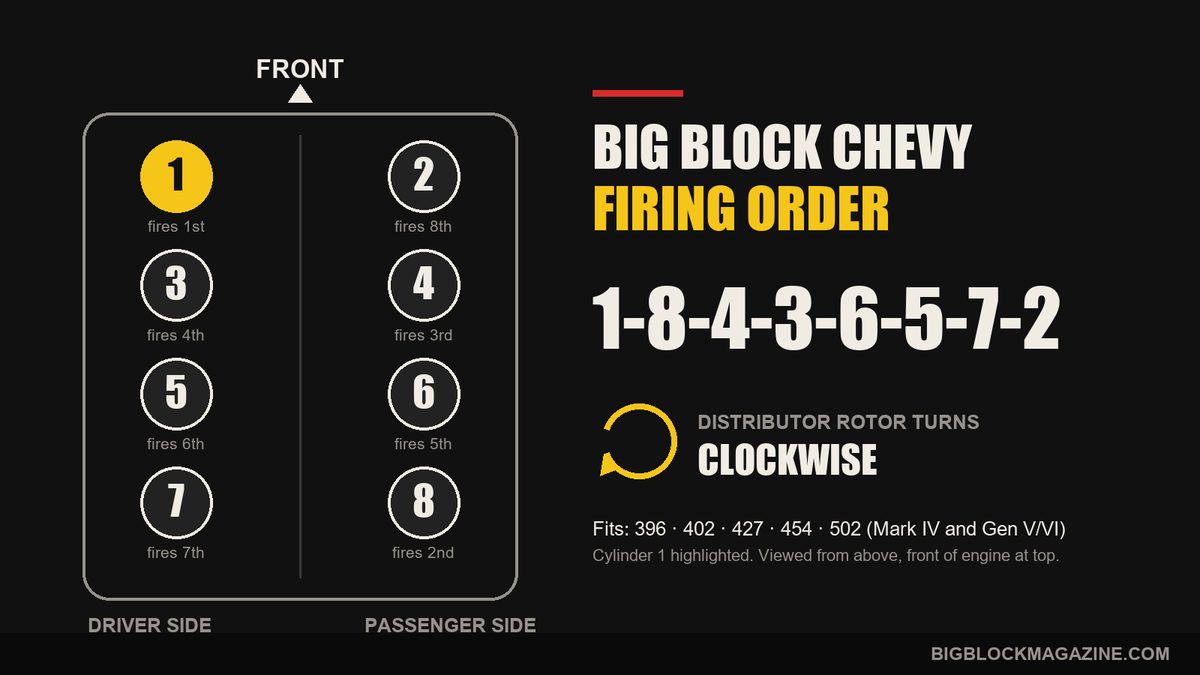
The big block Chevy firing order is 1-8-4-3-6-5-7-2, and the distributor rotor turns clockwise. Odd cylinders 1, 3, 5 and 7 sit on the driver side from front to back, even cylinders 2, 4, 6 and 8 on the passenger side. That answer covers the 396, 402, 427, 454 and 502 from 1965 onward. The rest of this page is about the parts that actually go wrong in the driveway: finding number one, reading the cap, the two wires you should never run side by side, and the cam swap that quietly changes the order.
Keep the diagram above open on your phone while you work. It shows the engine from above with the front at the top, which is the way you will be looking at it with the hood up, and each cylinder carries the position it fires in, so you can check a single wire without counting through the whole sequence.
Chevrolet numbers the Mark IV and its descendants the same way it numbers the small block. Stand at the front bumper and look back. The driver side bank, the left bank, carries cylinders 1, 3, 5 and 7, starting at the front. The passenger side bank carries 2, 4, 6 and 8. Cylinder number one is the front cylinder on the driver side, which is also the cylinder the timing marks on the balancer refer to.
The sequence 1-8-4-3-6-5-7-2 alternates banks most of the way through, which is what gives the engine its even pulse, but not every step. Cylinder 4 fires right after 8, both on the passenger side, and 3 fires right after 4, so the order crosses back and forth in a pattern that looks random until you trace it on the diagram. That apparent randomness is exactly why people get it wrong from memory. Write it on a piece of tape and stick it to the fender before you pull a single wire.
The big block Chevy firing order is identical to the small block order, which surprises a lot of people who assume the larger engine must be different. If you have ever wired a 350, you already know this one. Our big block vs small block explainer covers the real differences between the two families, and the firing order is not one of them.
Every production Mark IV engine uses it. That means the 396 that arrived for 1965, the 427 from 1966, the 454 that showed up for 1970 in the Chevelle and Corvette, and the 402 of 1970 to 1972 that Chevrolet kept badging as a 396. The Gen V big block that replaced the Mark IV in 1991 kept the same order, and so did the Gen VI that followed in 1996, along with the 502 crate engine built on that architecture.
The truck engines count too. A 454 out of a C30, a motorhome or a Suburban fires in the same order as the one in a Chevelle SS. If your engine is a junkyard mystery and you are not yet sure it is a Rat at all, start with our guide to big block Chevy casting numbers, which will tell you what the block is before you trust any firing order.
The exception is the Gen VII, the 8.1 liter Vortec that GM put in heavy duty trucks starting with the 2001 model year. It is a big block, it shares the family name, and it does not use the classic order. The 8.1 fires 1-8-7-2-6-5-4-3, the same sequence as the LS family, and it uses coil packs rather than a distributor, so there is no cap to wire anyway.
This matters for one reason: the 8.1 shows up in swap projects and on forum threads next to the older engines, and a chart that says all big block Chevys fire 1-8-4-3-6-5-7-2 without that footnote is wrong. If the engine has a distributor, it is a Mark IV, Gen V or Gen VI and the classic order applies. If it has individual coils, check before you assume.
If it has a distributor, it fires 1-8-4-3-6-5-7-2. If it has coil packs, stop and check.
The cap does not tell you where number one is. On a big block Chevy the distributor sits at the back of the intake, and the cap can go on in more than one position depending on how the distributor was last installed, so the tower that was number one on the last owner's engine may not be number one on yours. Find it from the engine, not from the cap.
Pull the number one spark plug, the front plug on the driver side. Put a thumb over the hole and have someone bump the engine over, or turn it by hand on the balancer bolt in the normal direction of rotation. When you feel compression push your thumb off, the piston is coming up on the compression stroke. Keep turning slowly until the timing mark on the balancer lines up with zero on the timing tab. That is top dead center on the compression stroke for cylinder one.
Now pop the cap and look at the rotor. Whichever cap terminal the rotor tip is pointing at is your number one tower. Mark it. From there, work clockwise around the cap and lay the wires down in firing order: 1, then 8, then 4, 3, 6, 5, 7 and 2. Clockwise is the direction the rotor turns on a big block Chevy, viewed from above. Wiring the cap in the wrong direction is the single most common reason a freshly assembled Rat backfires through the carburetor and refuses to start.
If the rotor points between two terminals, or nowhere useful, the distributor was dropped in a tooth or two off. Lift it, rotate the shaft until the rotor points at a convenient tower with the engine still at TDC, and seat it again, making sure the shaft engages the oil pump drive. Then wire from that tower.
Look at the driver side bank on the diagram. Cylinder 5 fires sixth and cylinder 7 fires seventh. They are right next to each other on the block and they fire back to back. Run those two wires parallel and tight against each other in the same loom and the spark in one can induce a voltage in the other, a condition usually called induction crossfire. The result is a miss or a ping that no amount of carburetor tuning will fix.
The cure costs nothing. Separate the 5 and 7 wires where they run alongside each other, or cross them at a right angle if they have to meet. Most aftermarket wire looms for the big block Chevy are designed with this in mind, and factory looms kept the two apart for the same reason. When a car comes in with a stubborn miss on that bank after a wire change, this is the first thing to check.
Some performance camshafts for the big block Chevy are ground with a different firing order on purpose. The most common is the 4 and 7 swap, which exchanges the positions of cylinders 4 and 7 and gives 1-8-7-3-6-5-4-2. The idea is to spread out the cylinders that fire back to back on the same end of the crank and smooth out the load on the main bearings and the crankshaft. Racers and engine builders such as Reher-Morrison have tested various combinations, and the debate over how much they help is long and loud on the racing forums.
For the purpose of this page the takeaway is simple. If the engine has an aftermarket cam, the cam card is the authority, not this chart. A swap cam installed with the plug wires wired to the stock order will run terribly or not at all. Before you rewire an engine you did not build, find out what cam is in it.
Once the wires are on in the right order, the engine should fire and idle. Set base timing with a timing light on the number one wire, with the vacuum advance disconnected and plugged if the setup calls for it. The correct figure depends on the engine, the cam, the compression and the fuel you run, so use the specification for your engine and adjust from there. Rotating the distributor counterclockwise advances the timing on a big block Chevy, because the rotor turns clockwise, and turning the housing against the rotor brings the spark in earlier.
If it still runs rough, do the quick checks in this order: confirm number one at TDC on the compression stroke, confirm the cap is wired clockwise, confirm 5 and 7 are separated, and confirm the cam is a stock order grind.
The 454 fires 1-8-4-3-6-5-7-2 with the distributor rotor turning clockwise. Cylinders 1, 3, 5 and 7 are on the driver side, front to back, and 2, 4, 6 and 8 are on the passenger side. The same order applies to the 396, 402, 427 and 502 with a distributor.
Yes. Both the classic small block Chevy and the Mark IV, Gen V and Gen VI big block use 1-8-4-3-6-5-7-2, the same cylinder numbering and the same clockwise distributor rotation. The exception in the big block family is the 8.1 Vortec, which uses 1-8-7-2-6-5-4-3 and coil packs.
Clockwise, viewed from above, on every Mark IV, Gen V and Gen VI big block with a distributor. Wire the cap clockwise from the number one tower in firing order. Because the rotor turns clockwise, rotating the distributor housing counterclockwise advances the ignition timing, and rotating it clockwise retards it.
Cylinder one is the front cylinder on the driver side bank. To find the number one terminal on the cap, bring that cylinder to top dead center on the compression stroke, then see which cap terminal the rotor points to. Do not trust a terminal marked by a previous owner.
The muscle world, every morning. Auctions, builds, reveals. Free.