Big Block Chevy Casting Numbers: What That Number Proves
It tells you which mould the iron came out of. It does not tell you what engine you are looking at, and almost every chart online blurs that line.
It tells you which mould the iron came out of. It does not tell you what engine you are looking at, and almost every chart online blurs that line.

Somebody is going to hand over real money for a 454 this weekend, and the only thing they will actually check is a seven digit number cast into a ledge at the back of the block. Big block Chevy casting numbers are the first thing everybody looks at and the most misread thing on the engine. The number is real. It just does not mean what most buyers think.
Here is the short version. The casting number identifies the mould the iron came out of, not the engine. Chevrolet ran the same casting across two displacements, across cars and trucks, across two bolt and four bolt mains, and in a few cases across two decades. Reading that number off the ledge and walking away is exactly how a motorhome 454 gets sold as a Chevelle engine.
The block casting number sits on a ledge at the rear of the block, below the deck, on the surface that mates to the bellhousing. On the vast majority of Mark IV big blocks it is on the driver side of that ledge, though some later blocks moved it across. It is six, seven or eight digits and never contains letters. Numbers like 361959, 3970010 and 14015445 are all valid. Stray letters nearby, usually GM or CFD for the Central Foundry Division, are foundry marks.
Expect to fight for it. That ledge collects forty years of baked oil, and with the engine in the car you work blind with a mirror. If the digits are shallow, press kitchen foil over them and rub. And remember you are reading one of three identifiers. The casting date and the suffix code sit elsewhere, and carry most of what you want.
Take the published lists at their word and read them carefully, because they contradict the way people use them. Casting 3855961 is listed as a 396 for 1965 and 1966 and as a 427 for 1966. Casting 3963512 is a 427 in 1969 and a 454 from 1970 through 1976. Casting 3969854 is a 396 in 1969 and a 402 from 1970 to 1972. Casting 3999290 covers a 396 truck block, a 402 truck block and a 402 car block.
It gets worse. Plenty of castings, 361959 and 3999289 among them, are documented as two bolt or four bolt mains depending on the block. So it will not reliably give you displacement, the vehicle, or even the bottom end. Our guide to big block versus small block Chevy engines covers the family. The casting number starts a conversation. It does not finish one.
The casting number tells you which mould the iron came out of. Everything you actually want to know is stamped somewhere else.
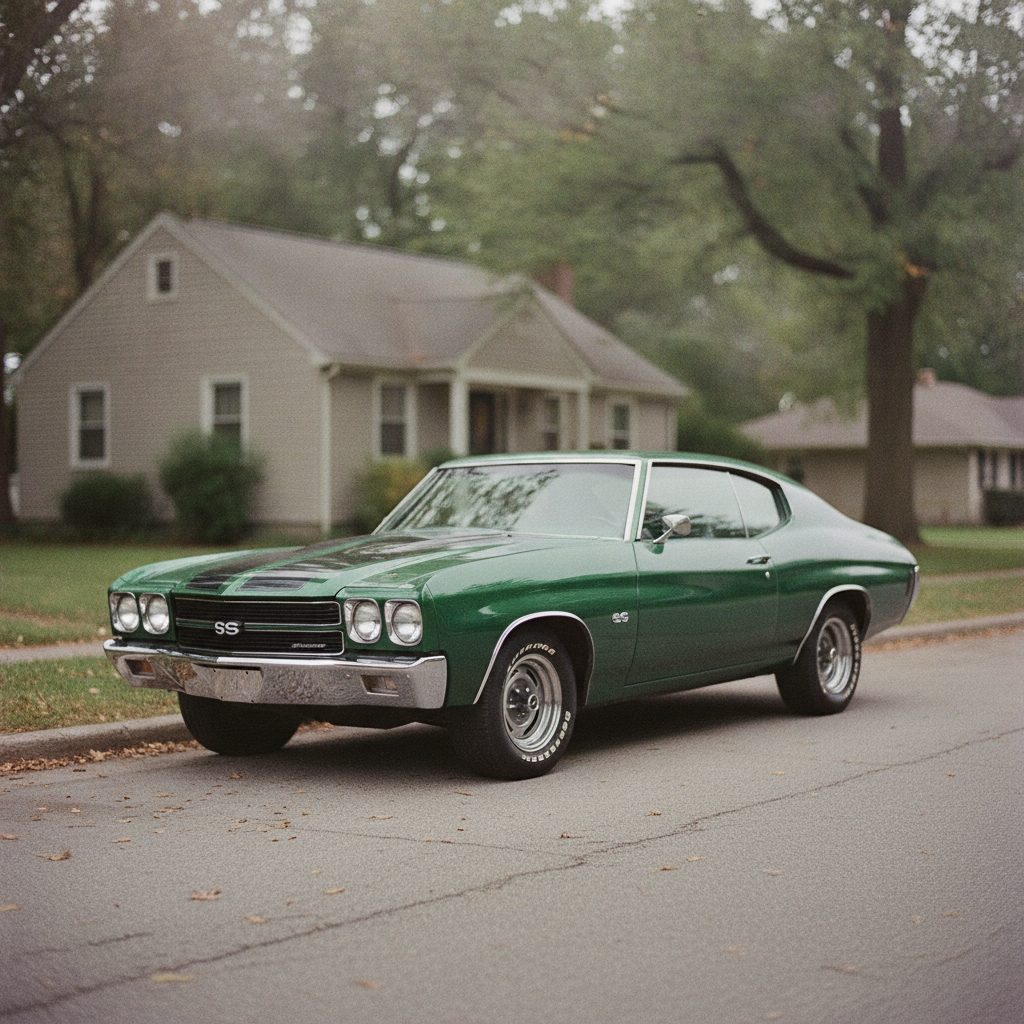
The Mark IV arrived for 1965 at 396 cubic inches, replacing the W series 348 and 409 with a conventional wedge chamber and valves canted in more than one plane, which is where the porcupine nickname came from. The 427 followed for 1966 on a 4.251 inch bore and the same 3.76 inch stroke, and the 454 arrived for 1970 on that bore with the stroke stretched to 4.00 inches. Along the way the 396 quietly stopped existing: from 1970 Chevrolet bored it thirty thousandths to 4.125 inches, making it a 402, then kept selling it as a 396 in the SS cars and a 400 elsewhere. Our 1970 Chevelle SS year guide walks that badge through the order sheet.
Two more splits matter at the chart. Truck big blocks include the 366 and a tall deck 427, standing 10.2 inches at the deck against 9.8 inches for anything in a passenger car, which is why the tables mark them with a T. And the family changed generations twice more: Generation V for 1991 with a one piece rear main seal and four bolt mains throughout, Generation VI for 1996, then the 8.1 litre 496 in 2001. On a bare block, that rear seal is the fastest era tell in the room.
Now the part almost nobody writes down. The reference charts that dominate the search results do not agree with each other, and the gaps are not small. Casting 340220 is a tall deck 427 truck block in all of them, but Mid America dates it 1968 to 1976, Out in the Shop and NastyZ28 both date it 1972 to 1976, and Mortec dates it 1968 to 1985. Four charts, three answers, seventeen years apart.
The same happens on the most common 454 block in existence. Mid America lists 361959 as a 1973 to 1975 Chevelle casting. Mortec lists the identical number as a 454 cast from 1973 all the way to 1990. MotorTrend, answering a reader on that exact number, put it at roughly 1970 through 1990. Nobody here is being dishonest. These are hobbyist compilations built from what people reported finding, and nobody went back and reconciled them.
The consequence is the whole point. Trust the first result on the page and a 361959 block reads as a mid seventies Chevelle part. In reality that casting ran long enough to have come out of a pickup, a motorhome or a boat, and the range you were shown is off by fifteen years at the far end. Treat every published year range as a rough window.
The casting date is a separate mark, usually on the rear ledge on the passenger side, though on early Mark IV blocks it hides near the freeze plug holes. It looks like E 12 7. The letter is the month, A for January through L for December, so E is May. The two digits are the day. The last digit is the year within the decade.
That last digit is the trap. A 7 could be 1967, 1977 or 1987, and on a casting that ran two decades that is not theoretical. Some blocks carry both digits, which settles it. A second ambiguity: in the first nine days of a month, a code reading D 2 6 might be April 2 in a year ending in six, or April 26 with the year worn away. The cross check is that a casting date has to fall before the engine assembly date, normally by weeks. Our year aware VIN and code decoder exists because year blind charts keep producing wrong answers.
The stamped pad on the front of the block, on the passenger side deck below the alternator, is where the real information lives. A code reading T0422TR breaks down cleanly: T is the engine plant, Tonawanda here, with F and V used for Flint. The 04 is the month, the 22 the day. What remains, TR, is the suffix code, and Chevrolet used one to three letters there to encode the engine, transmission and vehicle line. On later engines a partial VIN is stamped alongside.
That is the mark that separates an LS5 from an LS6, not the block casting. The 1970 Chevelle LS6 codes documented by the Chevelle registries are CRV and CRR. Two cautions apply. Suffix codes were reused: Mortec points out that CMR appears on three different 1974 models and again in 1978 on a Corvette with a different combination, so you need the casting date to know the decade. And because the pad is the only surface that proves anything, it is also the most forged surface on the engine.
Start with what the block cannot rule in. A passenger 454 and a truck 454 share the 9.8 inch deck, so the tall deck test only separates the 366 and 427 commercial engines, and several 454 castings appear in both worlds. What moves the needle is the cylinder head: the hot passenger engines ran rectangle port heads, the truck and low compression engines ran ovals. Casting 3964291 is the rectangle port closed chamber head used across the 396, 402, 427 and 454 from 1969 into the early seventies. But casting 3993820, an oval port, went onto 454s in cars and trucks alike from 1971, so heads narrow the field without closing it.
Then accept the limit. On a pre 1972 GM car the VIN encodes neither the engine nor the SS package, so no amount of block reading gets you to documentation. The build sheet, the Protect O Plate and the dealer paperwork prove a car, and that rule runs through every Chevelle deal we watch. Use the casting number for the era, the casting date for the year, the suffix code to name the engine, and paper to prove the car.
On the ledge at the rear of the block, below the deck, on the surface that meets the bellhousing, and usually on the driver side. Some later blocks moved it to the passenger side. It is six to eight digits with no letters. The casting date and the stamped suffix code are separate marks in different places.
Not precisely. Many castings ran for a decade or more, and the published year ranges for the same number disagree by as much as seventeen years between charts. The casting date code on the block, which gives month, day and the last digit of the year, is far closer to an answer than the casting number alone.
Mechanically they are nearly identical. From 1970 Chevrolet bored the 396 out by thirty thousandths of an inch, from 4.094 to 4.125, which put it at 402 cubic inches. Marketing kept calling it a 396 in the SS models and a 400 in other lines, so a car badged 396 for 1970 to 1972 is running a 402.
The aluminium ZL-1 427 block, casting 3946052 for 1969, is the one everybody wants and almost nobody sees. Among iron blocks the four bolt rectangle port 427 and 454 castings from the 1969 to 1972 window carry the most weight. Rarity claims move money, so verify with the stamped pad rather than the casting alone.
Reference data here was cross checked across four published casting charts that disagree with one another: Mortec, the Mid America Chevelle Club, Out in the Shop and NastyZ28, plus a MotorTrend reader answer on casting 361959. The cover image is an illustration produced in house, not a photograph of a specific engine.
The muscle world, every morning. Auctions, builds, reveals. Free.