The Chevy Nova Restomod Is Muscle's Best Sleeper
Empire Fabrication buried four figures of supercharged horsepower under a body that still looks like it rolled off the lot, and that restraint is the whole trick.
Empire Fabrication buried four figures of supercharged horsepower under a body that still looks like it rolled off the lot, and that restraint is the whole trick.
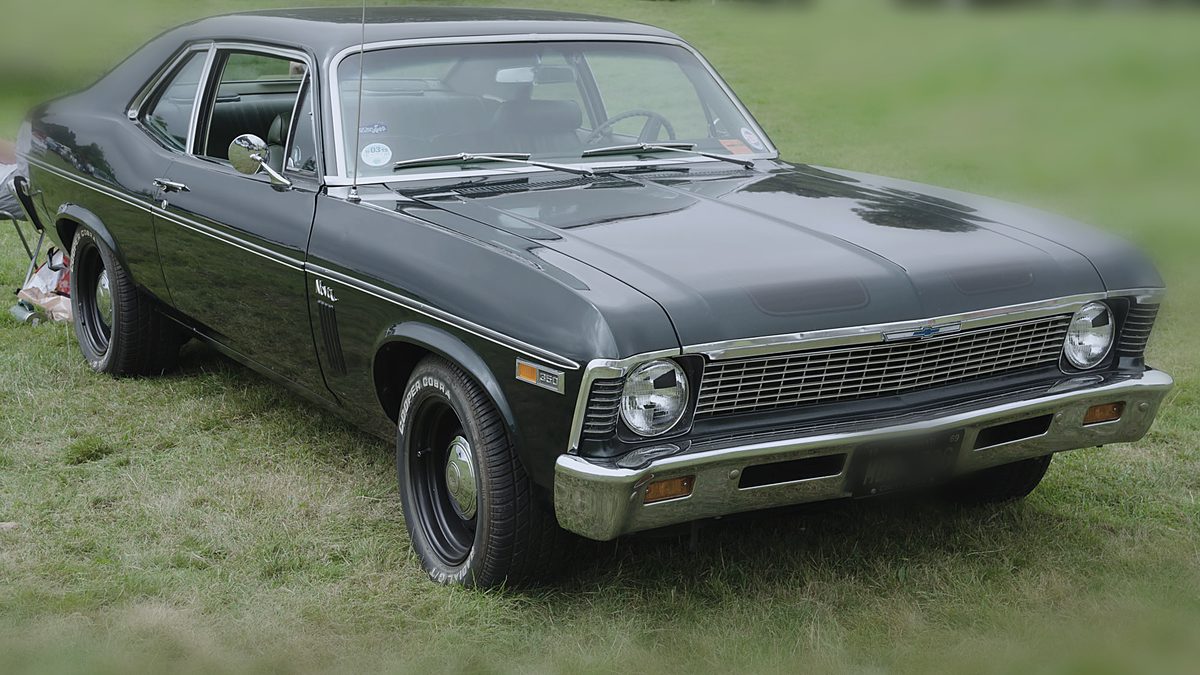
Park a properly sorted 1969 Nova next to almost anything else at a show and half the crowd walks right past it. Good builders are counting on that. The Chevy Nova restomod has quietly become the most complete package in American muscle, not because it shouts, but because it does not have to. Underneath plain, upright, almost boring sheet metal sits modern power, modern brakes and a chassis that would embarrass plenty of new performance cars in a corner.
The car making that argument loudest right now is a black 1969 called the Sinister Nova, built by Empire Fabrication and walked through in detail by Autotopia LA on their channel this summer. It debuted at the 2025 SEMA Show in the Toyo Tires Treadpass, and it is the clearest lesson available in what this platform can be when somebody refuses to get cute with it.
Chevrolet never intended the Nova to be a sports car. It arrived as the Chevy II for 1962, a plain compact aimed squarely at the Ford Falcon, and the third generation that ran from 1968 through 1974 was still a cheap family two door with an upright roof and a flat hood. That plainness is precisely why it works now. There is no styling drama to protect, so a builder can lower it, widen the tires and stuff an engine in without fighting the shape.
The engineering matters more than the looks, though. Those Novas carry their front suspension on a bolt on subframe rather than integrating it into the unibody, the same basic idea Chevrolet used on the first generation Camaro. That single design decision is why a whole industry sells complete replacement front clips for these cars. You are not cutting and grafting geometry into a monocoque. You unbolt the entire front end of the car and bolt on a modern one, with rack and pinion steering, coilovers and real brake clearance already engineered in. Add a body that is a couple hundred pounds lighter than a Chevelle and shells that still cost less than the equivalent Camaro, and the math writes itself.
Sean Ramage of Empire Fabrication built the Sinister Nova around a philosophy that most thousand horsepower cars abandon immediately. There is no wing. There are no scoops cut into the hood, no vents added to the fenders, no widebody flares announcing what is underneath. The coverage out of SEMA kept landing on the same phrase, a masterclass in restraint, and it fits.
The bodywork is where the money hides. Side marker lights are shaved smooth. The bumpers are tucked in tight against the body and shortened so the car reads lower and cleaner. The cowl hood is smoothed flat. Underneath the visible restraint sit details nobody at a show would ever catch, including soft close door latches lifted from a Cadillac Escalade. Every one of those changes costs real fabrication hours and none of them will get a single comment in a parking lot. That is the entire point.
The best restomods are the ones where you cannot tell what was changed until somebody starts it.
Empire Fabrication went to the top shelf here. The engine is a 427 cubic inch LS built on a Dart block by Nelson Racing Engines, with a Whipple supercharger on top of it. Power figures depend on who you ask. Autotopia LA's video description lists 1,200 horsepower on the dyno with roughly 900 reaching the rear wheels, while the SEMA coverage quotes the builder closer to 1,000 at the crank and somewhere around 800 at the tires. Pick whichever number you prefer. All of them are far more than the rear tires actually want. Behind it sits a 4L80 four speed automatic and a Strange differential, which is the honest choice for a car meant to be driven rather than staged.
You do not need any of that to build a good one. The same platform works with the ordinary version of this swap, which is a truck 5.3 or 6.0 out of a wrecking yard, a decent camshaft and a standalone harness. We walked through exactly that route in our piece on the junkyard 5.3 build, and it is still the cheapest reliable path to 400 usable horsepower in an old Chevrolet. The Nova's engine bay is wide, the frame rails sit far apart, and factory style LS mounts for the car have been off the shelf items for years.
The Sinister Nova rides on a full Detroit Speed hydroformed front subframe with the company's Quadralink rear suspension out back, and Baer brakes at all four corners. This is the part of the build that people underestimate. A stock 1969 Nova front end was designed around bias ply tires, drum brakes and a curb weight expectation that had nothing to do with 1,000 horsepower. Leaving it in place and adding power just makes the car faster at doing the thing it was already bad at.
The wheel and tire package tells the same story. Forgeline three piece GA3R wheels wear Toyo Proxes R888R rubber, 225/40ZR18 at the front and a 335/30ZR18 section at the rear. That rear tire is wider than what came under most supercars of the last twenty years, and it is doing more for the car's actual pace than the supercharger is. If you build one of these and your budget forces a choice, the tire and the chassis buy you more real speed than the last hundred horsepower ever will.
There is an entire branch of this hobby that goes the other way, and it produces genuinely spectacular cars. We covered one of them in our look at a 1,000 horsepower street Camaro, where the whole build announces itself from fifty feet away. Both approaches are legitimate. They just answer different questions.
The sleeper approach asks what the car would have looked like if Chevrolet had built it properly in the first place. That means the stance is aggressive but not slammed, the wheels are large but not cartoonish, and the paint is a colour a factory might actually have offered. Nothing on the outside of the Sinister Nova is there to tell you about the engine. You find out when the throttle opens, which is a far better reveal than a hood scoop.
The mistake almost everybody makes is buying the engine first. Do not. On a Chevy Nova restomod, the body decides the project and everything else is just money. These cars rust in predictable places: the rear frame rails where they run under the trunk floor, the trunk drop offs and the area around the rear window channel, plus the usual floor pans and lower quarters. A shell with rot in the rear rails is a fabrication project pretending to be a car, no matter how good the paint looks.
Sort the sheet metal, then the chassis and brakes, then the drivetrain. Building in that order means every stage is usable when it is finished, and it means you never bolt an expensive engine into a car you later have to take apart. It also stops you from repeating the classic error of chasing displacement to solve a handling problem, a subject we got into properly in our breakdown of big block versus small block thinking. Values on clean third generation Novas have been climbing steadily for years and good restomods sit well above driver quality survivors, but the build almost never returns what it costs. Do it because you want the car.
The 1968 through 1972 third generation cars are the sweet spot. They have the bolt on front subframe that modern replacement clips are engineered around, the widest aftermarket support, and the cleanest body lines of the run. The 1973 and 1974 cars work mechanically but carry heavier federal bumpers that most builders end up replacing.
For a driver, yes. An LS gives you more power than a period small block, better fuel economy, modern cooling and a computer that starts the car in any weather. Mounts, headers and oil pans for the swap are all off the shelf. The one honest trade off is originality, so a documented SS 396 car deserves its numbers matching engine.
The Yenko Nova is the crown, a 1969 fitted with a 427 by Don Yenko's Pennsylvania dealership, and only a small handful were ever built. Behind it sit the factory SS 396 cars, particularly the L78 versions. Both trade well above ordinary Novas, and both attract fakes, so documentation matters more than the badges on the fender.
It depends almost entirely on which one. A rough six cylinder shell is project money, a clean driver quality V8 coupe sits comfortably in the middle of the classic market, and a documented SS 396 or a well known restomod is a different conversation entirely. The trend across all of them has pointed upward for several years.
Photograph of a 1969 Chevrolet Nova by SG2012, licensed CC BY 2.0 via Wikimedia Commons. Cropped, colour graded and depth of field applied in house. It is a representative car, not the Sinister Nova itself.
The muscle world, every morning. Auctions, builds, reveals. Free.