Mopar Rear End Identification: Read the Housing First
A 1973 Charger axle build shows why the cover, carrier architecture, and factory evidence must be read in that order.
A 1973 Charger axle build shows why the cover, carrier architecture, and factory evidence must be read in that order.
Mopar rear end identification should begin before anybody reaches for a wire brush or a stamped-number chart. Stand behind the housing and decide whether it has a removable rear cover or a smooth welded bowl. Then inspect the front for a removable center section. That one architectural split separates the famous Chrysler 8¾ from the 7¼, 8¼, 9¼, and Dana 60 families more reliably than a seller's memory or a single blurry number. The numbers matter, but only after the housing has told you which language they speak.
That order is especially useful around a project such as the Petty Blue 1973 Charger discussed in a detailed Dead Dodge Garage build. A Charger could have left the factory with different axle families depending on engine, equipment, and model year, and half a century of swaps adds more uncertainty. Identify the hardware under the car first. Use tags, stampings, and documents to narrow its setup and history afterward. The Dodge Charger hub provides the broader model context, but the casting in front of you gets the first vote.
A 1970 Dodge rear-axle identification bulletin gives an unusually clear factory baseline. Its Coronet and Charger chart lists the 7¼ with nine rear-cover bolts and the filler plug in the cover. It lists the 8¼ with ten rear-cover bolts and the filler in the carrier area. For the 8¾, the cover-bolt entry simply says welded, because there is no removable inspection cover at the rear. The complete differential carrier, commonly called the third member or center section, comes out through the front of the housing.
This corrects a common shortcut: ten cover bolts do not uniquely identify a Mopar axle. In the same Chrysler chart, both the 8¼ and the 9¾ Dana axle use ten rear-cover bolts. The housings, cover shapes, sizes, and construction are different, but the raw count overlaps. A bolt count is supporting evidence. It is not a verdict. First determine whether the rear is covered or welded, then use the cover outline, filler location, casting details, and dimensions together.
The bulletin also says Chrysler-built axle build codes were painted on the left axle tube, while its 9¾ identification used a white tape strip with build information stamped in red. Paint and paper rarely survive under a driven car, so their absence proves little today. If they do survive, document them before cleaning. A harsh wire wheel can erase the best original evidence in seconds.
The small 7¼ is the light-duty member of this group. Its removable rear cover uses nine bolts and has an irregular, rounded outline. The 8¼ is larger and uses a ten-bolt rear cover. Neither one has the 8¾'s removable front carrier. If you can remove the gears from the back after taking off a stamped cover, you are not looking at an 8¾, regardless of what a marketplace listing says.
The later Chrysler 9¼ uses a 12-bolt rear cover with a broad, angular outline. Mopar's own performance-parts catalog identifies 9¼ gearsets by that 12-bolt cover. That makes it distinct from the ten-bolt 8¼ and the front-loading 8¾. Still, confirm the overall housing because aftermarket covers can change ribs, material, and appearance while preserving the bolt pattern.
The 9¾ is Chrysler's passenger-car designation for the Dana 60 family. It has a large removable rear cover, substantial tubes, and a noticeably bigger center casting. Do not confuse it with a Chrysler 9¼ because the names are close. Our Dana 60 identification guide covers the BOM number, casting details, and application checks that separate an actual Dana assembly from lookalikes and swapped components.
The housing tells you the family. The tag tells you the setup. The build sheet tells you what the car was supposed to have.
The 8¾ is a banjo-style housing. Its rear bowl is welded closed, while a ring of studs and nuts at the front retains the complete differential carrier. The pinion, ring gear, differential, bearings, and their adjustments leave as one assembly after the axle shafts are pulled outward. That front-loading layout is the fastest dependable clue on a complete axle and the reason enthusiasts can keep several geared center sections ready for one housing.
The removable carrier also explains why identifying an 8¾ housing does not identify everything inside it. A previous owner could have installed a different case, gear ratio, yoke, or differential without replacing the housing. Mopar's performance catalog even notes a modern aluminum carrier that fits 8¾ banjo housings and uses the large 742-style pinion stem. Architecture identifies the family, not the date or originality of every removable component.
Jamie at Dead Dodge Garage supplies the useful real-world example in The Big Mopar 8 3/4 Video. The center section on his bench is a 741 case destined for a Petty Blue 1973 Charger. He strips the assembly, retains a sound original ring-and-pinion set, replaces the open differential with a serviceable clutch-type Sure-Grip, and walks through pinion preload and backlash setup.
The value is not a magic number copied from the screen. It is the sequence and the attention to the parts actually present. The 741 and 742 use a factory spacer and selective shims to establish pinion-bearing preload, while the 489 uses a crush sleeve. Jamie uses the correct inch-pound beam wrench for rotating preload and the threaded side adjusters for backlash. His finished backlash is about .008 inch, inside the range stated for that build, and he torques the bearing caps to 90 lb-ft.
Treat those figures as documentation of his particular assembly, not universal instructions for an unknown rear. Bearing condition, lubricant on the parts, seal drag, gear manufacturer, and service specification all affect the correct procedure. Obtain the service manual and gear maker's sheet for your exact combination. A technically honest build feature shows what was done and why without turning one bench result into a rule for every axle.
On an 8¾, 741, 742, and 489 are the familiar last three digits of center-section casting numbers. They identify carrier-case designs, not complete axle housings. The 741 uses the smallest of the three common muscle-era pinion stems. The 742 uses a larger straight stem, and the later 489 uses a larger tapered stem with a crush-sleeve preload system. Read the raised casting number on the case itself rather than inferring it from the car's year.
Those suffixes also do not encode the gear ratio or guarantee Sure-Grip. Any of the cases may have been rebuilt with a different ring and pinion, and differential carriers can be changed. In the video, the loose 741 receives a clutch-type Sure-Grip. Jamie also shows a separate 489 with 4.88 gears and a cone-type Sure-Grip. The side-by-side example is a useful warning against calling every 489 a specific ratio or differential type.
The clutch and cone versions are mechanically different. The clutch unit uses replaceable friction pieces and is the serviceable design Jamie prefers. The cone unit uses tapered friction surfaces loaded by springs and is not normally rebuilt in the same way once its cones bottom out. External case digits do not settle that internal question. If it affects the price or intended use, inspect the differential itself.
A surviving metal ratio tag under a carrier nut is useful, but it can be lost, moved, or left behind after a gear change. When the center section is open, ring-and-pinion tooth counts are stronger evidence. Divide the ring-gear tooth count by the pinion count to calculate the ratio. A wheel-and-driveshaft rotation test can screen an assembled axle, but tire position, differential action, and counting error make it an estimate rather than final proof.
Sure-Grip deserves the same caution. Turning one wheel and watching the other can suggest an open or limited-slip differential, yet worn clutches, cone condition, brake drag, and how the car is supported can confuse the result. A factory tag supports the claim. Direct inspection establishes which carrier is installed and what condition it is in. Do not pay a Sure-Grip premium for a tag alone.
Original application is a separate investigation because housings and 8¾ center sections interchange. Check width, spring-pad location, brake package, tube markings, casting and assembly dates, then compare those findings with the car's VIN and paperwork. Our Mopar broadcast sheet guide shows how to prove that a sheet belongs to the vehicle, while the Mopar VIN decoder establishes the car identity that the axle evidence must support.
The final description should be narrow enough to survive scrutiny. Say 8¾ housing with a 741 center section, 3.55 gears, and clutch Sure-Grip if each item has been verified. Do not promote that into original Charger rear axle unless the dimensions, dates, codes, and vehicle records connect the complete assembly to the car. A swapped axle can be an excellent upgrade. It is simply a different claim from factory-installed.
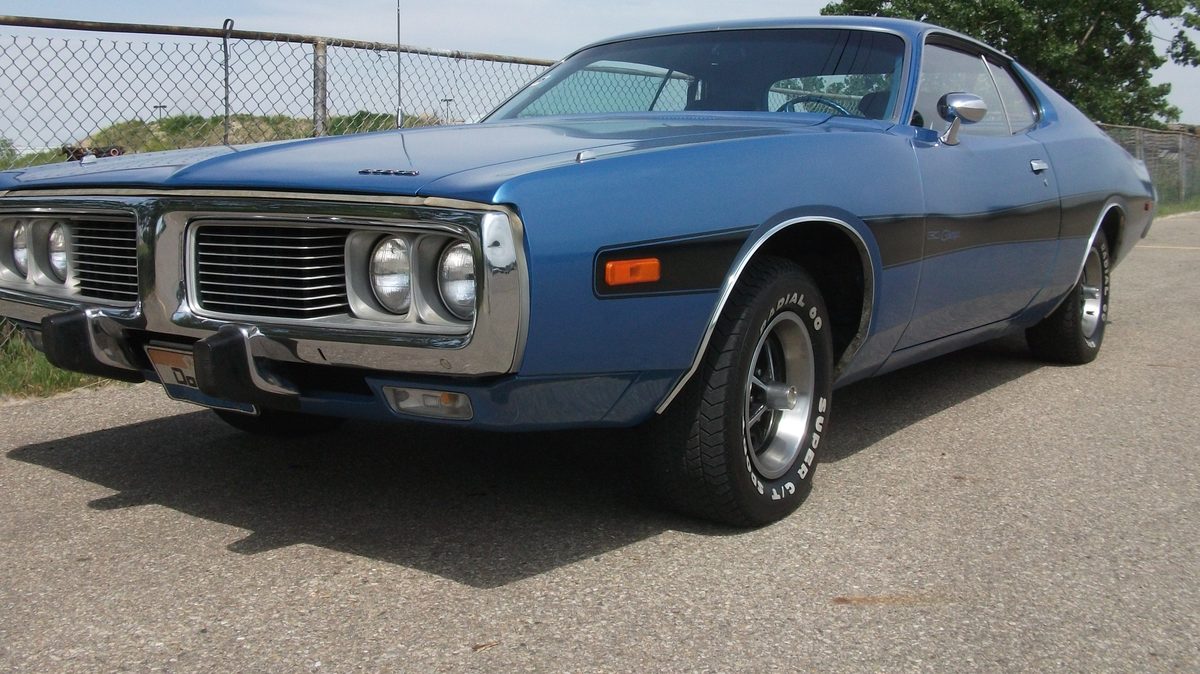
Cover image: a representative 1973 Dodge Charger photographed by dave_7, used under CC BY 2.0. The blue car matches the year and body style discussed, but it is not the Dead Dodge Garage project car.
Look for a smooth welded rear bowl with no removable rear cover, then inspect the front for a removable center section retained by a ring of nuts. That front-loading architecture identifies the 8¾ family. The 741, 742, or 489 casting suffix identifies the carrier installed inside it.
Not by itself. Chrysler's 1970 identification chart lists ten rear-cover bolts for both the 8¼ and the 9¾ Dana axle. Compare housing size, cover shape, filler location, tube construction, and any surviving tags or markings. The complete group of clues identifies the axle more safely than bolt count alone.
They are three Chrysler 8¾ removable carrier designs with different pinion stems and preload systems. The 741 has the smaller stem, the 742 a larger straight stem, and the 489 a larger tapered stem with a crush sleeve. Those numbers do not identify gear ratio, Sure-Grip type, or vehicle application.
First identify the housing and installed carrier, then record dimensions, tube markings, tags, dates, brake equipment, and gear details. Compare that evidence with the VIN, broadcast sheet, axle codes, and period application data. Because housings and center sections swap easily, one correct casting number cannot prove a born-with assembly.
The muscle world, every morning. Auctions, builds, reveals. Free.
.jpg)