The Plymouth Road Runner Sold Speed Cheap
Plymouth engineered a muscle car backwards from a price tag, and it outsold every forecast in the building.
Plymouth engineered a muscle car backwards from a price tag, and it outsold every forecast in the building.
The Plymouth Road Runner began as an argument inside Chrysler about what a muscle car ought to cost. By 1967 the segment had drifted upmarket, weighed down with vinyl roofs, console clocks and courtesy lights, and a product planning group at Plymouth asked the blunt question nobody else was asking. What happens if you take all of that back out and sell nothing but the engine?
The answer was a two-door Belvedere with a big-block, a heavy-duty suspension, a bench seat, rubber floor mats and a base sticker of $2,896. Plymouth forecast around 2,500 sales for the first year. It built 44,599. Very little in the muscle era worked out that cleanly, and nothing else in the era was engineered backwards from a price tag with that much discipline.
Every other muscle car of the period was built by addition. Start with a mid-size sedan, add a bigger engine, then keep adding until the sticker justified the badge. Plymouth inverted the process. The 1968 car started with the cheapest Belvedere body in the catalog and then subtracted everything that did not make it faster. No carpet. No armrests on the base coupe. Taxi-grade door panels and a bench seat, because buckets and a console cost money that could have gone into cubic inches.
What stayed was the part that mattered. A 383 with genuinely serious internals, heavy-duty torsion bars and leaf springs, a beefed-up drum brake package, and 11-inch clutch hardware on four-speed cars. The car looked almost apologetic parked next to a loaded GTO, which was precisely the point. Buyers under 25 could not afford the GTO, and Plymouth had just worked out that they could afford this.
Then came the piece of marketing that turned a cheap sedan into a cultural object. Plymouth paid Warner Bros.-Seven Arts $50,000 for the rights to the Road Runner name and cartoon likeness, and spent another $10,000 developing a horn that went beep beep. Executives reportedly hated it. Every teenager in America loved it, and the bird decal on the fender did more for the car's identity than any amount of chrome would have.
This is the detail that separates the Road Runner from the badge-engineering that surrounded it, and most spec tables get it wrong. The standard engine was a 383 cubic inch V8, but it was not the 383 you got in a Belvedere or a Satellite. Plymouth handed it the camshaft from the 440 Super Commando, raised compression to 10.5:1, and fitted the heads, intake and exhaust manifolds developed for the bigger engine.
The result was 335 horsepower at 5,200 rpm and 425 lb-ft at 3,400 rpm from an engine most rivals treated as a mid-range option. It was, in effect, a 440 top end sitting on a 383 short block, and it is the reason a base Road Runner never felt like an entry-level car. Only air conditioning was off the table, because the compressor and the ram-air ductwork would not coexist.
Above it sat the 426 Hemi at $714, rated at 425 horsepower and 490 lb-ft, an option that cost roughly a quarter of the car it went into. Very few buyers signed up, which is exactly why a documented Hemi car occupies the summit of the Mopar market today. If you want the engineering behind that engine and why its combustion chamber shape mattered so much, we broke it down in our guide to what a Hemi engine actually is.
The 1968 car arrived as a pillared coupe, with a hardtop joining during the first model year once Plymouth realized how badly it had underestimated demand. For 1969 the range filled out properly with a convertible, revised tail lamps and a much broader options list, and the buying public responded with 84,420 cars including exports. That is a staggering number for a model in its second year.
Motor Trend named the 1969 Plymouth Road Runner its Car of the Year, and the award was not a sentimental one. The magazine's argument was about value engineering rather than outright pace, which is the correct read of the car. Plymouth had proved that performance did not require luxury, and the rest of Detroit spent the next two years launching budget muscle answers of its own.
The 1969 car is also where the model's identity fully hardened. Bird decals front and rear, the beep beep horn as standard equipment, and a hood scoop treatment that told anyone behind you what they were looking at. It remains the year most collectors picture when the name comes up, and the year that dominates the auction catalogs.
Midway through 1969 Plymouth released the A12 package, and it is the purest expression of everything the Road Runner stood for. The engine was a 440 wearing three two-barrel Holley carburetors, rated at 390 horsepower at 4,700 rpm, more than the Hemi made low down and for a fraction of the price. Roughly 1,432 A12 cars were built.
The hardware around it was pure racer logic. A flat black fiberglass hood with a functional scoop, held down by four pins and lifted off entirely for service, because hinges add weight. Black steel wheels with no hubcaps at all. No wheel trim, no brightwork, nothing to polish. It is the only factory muscle car of the era that looked less finished than the base model on purpose, and it is the one a lot of Mopar people would take over the Hemi.
Plymouth did not add speed to a nice car. It took the nice car away and left the speed.
For 1970 the body was restyled with a new grille and tail treatment, and the option list gained the Air Grabber, a scoop that rose out of the hood on demand via a lever in the cabin and wore a shark's teeth graphic on its sides. It was theater, and it was completely in character. Sales settled to around 41,000, still a large number, though insurance surcharges on big-block cars were beginning to bite.
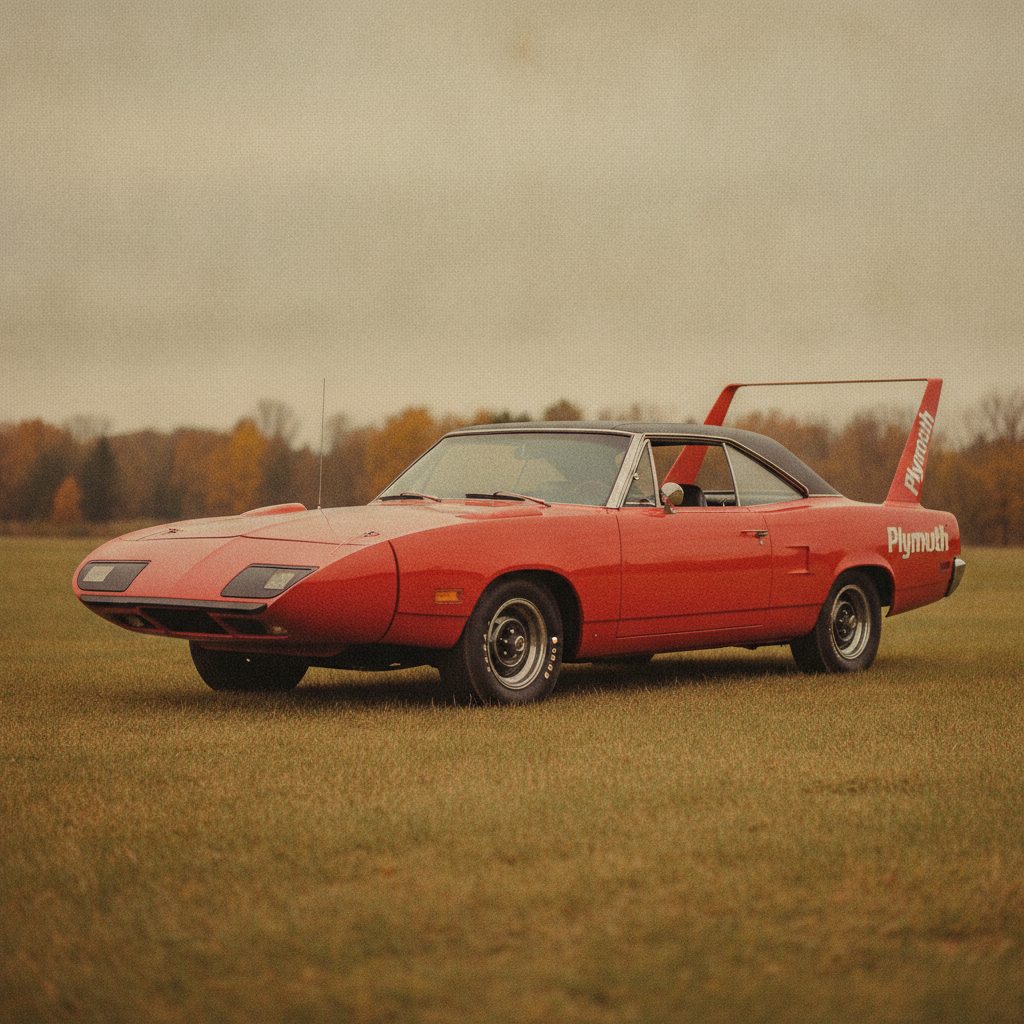
The 1970 Plymouth Road Runner also produced the most extreme thing Chrysler ever put a license plate on. The Superbird was a Road Runner with an 18-inch nose cone, a rear wing tall enough to clear the trunk lid and a mission statement written in NASCAR homologation rules. Its collector story went in a very different direction from the rest of the range, which we cover in our look at what a genuine Superbird is worth.
This is also the body that the modified crowd keeps coming back to. The B-body chassis takes power well and the aftermarket support is deep, which is why a 1970 shell can end up somewhere as extreme as the 9-second Road Runner we featured. The same platform underpinned the Dodge Charger, so parts knowledge crosses between the two freely.
The 1971 restyle moved the Road Runner onto the Satellite series and into Chrysler's fuselage design language: a deeply recessed grille inside a loop bumper, flared fenders, a steeply raked windshield and a high rear deck. It was the most aerodynamic shape the model ever wore and, commercially, a disaster. Sales collapsed to 13,664. The 426 Hemi bowed out that year with just 55 Road Runners built, alongside 246 with the 440 Six Barrel.
What followed was the same story every big-block car lived through. Compression ratios fell to meet emissions rules, net horsepower ratings replaced gross ones, and insurance underwriters finished what the regulators started. Production ran 7,628 in 1972, 19,056 in 1973, 11,555 in 1974 and 7,183 in 1975, the year the name moved onto the redesigned Fury coupe. From 1976 it was a trim and graphics package on the compact Volare, and it was gone entirely after 1980.
None of that reduces what the original did. Between 1968 and 1971 Plymouth sold close to 200,000 of them, which makes the Road Runner one of the highest-volume genuine muscle cars ever built, and one of the very few that a working person could actually finance. Among the genuine muscle cars of the era, very few reached that many driveways, and fewer still did it without a finance department in the way.
Here is the good news, and it is the opposite of the situation Chevelle SS buyers face. The Road Runner was a distinct model, not an option package bolted onto something else, so it is written into the VIN. The first four characters identify it directly: RM21 is the two-door coupe, RM23 the two-door hardtop and RM27 the convertible. A car whose VIN starts RH or RP is a Satellite or a Belvedere wearing decals, no matter what the fender says.
The fifth character carries the engine. H is the 383 four-barrel, J is the 426 Hemi and M is the 440 Six Barrel, and that single letter is the difference between a common car and a serious one. Cross-check it against the fender tag on the inner fender, which carries the build codes, and against casting numbers and date codes on the block and heads. A correct engine in a car whose VIN never had one is a re-powered driver, priced accordingly.
Beyond the paperwork, look at the same things you would on any 55-year-old unibody Mopar. Rear frame rails, trunk floor, the lower rear quarters behind the wheels and the cowl area under the windshield are where these cars rot, and all four are expensive to do properly. A tidy 383 car with clean metal and a matching VIN is a far better buy than a rusty Hemi clone with a beautiful paint job.
The Road Runner launched in 1968 at a base price of $2,896, and the 1969 car sat in the same territory before options. That figure bought a big-block two-door with a bench seat and rubber floor mats. The 426 Hemi added $714, roughly a quarter of the price of the entire car.
The model itself is not rare, with close to 200,000 built between 1968 and 1971. Specific versions absolutely are. Only 55 Road Runners left with a 426 Hemi in 1971, around 1,432 got the 1969 A12 440 Six Barrel package, and documented convertibles in any year are scarce.
Most collectors point at 1969. It was the Motor Trend Car of the Year, it offered the widest choice of body styles and engines including the mid-year A12 package, and it sold in the greatest numbers. Purists prefer the plainer 1968 car, and 1970 has the strongest styling case.
Values run over a very wide range and depend far more on documentation than on cosmetics. A clean 383 automatic car sits at the accessible end of the classic Mopar market, while verified Hemi and Six Barrel cars trade in an entirely different league. Direction has been upward for documented cars for years.
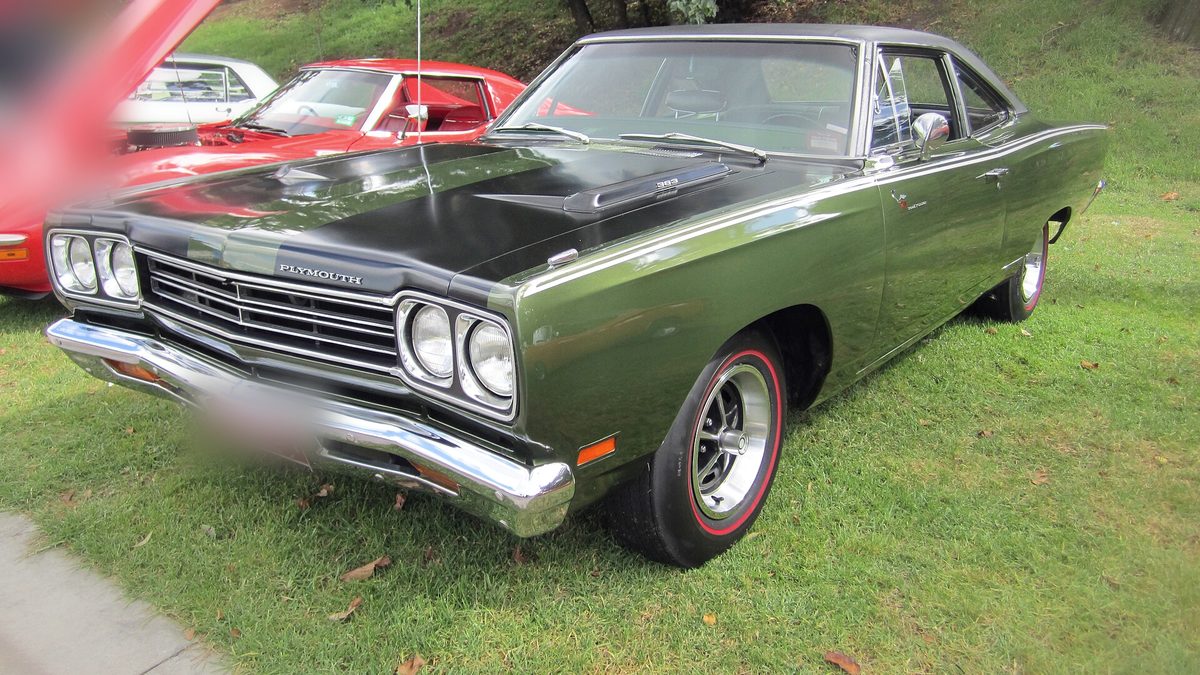
Photograph: a 1969 Plymouth Road Runner 383 hardtop, by Sicnag, licensed CC BY 2.0 via Wikimedia Commons. Depth of field and grading applied in house.
The muscle world, every morning. Auctions, builds, reveals. Free.