Pontiac 400 Firing Order: Same as a Chevy, Wired Backward
A Pontiac 400 fires 1-8-4-3-6-5-7-2 just like a Chevrolet, but the rotor turns counterclockwise, and that one difference is why so many fresh GTO engines will not start.
A Pontiac 400 fires 1-8-4-3-6-5-7-2 just like a Chevrolet, but the rotor turns counterclockwise, and that one difference is why so many fresh GTO engines will not start.
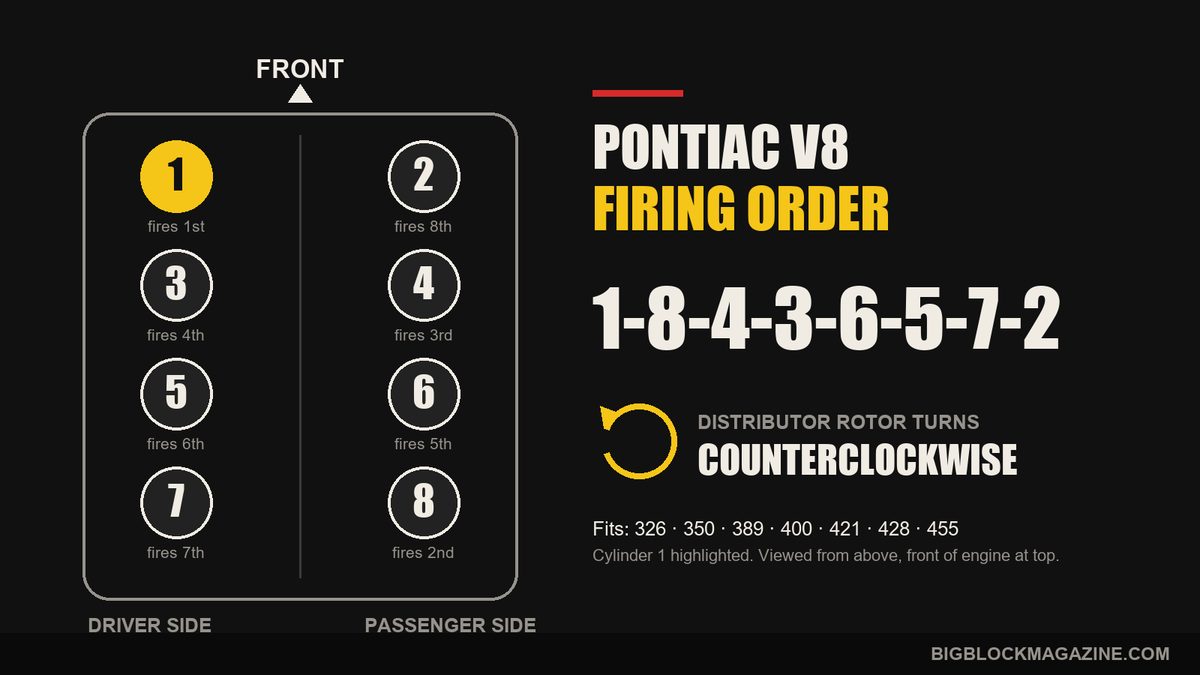
The Pontiac 400 firing order is 1-8-4-3-6-5-7-2, and the distributor rotor turns counterclockwise. Odd cylinders 1, 3, 5 and 7 run front to back on the driver side, even cylinders 2, 4, 6 and 8 on the passenger side. The same order and rotation apply to the 389, 421, 428 and 455, and to the 326 and 350. If that sequence looks familiar, it should. It is the Chevrolet firing order. The difference is that a Pontiac distributor spins the other way, and that single fact sinks more weekend engine swaps than any other wiring mistake.
The diagram above shows the engine from above with the front at the top, each cylinder labelled with the position it fires in. Keep it handy when you are wiring. The rotation arrow is the part to look at twice.
Pontiac numbers its V8 the GM way. Stand at the front of the car and look back. The driver side bank holds 1, 3, 5 and 7, with cylinder 1 at the front. The passenger side bank holds 2, 4, 6 and 8. The order is 1-8-4-3-6-5-7-2. Cylinder 1 is the reference for the timing marks, and it is the cylinder you will bring up to top dead center to find the number one tower on the cap.
The Pontiac distributor sits at the back of the engine. That location is the same general area as a Chevrolet, which is part of why people assume the two are interchangeable at the cap. They are not.
A Chevrolet distributor turns clockwise. A Pontiac distributor turns counterclockwise. The firing order is the same, so if you wire a Pontiac cap the Chevrolet way, the wires are in the right sequence but going around the cap in the wrong direction. Cylinder 1 fires correctly and everything after it is wrong. The engine pops, spits back through the carburetor and never catches.
This is the mistake to rule out first on any Pontiac that will not start after a rebuild, a distributor swap or a set of new plug wires. It is especially common when the person doing the work grew up on small block Chevrolets, or when the wires were laid out by following a general GM chart that does not mention rotation. Plenty of online firing order charts give one GM line for every division. That works for the sequence and fails for the direction.
Same numbers as a Chevy, opposite direction around the cap. That one detail decides whether a Pontiac starts.
Pontiac built its own V8 from 1955 until the early 1980s, and the core muscle car engines all share the 1-8-4-3-6-5-7-2 order with counterclockwise rotation. The 389 powered the first GTO for 1964 and stayed through 1966. The 421 served the full size cars and the high performance Catalinas and Bonnevilles. The 400 replaced the 389 for 1967 and carried the GTO, Firebird and Trans Am through the Ram Air years and on to 1979. The 428 was the big car option from 1967 to 1969, and the 455 arrived for 1970 and ran through 1976, including the Super Duty 455 of 1973 and 1974.
The smaller 326 and 350 use the same order and rotation, which matters because they look almost identical to a 400 from the outside. Telling them apart is a job for the engine code and the block casting, not for the ignition. Our guides to Pontiac engine codes and Pontiac block casting numbers walk through both.
From 1977 onward GM increasingly shared engines between divisions, and a car with Pontiac badges is not guaranteed to have a Pontiac engine. The 1977 to 1979 Trans Am is the famous example: depending on the year, the market and the option code, the car under the 6.6 Litre decal could carry a Pontiac 400 or an Oldsmobile 403. Engines also move between cars over fifty years, so a Firebird of any year can arrive with something other than what left the factory.
Before you trust any firing order chart, confirm the engine itself. The block casting number and the engine code stamped on the block tell you what it is. If it is a Pontiac, this page applies. If it turns out to be an engine from another division, use that engine's own reference rather than the one for the badge on the fender. Our GTO hub collects the identification guides in one place.
Find number one from the engine, not from the cap. A distributor that has been out of the engine can go back in more than one way, so the cap tower that used to be number one may not be any more.
Pull the plug from cylinder 1, the front cylinder on the driver side. Put a thumb over the hole and turn the engine in its normal direction until you feel compression building. Continue slowly until the timing mark on the balancer lines up with zero on the timing tab. The piston is now at top dead center on the compression stroke.
Lift the cap and note which terminal the rotor points to. That is the number one tower. From there, go counterclockwise around the cap, viewed from above, and install the wires in order: 1, 8, 4, 3, 6, 5, 7, 2. If the rotor points between towers at TDC, lift the distributor, turn the shaft so the rotor points at a usable terminal, seat it fully on the oil pump drive and start again from that tower.
On the driver side bank, cylinders 5 and 7 sit next to each other and fire back to back, sixth and seventh in the sequence. Running their wires tight and parallel invites induction crossfire, where the spark in one wire induces a voltage in the other and causes a miss on that bank. Separate those two wires along their run or cross them at a right angle. This is the same pair that gives Chevrolet owners trouble, because the order is the same.
Once it starts, set base timing with a light on the number one wire, using the specification for your engine and its vacuum advance setup. Because the Pontiac rotor turns counterclockwise, rotating the distributor housing clockwise advances the timing and rotating it counterclockwise retards it. Again, that is the reverse of a Chevrolet. If the engine still runs badly, go back through four checks: number one at TDC on compression, the cap wired counterclockwise, wires 5 and 7 apart, and a cam with a stock firing order.
The Pontiac 400 fires 1-8-4-3-6-5-7-2 with the distributor rotor turning counterclockwise. Cylinders 1, 3, 5 and 7 are on the driver side, front to back, and 2, 4, 6 and 8 are on the passenger side. The 389, 421, 428 and 455 use the same order and rotation.
The sequence is the same, 1-8-4-3-6-5-7-2, and so is the cylinder numbering. The distributor rotation is not. A Pontiac rotor turns counterclockwise and a Chevrolet rotor turns clockwise, so the cap must be wired in the opposite direction. Wiring a Pontiac the Chevrolet way is the most common reason it will not start.
Counterclockwise, viewed from above, on the Pontiac V8 family including the 326, 350, 389, 400, 421, 428 and 455. Wire the cap counterclockwise from the number one tower. Turning the distributor housing clockwise advances the ignition timing, which is the reverse of a Chevrolet.
The Pontiac 455 fires 1-8-4-3-6-5-7-2 with counterclockwise rotor rotation, identical to the 400. Odd cylinders are on the driver side and even cylinders on the passenger side. Confirm the engine is actually a Pontiac 455 and not another division's 455, since Oldsmobile and Buick built their own.
The muscle world, every morning. Auctions, builds, reveals. Free.