Pontiac Block Casting Numbers: Read Every Clue
The number in the iron starts the identification, but the date, stamped code, and VIN derivative are what finish it.
The number in the iron starts the identification, but the date, stamped code, and VIN derivative are what finish it.
Pontiac block casting numbers look like the answer. They are large, permanent, and often the first thing a seller photographs. Yet one number can cover several model years, horsepower levels, and two-bolt or four-bolt machining. Read it alone and a common 400 can acquire an expensive story before the grease is dry. Read the casting with its date, stamped application code, and VIN derivative, and the block begins to identify itself honestly.
This guide covers the traditional Pontiac V8 family used from 1955 through 1979, not Chevrolet or Oldsmobile engines installed in some later Pontiacs. That distinction matters because Pontiac built 287 through 455 cubic-inch versions around one closely related architecture. The family resemblance makes swaps easy to overlook. It also makes the full identification sequence more valuable than a single chart lookup.
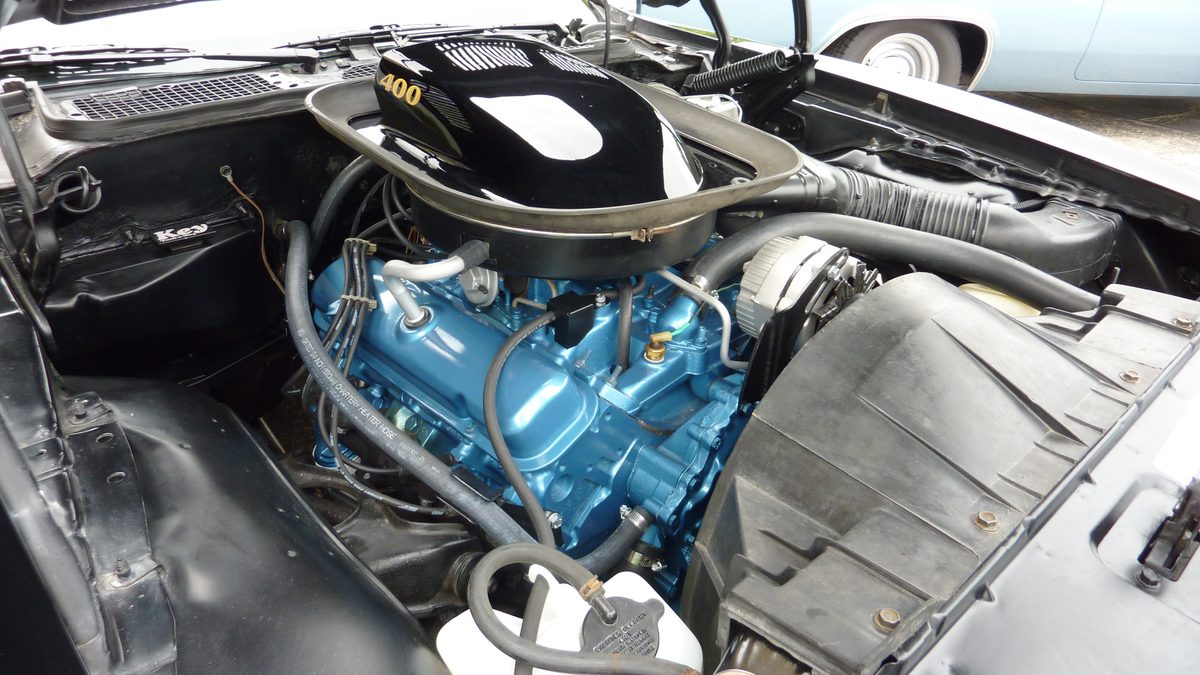
Lead photo: "400ci Pontiac" by JL1Row, licensed under CC BY-SA 3.0 and resized for publication. It shows a real Pontiac 400 as a representative example, not the specific block decoded below.
Location changes with the era. On 1955 through 1963 blocks, look along the passenger side of the block below the head surface. For 1964 through early 1967 production, look around the distributor pad at the top rear. From roughly March 1967 forward, the casting number moved to a ledge at the rear of the passenger-side bank, behind cylinder number eight. A phone camera, mirror, solvent, and a nylon brush are safer than attacking faint raised digits with a grinder.
First decide whether a mark is cast or stamped. A casting number and casting date were formed with the iron, so their characters stand proud or sit in a molded recess. The two-letter engine application code, production engine number, and later VIN derivative were struck into machined surfaces after casting. The distinction is not trivia. A restamp can imitate a factory code, while the casting underneath still limits what the block can be.
The current number-one search result says the partial VIN is cast near the timing cover. Pontiac's own 1969 factory service manual says the vehicle identification number is stamped to the right of the timing cover on V8 engines. The same manual describes the engine code as another stamp below the production engine number. Cast number, stamped engine code, and stamped VIN derivative are three different clues.
A useful short list begins with 9786133 for the 1967 400, then 9790071 for the standard 1968 and 1969 400. The 1968 and 1969 428 commonly carries 9792968. For 1970, the regular 400 is associated with 9799914, while the scarce Ram Air IV version is commonly read as 9799915. Pontiac created some of those 5-ending blocks by removing the final 4 from the 9799914 pattern and applying a 5, so a hand-finished final digit is not automatically fraud.
For the 455, 1970 begins with 9799140. The 1971 455 HO uses 483677, while 485428 appears across later 455 production. The 1973 and 1974 Super Duty 455 uses 490132, often shown with the leading digits visually separated. For the 400, 481988 dominates 1971 through much of 1974 and returns in special later use, while 488988 appears in late 1974 production. Late 1975 and 1976 regular 400 blocks commonly use 500557.
Those are landmarks, not a complete application table. Earlier examples include 532000 for the 1959 389, 9773155 for the 1964 389, and 9778789 for 1965 and 1966 389 production. A serious inspection should record every digit exactly as found, then photograph the date code and front pad before consulting a list. One blurred 8 mistaken for a 3 can send the whole search down the wrong branch.
The casting number identifies an iron design and narrows its displacement and production period. It does not, by itself, prove the carburetor, camshaft, cylinder heads, horsepower rating, transmission pairing, car line, or original vehicle. Casting 9790071 is the clean example. Pontiac used it for ordinary and high-output 400 applications across 1968 and 1969. Seeing that number does not turn the block into a Ram Air engine, a GTO engine, or a Judge engine.
Main-cap claims need the same restraint. Some Pontiac blocks were drilled and tapped for four-bolt caps but assembled with two-bolt caps. A chart describing a casting as four-bolt capable is not a view inside the crankcase. Remove the oil pan and inspect the caps, fasteners, and unused outer holes. Even then, the hardware describes the block as it sits today, not necessarily the way Pontiac assembled it.
A casting number identifies the iron. The stamps and the car's paperwork identify the story.
That hierarchy keeps this page separate from our full Pontiac engine codes guide. The casting is the first filter. The two-letter application code supplies the year-specific engine and transmission combination. The casting date checks whether that interpretation is chronologically possible. The VIN derivative, when the model year and plant used one, can connect the assembly to a particular car.
Pontiac casting dates normally use a letter for the month, one or two digits for the day, and a final digit for the calendar year. A code such as F126 reads as June 12 in a year ending in 6. The final digit repeats every decade, so the block design, casting number location, motor-mount pattern, freeze plugs, and application code must supply the decade. Never choose the decade merely because it matches the seller's car.
The calendar date can precede the car's model year because fall production used parts cast in the previous calendar year. A late-1968 casting can be perfectly reasonable in an early 1969 car. What matters is sequence. The block cannot be cast after the completed vehicle, and an implausibly wide gap deserves more evidence. Factory scheduling was not a universal thirty-day rule, so treat popular date-window formulas as guidance rather than proof.
Month letters also deserve care around 1967 production, where surviving references document unusual use of I, J, and M. If the date sits near a model-year boundary, do not force the letter through a generic A-to-L chart. Record the mark, casting number, application code, and the car's build timing, then test which interpretation makes all four agree.
The first trap is the 1974 400. One leading chart assigns 481988 across the year, while another assigns 488988 to 1974. Period-aware Pontiac research places 488988 in late 1974 production, which explains why blanket year tables conflict. The casting date and application stamp settle an actual block better than voting among copied lists. A transition can make two charts partly right and still make both useless without the date.
The second trap is the transfer lug, a small pyramid-like feature near the distributor area often associated with 421, 428, and 455 blocks. It is a helpful physical clue, not a verdict. Super Duty exceptions exist, and decades of machining, replacement parts, and grime complicate the view. Likewise, raised displacement numerals on later blocks help separate a 350, 400, or 455, but they do not establish the engine's original application.
Pontiac's broad family resemblance is also why bore and main-journal measurements matter during a bare-block purchase. The 326, 350, 389, and 400 group uses 3.00-inch main journals, while the 421, 428, and 455 group uses 3.25-inch mains. Measure when the deal depends on displacement. Paint color, valve covers, intake, and air cleaner can all move between engines in an afternoon.
Start with clean photographs of the rear casting number, distributor-area date, front passenger-side machined pad, VIN derivative area, motor-mount bosses, and both sides of the block. Transcribe the marks independently from the seller's description. Then follow the chain: casting family, casting date, two-letter application code, physical configuration, and VIN derivative. Our Pontiac VIN decoder explains what the car's VIN can and cannot establish by model year.
If originality affects the price, compare the derivative to the car and inspect the font, alignment, pad texture, and surrounding machining. A matching sequence is powerful evidence, but it is not immune to restamping. Pontiac Historic Services paperwork can document how the car was billed, while the block evidence documents the engine in front of you. Neither should be stretched to answer the other's job.
Finally, price the engine you can prove, not the engine the loose parts suggest. A correct intake and desirable heads do not upgrade an ordinary block into a factory Ram Air assembly. The same discipline applies to the broader numbers-matching question, and it matters most on valuable cars in the Pontiac GTO family. Documentation should raise confidence one independent layer at a time.
On 1955 through 1963 Pontiac V8s, check the passenger side of the block. From 1964 into early 1967, check around the distributor pad. From roughly March 1967 forward, look at the rear of the passenger-side bank behind cylinder number eight, often using a mirror or phone camera.
It can narrow the casting family, displacement, and production period, but it rarely identifies the complete engine alone. Confirm the casting date, stamped two-letter application code, physical main caps, and VIN derivative. Shared castings were used across different outputs and car lines, so the number is a starting point.
Begin with the casting number and date, then look for later raised displacement marks and the transfer-lug clue near the distributor. For a bare block, measure the main journals: traditional 400s use 3.00-inch mains and 455s use 3.25-inch mains. Confirm every clue because external parts interchange easily.
No. Some Pontiac blocks were drilled for four-bolt caps but assembled with two-bolt caps, and parts can be changed later. The only direct check is under the oil pan. Inspect the installed caps, fasteners, and outer bolt holes, then use the casting and application code to interpret what you found.
The muscle world, every morning. Auctions, builds, reveals. Free.