Numbers Matching Is Not What You Think
The most repeated phrase in the collector car market means one thing on a Chevrolet, something else on a Mopar, and almost nothing at all on a 1965 Pontiac.
The most repeated phrase in the collector car market means one thing on a Chevrolet, something else on a Mopar, and almost nothing at all on a 1965 Pontiac.
Numbers matching is the most repeated phrase in the collector car market and the least defined. It gets printed in auction catalogs, shouted in classified ads, and argued over in every forum thread about what a car is really worth. Ask ten sellers what it means and you will get ten answers, most of them sincere, several of them wrong, and almost none of them specific to the car sitting in front of you.
The problem is not that people are lying. It is that one phrase is being used to describe at least three completely different verification systems, and which one applies to you depends entirely on who built your car and what year they built it. A 1970 Challenger can be checked against a stamped number in about four minutes with a flashlight and a rag. A 1965 Pontiac GTO cannot be checked that way at all, because the number everyone tells you to look for was never put there.
At its simplest, numbers matching means the major components on a car are the ones the factory installed: the body, the engine, the transmission, and usually the rear axle. Wikipedia's entry defines it as a car with original major components that match one another, and it is careful to add the qualifier that carries all the weight. The VIN should match the engine block, it says, if that is how the original manufacturer identified it.
That last clause is the entire subject. Some manufacturers identified engines that way. Some never did. Some did it for a few years and then stopped, and some did it at one assembly plant and not at another one building the same car. Every guide on the first page of Google hands you the definition. Almost none of them hands you the qualifier, which means the advice they give cannot actually be carried out on a large share of the cars people own.
The practice has a traceable origin. Writing for Hagerty, veteran auction analyst Rick Carey traces the term to 1960, when Chevrolet began stamping a derivative of the intended chassis number onto the engine itself. Engines had carried numbers long before that, but those were internal accounting codes. They told a production planner what the engine was. They said nothing about which car it was going into.
Once the horsepower race got going after 1954, that gap started to matter. By 1957 Chevrolet offered four different 283 cubic inch V8s in Corvettes alone, and the specific engine became the difference between an ordinary car and a valuable one. Carey's worked example is a 1963 fuel injected Corvette with the engine pad stamped 3106704 F1016RF, which decodes to the Flint engine plant, October 16, a 327 making 360 horsepower, backed by a manual transmission, for 1963 chassis sequence number 310670. The October build sits sensibly ahead of that car's place in the production run. That is what a real match looks like.
Here is the claim you will read almost everywhere, including on page one for this search: from the 1968 model year, federal law made VIN stamping on the engine and transmission mandatory. It gets repeated so consistently that it has taken on the texture of a fact. It quietly conflates two different rules, and the confusion matters more than it looks.
The federal standard people are reaching for is FMVSS 115, enacted in 1968 and effective January 1, 1969. Read what it actually required and you find it governs something else entirely. It required the VIN to be permanently sunk or embossed where a person standing at the left windshield pillar could read it through the glass. That is the dash plate, and only the dash plate. It says nothing whatsoever about the engine or the transmission. Federal parts marking of drivetrain and body components did not become law until the Motor Vehicle Theft Law Enforcement Act of 1984, and the standard that came out of it applied to designated high theft car lines beginning with the 1987 model year, requiring the VIN on the engine, the transmission and twelve major body parts.
So the drivetrain stamping on your muscle car was a manufacturer decision, not a legal requirement. That one correction explains what confuses buyers most. If it had been the law, it would be uniform. It was not, so it is not, and no amount of confident advice can make a stamp appear on a car whose builder never chose to apply one.
Had drivetrain stamping been federally required in 1968, it would be consistent across every make and every plant. It was never required, which is precisely why it is not consistent.
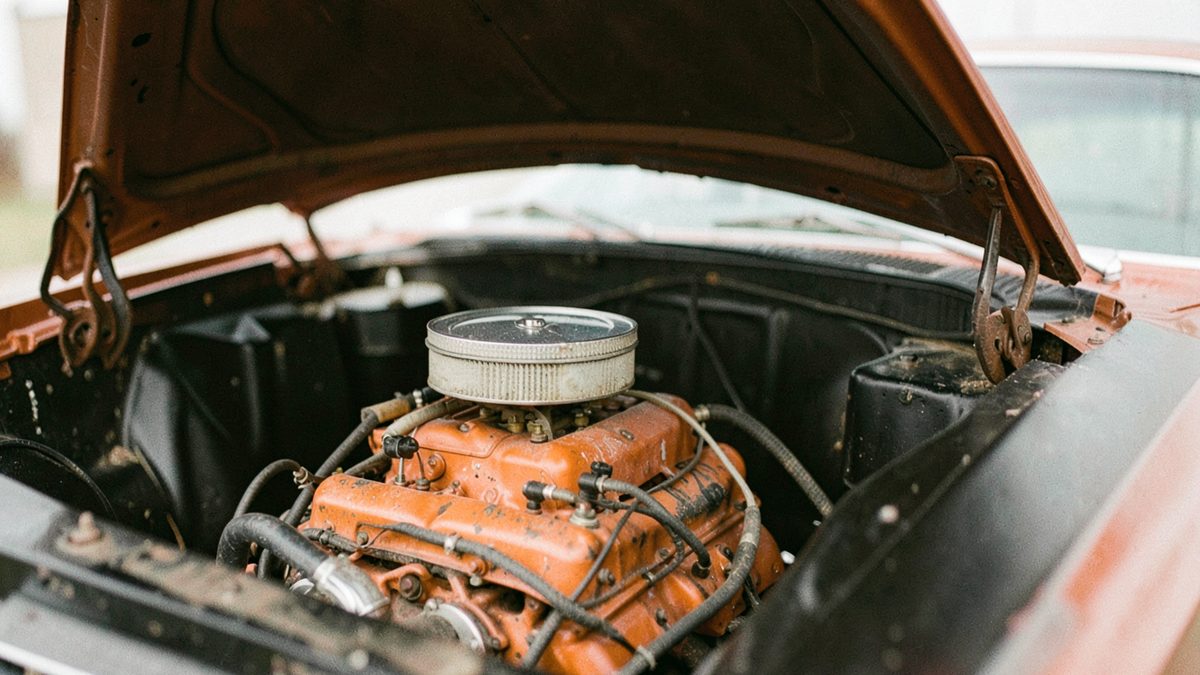
Chrysler is the straightforward one. From 1968 through the early seventies, Mopar assembly plants stamped the last eight digits of the car's VIN onto both the engine block and the transmission. On the small blocks, the 318, 340 and 360, it sits on the driver's side at the front of the block just below the cylinder head. On the big blocks, the 383 and 440, it goes in front of the valley pan. Manual transmissions carry it on a pad on the right hand side. If you own a B body or an E body, you can genuinely verify the car yourself in an afternoon, and our Mopar VIN decoder walks through the rest of the sequence.
Ford is the frustrating one. Ford plants also began stamping VIN derivatives on blocks in 1968, but the practice was never applied uniformly, and restoration sources consistently report that a substantial share of cars from those years left the factory with no stamp at all. Where it exists on a 1968 V8, it turns up on the flat surface behind the intake manifold, and on 289 and 302 small blocks on the driver's side above the oil pan rail toward the front. It is abbreviated rather than complete: a car carrying VIN 8R02F100001 gets 8R100001. The practical consequence is worth stating plainly, because no incumbent guide does. An unstamped Ford block is not evidence of a swap. It is evidence of a Ford.
Pontiac, Oldsmobile, Buick and Cadillac are the ones nobody warns you about. Their engines carry two letter engine codes and casting numbers, which establish what the engine is and roughly when it was cast, but do not tie it to one specific car. For those makes you are working with inference rather than proof. The same discipline applies on the Chevrolet side, which is why big block Chevy casting numbers identify the casting rather than the engine, and why a Muncie four speed is dated by its case rather than typed by it.
There is a second confusion running through these search results, and it is geographic. Several of the guides ranking for this phrase are European, and they describe a genuinely different system: chassis number, engine number and gearbox number, all checked against the original factory build record. That is how you verify a Porsche, whose engine numbers were recorded on the Kardex, or a Jaguar, which carries two engine numbers cross referenced against a Heritage Trust certificate.
None of that transfers to Detroit. American muscle cars have no separately recorded engine serial tied to a build record. The documentation services that do exist, the Marti Report for 1967 and later Fords and Pontiac Historic Services for Pontiacs from 1961 through 1999, reconstruct how a car was originally equipped. They do not record engine numbers. So a European style check cannot be performed on a Chevelle, and an owner following that advice ends up hunting for a record that was never kept. The two systems share a phrase and nothing else.
Start with what is knowable without touching anything. Decode the VIN itself, because on Ford and Chrysler cars the VIN encodes the original engine configuration. A 1970 Cuda T/A carries a J in the fifth position for the 340 six barrel. A 1970 Boss 302 carries a G. If the VIN says one engine and the car has another sitting in it, the conversation is over before you go looking for a single stamp.
Then work the chronology, the check that costs nothing and catches the most. Every casting carries a part number and a casting date, usually a raised circle with a month and a day in it. The casting has to predate the engine assembly, and the engine assembly has to predate the car's build date, with slack for shipping. A block cast after the car was built is not a discrepancy, it is an impossibility. Our Ford part number decoder covers how those numbers are structured, and the trap that the number cast into a part is frequently not the number the published charts decode.
Finally, look at the pad itself and not only at the digits sitting on it. A deck surface can be machined flat and restamped, so the texture around the numbers matters as much as the numbers do. Original factory broach marks are hard to fake and easy to destroy, and a suspiciously clean pad under an otherwise crusty engine is worth a long second look.
Directionally, originality still carries a premium, and it is largest at the very top of the market, where a rare drivetrain accounts for most of the value in the first place. On a documented Hemi car or a factory fuel injected Corvette, the stamp is the difference between two very different numbers. Further down the market the premium narrows, and on a car bought to be driven rather than shown it can thin out to almost nothing.
It is worth being honest about the limit, and the strongest voice on that point sits at the top of these results. After describing a Chevrolet represented as matching numbers that failed to sell at a hammer bid of eighty five thousand dollars and later traded twice for less, Carey's conclusion is that inference is not proof, and that in the world of matching numbers proof is elusive if it exists at all. A stamp raises your confidence. It does not settle the question. When the money gets serious, the answer is a marque expert and a written report, not a phrase in an advertisement.
It means the major components, the body, engine, transmission and often the rear axle, are the ones the factory originally installed. In practice the phrase usually points to a number stamped on the engine and transmission tying them to the car's VIN. Whether that number exists at all depends on the manufacturer and the model year.
Usually yes, and the premium grows with rarity. On a rare high performance drivetrain, originality can account for a large share of total value. On a common model bought to drive, the gap narrows sharply, and a well sorted replacement engine costs far less than chasing an original block across the country.
Decode the VIN first for the original engine configuration, then look for a VIN derivative stamped on the block, which exists on most 1968 and later Chrysler products and on many Fords. Then confirm the casting numbers and casting dates sit sensibly before the car's build date.
No. Chevrolet stamped a chassis derivative from 1960 and Chrysler stamped the last eight VIN digits from 1968, while Ford did so inconsistently across its plants. Pontiac, Oldsmobile and Buick engines carry engine codes and casting numbers but nothing tying them to one specific car, so those rely on inference.
The muscle world, every morning. Auctions, builds, reveals. Free.