Pontiac VIN Decoder: What Thirteen Digits Actually Prove
The number on the dash answers the model question for six years out of eleven, and almost no chart online tells you which six.
The number on the dash answers the model question for six years out of eleven, and almost no chart online tells you which six.
Type a 1969 GTO's thirteen characters into the first free Pontiac VIN decoder in the results and it will ask you to check your entry. The tool is not broken. Pontiac went to the seventeen character VIN in 1981, and almost every lookup online was built for the cars that came after. The classic charts that do exist were typed up by enthusiasts years ago and never checked against one another, which is why three will hand you three answers.
So this is the version that tells you where the number stops working, which model years change the layout underneath you, and the two questions it can only answer one at a time.
For 1964 through 1967 the plate is riveted to the driver's side door hinge pillar. From 1968 it sits on top of the dash at the driver's side, read through the base of the windshield, where federal rules put it on every American car that year. Pontiac also began stamping a shortened version of the number onto the engine block and the transmission in 1968, and that stamping, not the dash plate, is what people mean by numbers matching.
The number itself runs thirteen characters. No check digit, no world manufacturer code, no room for the equipment lists a modern report spits out. Position one is the division, and Pontiac is always 2. Positions two and three are the series: 33, 35 and 37 cover the Tempest and LeMans family, 42 is the GTO, 52 is the Catalina. Positions four and five are the body style: 07 or 27 for a two door post sedan, 17 or 37 for a two door hardtop, 67 for a convertible.
Position six is the model year, running 5 through 9 for 1965 to 1969, then 0 and 1. Position seven is the plant letter, and the last six digits are the build sequence. What is not in there is the engine. A 1969 GTO reads the same whether it left Pontiac with the base 400 or a Ram Air IV.
The 1964 cars use a shorter number in a different order. The first digit is cylinder count, 6 or 8. The second is the series: 0 for Tempest, 1 for Tempest Custom, 2 for Tempest LeMans. The third is the year, a 4. The fourth is the plant, then the sequence.
The trap: the 1964 plant letters are not the letters you will use twelve months later. In 1964, F is Fremont and M is Kansas City. From 1965 onward Fremont is Z and Kansas City is K. Read a 1964 number against a 1965 chart, which is what happens the moment someone lands on a page titled 1965 to 2002, and you will place the car in the wrong state.
This is the part no chart states plainly. For 1964 and 1965 the GTO was not a model. It was an option on the Tempest LeMans, sale code 382, order code W62, fitted to 32,450 cars in 1964 and 75,352 in 1965. The VIN on every one of them says LeMans, because as far as the factory was concerned there was no such car.
For 1966 the GTO became its own series, 242, and held that number through 1971. Those six model years are the only ones where the VIN settles the argument on its own.
Then it goes away again. For 1972 the GTO went back to being an option on the LeMans, and only 5,807 were sold. It stayed an option in 1973, and for 1974 it moved onto the compact Ventura. A genuine 1972, 1973 or 1974 GTO therefore carries a VIN reading LeMans or Ventura. Six years in the middle of an eleven year run, and outside that window the number does not have the field.
1972 rewrote the layout. The numeric series gives way to a letter at position two, D for LeMans and G for the luxury models. Body style moves to positions three and four. And a new field appears at position five: the engine code.
On the 1972 intermediates that code reads D for the 250 one barrel six, M for the 350 two barrel, R for the 400 two barrel, S for the 400 four barrel at 200 horsepower, T for the 400 four barrel at 250, X for the 455 at 300, and Y for the 455 at 250. For the first time the plate tells you what is between the fenders.
A 1969 GTO's VIN proves the car and cannot prove the engine. A 1972 GTO's VIN proves the engine and cannot prove the car.
That trade has a practical use nobody prints. The 1972 GTO option was built around the 400 four barrel rated at 250 horsepower net, with the 455 and the 455 HO above it on the order sheet. So position five can disqualify a car. A 1972 LeMans wearing GTO badges with a D or an M in position five did not leave the factory as one. It can never confirm a car, because plenty of ordinary LeMans coupes got the same 400, but a test that only says no is still worth thirty seconds.
The Firebird runs on separate logic, and it changes twice. For 1967 through 1969 the third digit is cylinder count: 223 is a six, 224 is a V8. Body style is 37 for the coupe and 67 for the convertible, and the plants are U for Lordstown, N for Norwood and L for Van Nuys. The factory also ran two sequence blocks, starting V8 cars at 100001 and sixes at 600001, which matters in a moment.
For 1970 and 1971 that third digit stops meaning cylinders and starts meaning model. 223 is the base car, 224 the Esprit, 226 the Formula and 228 the Trans Am, all on body 87. So from 1970 the Trans Am genuinely is in the VIN, the mirror image of the GTO story.
The 1969 Trans Am is not. It arrived in March 1969 as option WS4 on the Firebird 400, Cameo White with blue stripes, and 697 were built. Its VIN reads like any other V8 Firebird that year, and the proof is a WS4 stamp on the body data plate on the firewall. From 1972 the series becomes a letter at position two: S for base, T for Esprit, U for Formula, V and later W for Trans Am, with the engine code again at position five.
Line the top results up side by side and they contradict one another on basic facts. The most widely copied classic chart lists assembly plant V as Bloomfield, Illinois. General Motors never had an assembly plant in Bloomfield, Illinois. V is Pontiac Central Assembly, in Pontiac, Michigan. The same invented plant turns up on Buick charts, which tells you these tables were copied rather than checked.
That is not the document's worst moment. The same PDF prints a Pontiac plant list for 1965 to 1971 including C, D, E, U, V and X, then prints a second plant list for the GTO covering the identical years that adds A for Atlanta and drops all six. One document, one division, the same years, two answers.
The parts store chart at position two says the Firebird series is 223 for all of 1967 to 1969, and puts the engine at position eight, 1 for a V8 and 6 for a six. Position eight is the first digit of the sequence number. It reads 1 on V8 cars and 6 on sixes only because the factory ran them in separate blocks, so the rule looks right on a first generation car while describing the wrong field entirely. Carry it to a 1970 Firebird and it collapses.
The same page lists the letter series S, T, U and V under a heading beginning in 1967. Those letters do not exist until 1972, so anyone checking a genuine 1970 Trans Am against that table will hunt for a V that was never stamped.
Everything the VIN cannot reach lives on the cowl tag or in the factory records. The Judge is the clearest case. It was an option package and never a series, so a genuine 1969 Judge and a plain 1969 GTO share the same 242 structure. Ram Air is the same story, and so is the axle ratio.
For Pontiac the last word belongs to PHS, the archive assembled by Jim Mattison out of Pontiac's own microfiche. It covers roughly 1961 through 1986 and returns the factory invoice or billing history for that specific car, a letter decoding the option codes, and a copy of the dealer order form. That is the document that settles a Judge, a Ram Air car or a 1972 GTO.
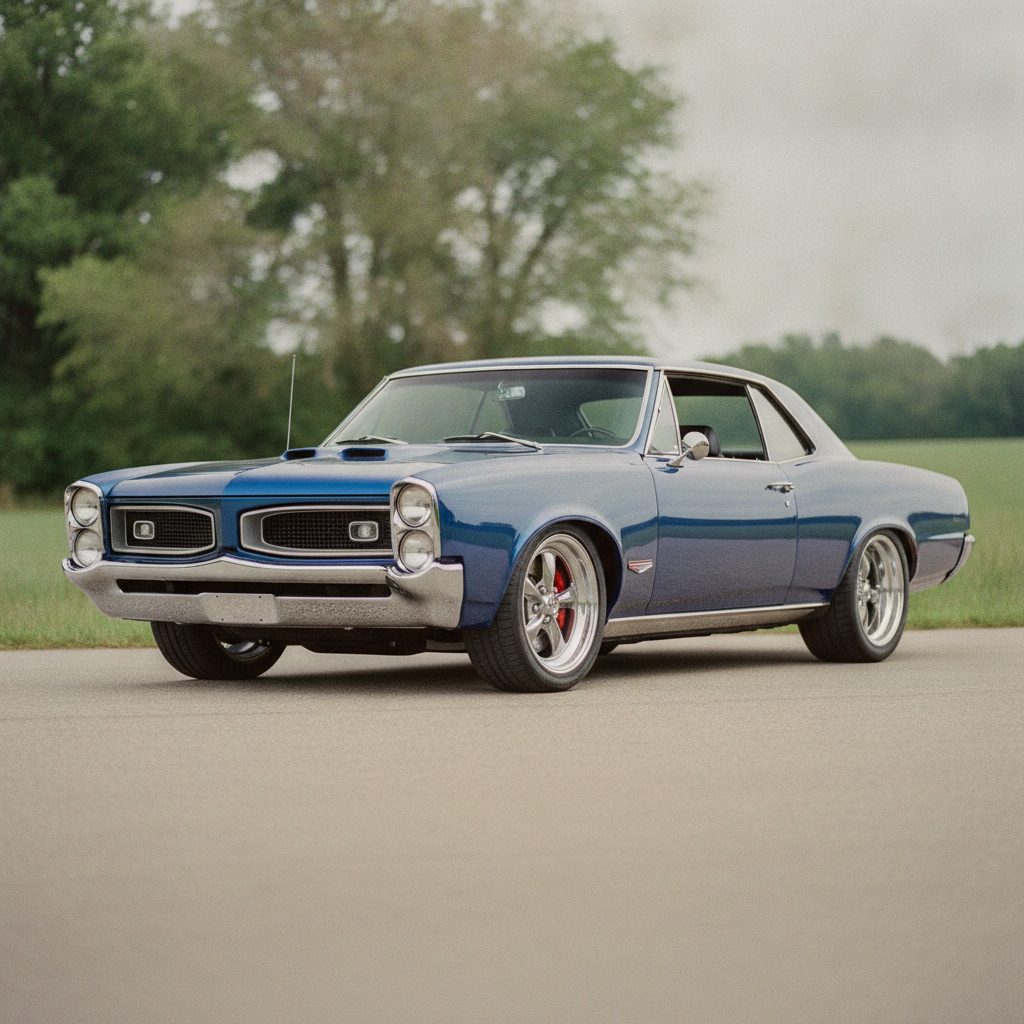
Cover photograph: a 1968 Pontiac GTO by Calreyn88, via Wikimedia Commons, CC0.
Not before 1972. A 1965 to 1971 Pontiac VIN carries division, series, body style, model year, plant and build sequence, and no engine field at all. From 1972 an engine code appears at position five. On earlier cars the engine is identified instead by the block casting number and the two letter code stamped on the block.
No online decoder produces one. For Pontiac the equivalent is a PHS packet, ordered against the VIN, which returns the factory invoice or billing history plus a decode of the option codes. Loose build sheets do survive under the rear seat or on top of the fuel tank, but those are found, never looked up.
Not from the VIN, because the Judge was an option package and shares the 242 series with every other 1969 GTO. The cowl tag option codes are the first check and PHS documentation is the second. Without one of those two a Judge is a claim rather than a fact, whatever the stripes say.
1981, along with the rest of the industry, when the seventeen character standard became mandatory. That single date explains why the federal and commercial VIN lookups return nothing useful for a GTO, a Firebird or a Catalina. Those tools begin at the 1981 model year and cannot read a thirteen character number.
The muscle world, every morning. Auctions, builds, reveals. Free.