1969 Camaro Trim Tag Decoder: Read It Right
The little Fisher Body plate can recover a Camaro's original color and trim, but it cannot prove nearly as much as hopeful sellers claim.
The little Fisher Body plate can recover a Camaro's original color and trim, but it cannot prove nearly as much as hopeful sellers claim.

A 1969 Camaro trim tag decoder can turn a grimy aluminum plate into the car's original body style, assembly plant, interior, paint, and approximate body-build week. It can also start a very expensive argument. The trouble begins when a useful Fisher Body production tag gets treated like a complete birth certificate. It isn't one. The tag describes the body Fisher had to build, not every engine, transmission, or dealer-installed part that Chevrolet put around it.
That limit is the key to reading the plate honestly. Decode each field, keep the Norwood and Van Nuys formats separate, and then test any performance claim against the VIN, drivetrain stamps, dates, and surviving paperwork. The plate sits on the driver's side of the firewall near the master cylinder. Photograph it before cleaning anything, including the rivets and the metal around them. A correct code on a replacement tag is still a replacement tag. The Camaro make hub supplies the wider model context once the plate has been read.
Start with the characters after ST. The 69 identifies the model year. The Fisher style number 12437 means a Camaro coupe, while 12467 means a Camaro convertible. NOR identifies Norwood, Ohio. LOS and VN identify the Van Nuys, California operation, with the plant marking changing from LOS to VN around mid-December 1968. The digits following the plant code are the Fisher body number, not the last digits of the VIN.
The TR field carries a three-digit interior code. For 1969, 711 means black standard bucket upholstery and 712 means black custom buckets. Codes 713 and 729 identify black and ivory houndstooth custom interiors. The PNT field uses numeric body-color codes. A pair such as 71-71 means LeMans Blue on both the lower and upper body. If the car had a vinyl or convertible top, a letter can replace the second body-color number.
The build-date code uses two digits for the month and a letter for the week. Thus 05A means the body build started in the first week of May, while 11C points to the third week of November. Treat that as an approximate body date, not the exact final-assembly day. Camaro Research Group's field-by-field research also shows that Van Nuys tags can carry a separate letter-and-number scheduling code. That plant sequence is not a hidden option code.
The famous X codes belong to Norwood, and even there they do not cover the whole model year. Camaro Research Group has documented the transition at the 12B build week, the second week of December 1968. Some 12B cars have an X code and some do not. Earlier Norwood cars lack one, while later examples normally carry one. Van Nuys cars never received these Norwood X codes.
That plant boundary matters more than the code chart. A Van Nuys Z/28 without X33 or X77 is not missing proof it should have had. An early Norwood SS can also be authentic without an X code. Before decoding the bottom line, read the plant and body date. Otherwise a perfectly accurate chart can produce a false rejection. Our 1969 Camaro Z/28 guide follows that verification problem from the body tag to the DZ engine stamp.
An X code can support a performance claim. The absence of one means nothing until the plant and build week are known.
The X-code family is arranged around body trim. X11 covers a non-SS396, non-Z/28 body with Z21 Style Trim or Z22 Rally Sport, and it can include an SS350. X44 is the corresponding non-SS, non-Z/28 body without those trim packages. X55 identifies an SS350 without Style Trim or Rally Sport. This is why X11 is not an SS350 certificate. Camaro Research Group estimates that only about one in ten X11-coded cars were actually SS350s.
X22 identifies an SS396 body with Style Trim or Rally Sport, and X66 is the SS396 body without either. X33 identifies a Z/28 with Style Trim or Rally Sport, while X77 is a Z/28 without them. X11, X22, and X33 therefore sit on the style-trim side of the chart. X44, X55, X66, and X77 sit on the plain-trim side. The code told Fisher workers which moldings and paint treatments the body needed. It was not written as a collector authentication system.
There are exceptions. Most COPO Camaros used X11 or X44 bodies, and some early COPO cars used X22 or X66. Z10 and Z11 identify the Norwood-built Indy pace-car coupe and convertible configurations. D80 can accompany an X code for spoilers, but it was not stamped consistently, and an A can identify power windows without being universal. One missing secondary mark should never outweigh a complete, consistent evidence trail.
Here is the live search-result error that can cost a buyer money. A page-one 1969 decoder labels 12437 as a V8 coupe and 12467 as a V8 convertible. That meaning belongs to the VIN pattern, not the 1969 Fisher Body tag. Fisher did not need engine type to build the shell. For 1968 and 1969, it fixed the third digit of the cowl-tag style number at 4 for every Camaro, whether the finished car received an inline-six or a V8.
So a cowl tag reading ST 69 12437 establishes a 1969 Camaro coupe body. It does not establish a V8, an SS, or a Z/28. The separate 13-character VIN carries the original six-cylinder-versus-V8 distinction, but even the VIN does not identify which V8 option was installed. This is the same evidence hierarchy behind our GM RPO codes guide: body data, vehicle identity, drivetrain stamps, and factory paperwork answer different questions. Do not make one plate do all four jobs.
Chevrolet changed Camaro body-paint codes from letters in 1967 and 1968 to numbers in 1969. Familiar examples include 10 Tuxedo Black, 50 Dover White, 52 Garnet Red, 69 Cortez Silver, 71 LeMans Blue, 72 Hugger Orange, 76 Daytona Yellow, and 79 Rallye Green. A solid-color car normally repeats the number. Two different numbers indicate one of the offered two-tone combinations, such as 53-50 for Glacier Blue with Dover White.
A dash in the paint position indicates special paint rather than one secret universal color. Non-standard body color, stripe deletion, or a non-standard stripe color could require special handling. The tag tells you that the ordinary chart is no longer enough. The window sticker, broadcast copy, dealer paperwork, and protected traces of original finish must identify what the car actually received. Do not convert a dash into a fashionable color because a seller's story sounds plausible.
Use the interior code with the body style and paint rather than in isolation. Camaro Research Group notes that houndstooth was generally unavailable on convertibles except for Z11 pace-car replicas. Orange houndstooth 720 normally paired with Hugger Orange, and yellow houndstooth 714 normally paired with Daytona Yellow, though limited exceptions have been observed. An unusual combination raises the documentation standard. It does not authorize an instant verdict from a single table.
First, record the cowl tag, VIN, engine-pad stamp, partial VIN, transmission markings, rear-axle code, casting dates, and visible date codes without decoding them on the spot. Clean photographs prevent the desired answer from filling weak characters. Next, check that the tag's body date precedes final assembly by a plausible interval and that engine and component dates make chronological sense. A date after the car was assembled is a hard contradiction. A date earlier than expected is a question, not automatic fraud.
Second, compare physical evidence with documents. A Protect-O-Plate, broadcast copy, original invoice, window sticker, warranty material, and long ownership history become powerful when the identifiers agree. Inspect the tag's rivets and surrounding finish, but remember that restored cars can have disturbed paint for innocent reasons. Our numbers-matching guide explains why correct-for-the-year parts and born-with parts are separate claims.
Finally, write the conclusion narrowly. Say the tag supports a Norwood-built X33 Z/28 body with code 71 paint and trim 711, if that is what it says. Do not shorten that to real Z/28 until the drivetrain and paperwork agree. For a high-value car, hire a first-generation Camaro specialist who does not have a financial interest in the sale. A careful inspection is cheaper than discovering that the only authentic performance part was the story.
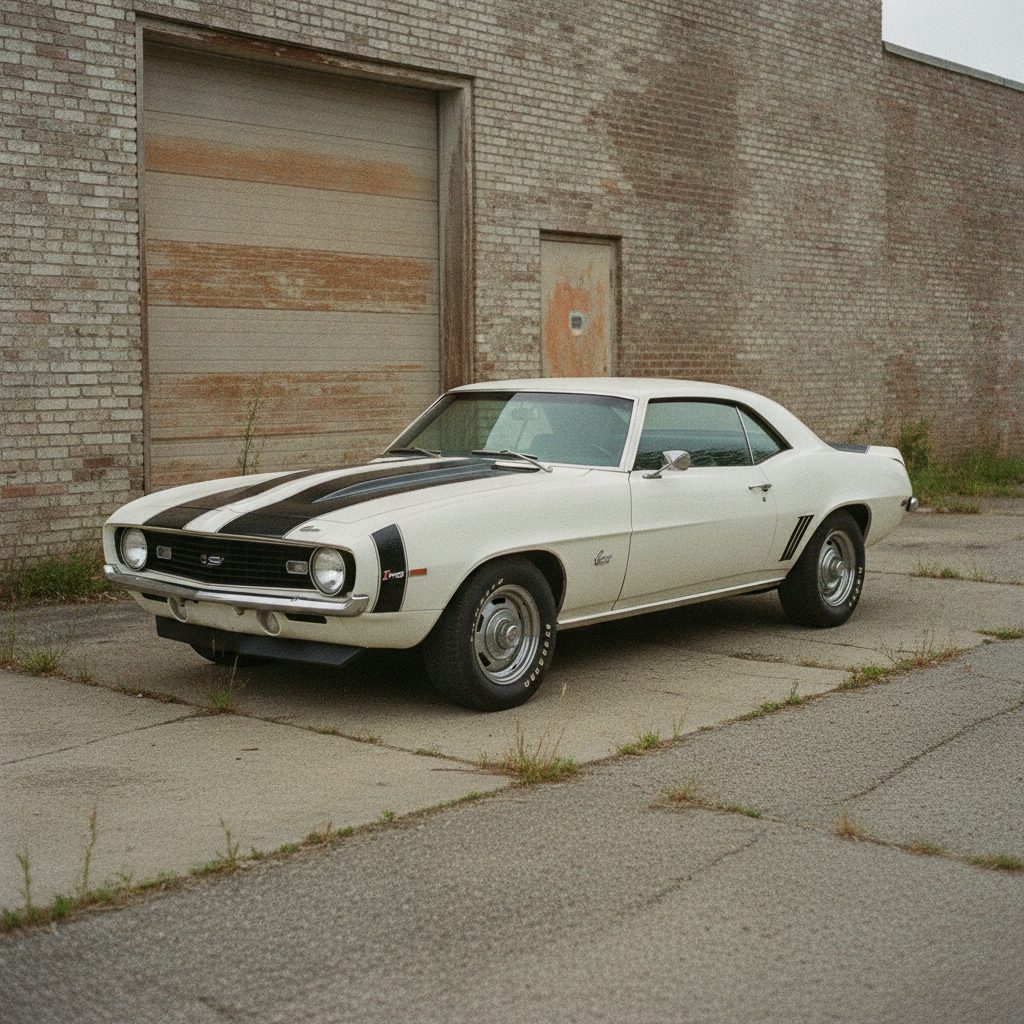
Cover photo: a real 1969 Chevrolet Camaro photographed by Erik Nomm, used under the Creative Commons Attribution 2.0 license. The lighting leaves no visible badge, emblem, plate, sign, or lettering to misread.
It identifies the model year, coupe or convertible Fisher body, body plant, Fisher body number, interior trim, exterior paint, and approximate body-build week. A late Norwood tag may also carry an X code. It does not by itself prove the original engine, transmission, VIN identity, or every Chevrolet option.
No. X11 identifies a non-SS396, non-Z/28 body with Style Trim or Rally Sport, and that group includes both ordinary cars and some SS350s. The code cannot separate those possibilities. Verify an SS350 through drivetrain stampings, dates, VIN consistency, factory paperwork, and a qualified inspection.
Van Nuys did not use the Norwood X-code system. Norwood introduced it around the 12B build week in December 1968, with both coded and uncoded tags documented during the transition. A missing X code is therefore normal on every Van Nuys car and on earlier Norwood production.
A late Norwood X33 or X77 tag strongly supports a Z/28 body configuration, but the tag can be replaced and does not tie the engine to the car. Early Norwood and all Van Nuys Z/28s lack those codes. Confirm the DZ application stamp, partial VIN, dates, documents, and tag originality together.
The muscle world, every morning. Auctions, builds, reveals. Free.