Chevelle Cowl Tag Decoder: What the Plate Proves
The Fisher Body plate on a 1964 to 1972 Chevelle nails the paint and trim, but it cannot prove the engine or the SS, and the VIN can only do it in certain years.
The Fisher Body plate on a 1964 to 1972 Chevelle nails the paint and trim, but it cannot prove the engine or the SS, and the VIN can only do it in certain years.
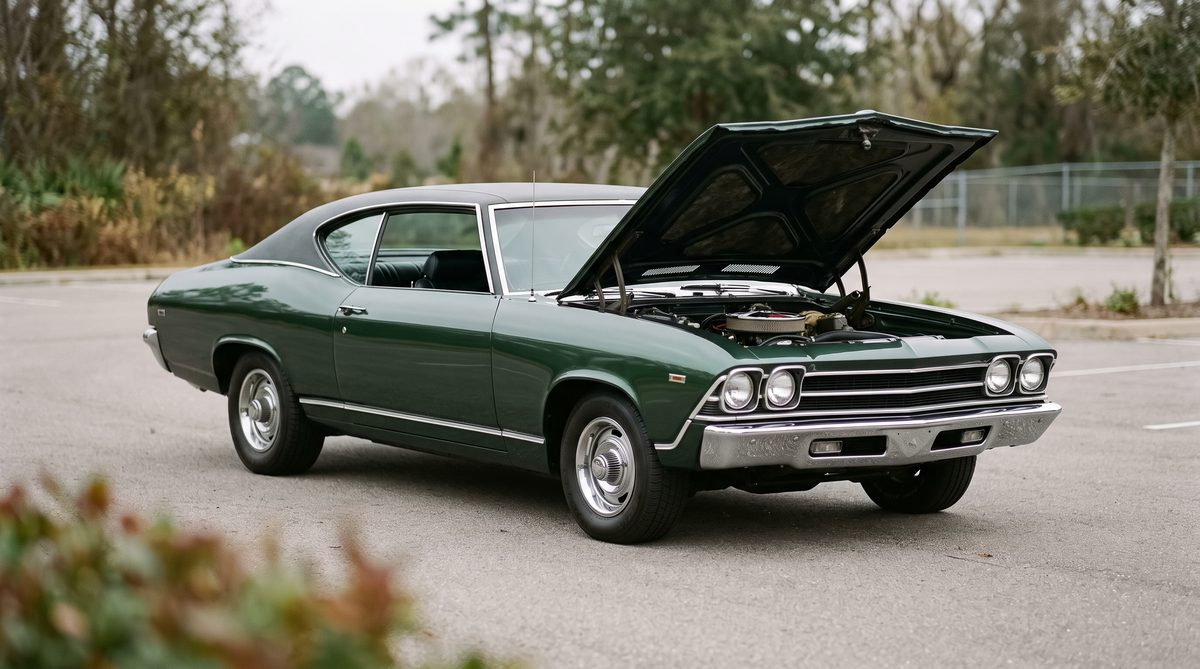
Pop the hood on any 1964 to 1972 Chevelle and look at the upper firewall on the driver side. That small stamped plate held on by two rivets is the Fisher Body number plate, the thing everybody calls the cowl tag or trim tag. It is the first stop in any Chevelle inspection, and it is also the most misread piece of paper on the car. Sellers point at it to prove an SS. Buyers point at it to prove a V8. In most years it can do neither, and knowing exactly where its authority stops is worth more than any decoder chart.
Below, the tag line by line, then the years 1964 to 1972, because the answer changes with the model year, plus three errors that rank for this search today.
The plate was Fisher's work order for the shell, stamped before the body went down the line. That is why it details paint, trim and body style and says almost nothing about the engine bay. Layouts moved by plant and year, but the same fields appear on nearly every U.S. tag.
Style line. ST, the two-digit model year, then the five-digit Fisher style number, such as 13637 for a 1969 Malibu sport coupe. The first three digits echo the Chevrolet series, the last two give the body: 37 a two-door hardtop sport coupe, 27 a pillared coupe, 67 a convertible, 69 a four-door sedan, 80 the El Camino. In 1966 and 1967 only, the sport coupe used 17 instead of 37.
Plant and body number. A plant code (ATL Atlanta, BAL Baltimore, FRA or FM Framingham, BF Fremont, KAN Kansas City, OS Oshawa, with Arlington, Flint and Van Nuys appearing in later years) and the Fisher body or unit number, followed by BDY. That body number is not the VIN, and each plant counted it its own way.
Trim and paint. TR plus a three-digit interior code for seat type, color and material, then two paint codes, lower body first and upper second, then PNT. A single letter in the second slot means a vinyl or convertible top color rather than a painted roof. Dashes in the paint positions usually mean special order paint.
Time built. A two-digit month and a week letter, A for the first week through E for the fifth, so 02D reads February, fourth week. That is the date the Fisher body was scheduled, not the day the finished car rolled out, and it can trail or lead the VIN sequence.
Option codes. Some plants added body option groups or plant data numbers on extra lines. Many of those letters are still undocumented, so anyone who decodes every one is guessing.
The rule that settles most arguments: on a U.S. built 1964 to 1972 Chevelle, the cowl tag carries no engine code and no SS code, in any year. Fisher Body built the shell to the style, color and trim on the order. Whether the finished car got a 230 six, a 327 or a 396 was Chevrolet's business at final assembly, and at most U.S. plants Fisher did not even change the style number for a six versus a V8.
That last point is the one that catches people. A 1965 Malibu SS sport coupe is series 137 with a six and 138 with a V8 in the VIN. At most U.S. plants the tag read 13837 either way. Fremont was the exception that stamped 13737 on a six-cylinder car, and Oshawa style numbers did follow the engine. So a 13837 tag from Atlanta or Kansas City tells you the body was built as a Malibu SS sport coupe, and nothing at all about the cylinder count.
The cowl tag tells you what Fisher Body built. The VIN tells you what Chevrolet sold. They are two different documents, and they are allowed to disagree.
The exceptions are narrow. Canadian Oshawa tags often list RPO codes, so a Canadian SS396 can show L34 or Z25 on the plate, and some 1970 and 1971 Baltimore and Kansas City tags used style numbers that match the VIN series. A U.S. plate that looks too helpful deserves a closer look at its rivets.
Since the tag cannot answer the SS question, the VIN has to, and what it can answer depends on the year.
1964. The Malibu SS is its own series, 57 for a six and 58 for a V8, so a sport coupe VIN starts 45737 or 45837. The VIN proves the SS and the base engine type, nothing more.
1965. Still its own series, now 137 and 138. A 138 VIN proves a V8 Malibu SS, but it does not separate a 283 car from the 201 Z16 SS396 cars, which carried the same series. The Z16 needs its own documentation.
1966 to 1968. The SS396 is a separate 138 series, 13817 and 13867 for 1966 and 1967, 13837 and 13867 for 1968, plus the 13880 El Camino in 1968, the only year an SS396 El Camino can be proven from the VIN. Even here, 138 alone is not enough, because the Concours wagon, new for 1967, also carried a 138 series number.
1969 to 1971. The SS becomes an option. Z25 SS396 in 1969 and 1970, Z15 SS454 in 1970, and Z15 as simply the SS in 1971. From here on, neither the tag nor the VIN carries the SS. You need a build sheet, an original Protect-O-Plate, a dealer invoice, or a window sticker.
1972. The fifth VIN character finally carries the engine: D for the 250 six, F for the 307, H and J for the 350s, U for the 402 and W for the 454. The 454 required the SS option, so a genuine W VIN proves an SS. An H, J or U fits an SS without proving one, and a D or F car cannot be an SS. Earlier cars depend on documents instead, as our 1970 Chevelle SS story shows.
Three claims ranking for this search today fail against that record.
First, that all 1969 to 1972 V8 Chevelles start with 136. They do not. In 1969 the Z25 SS396 package could be ordered on the 300 Deluxe, series 134, as well as the Malibu, so a real 1969 SS396 coupe can carry a 134 VIN and a 13437 or 13427 tag. The base Chevelle line used 134 again in the following years.
Second, that the VIN no longer distinguishes an SS from 1969 through 1972. True for 1969 to 1971, wrong for 1972, when the engine code arrives at position five and a W proves the SS.
Third, that a 138 prefix identifies an SS from 1964 to 1968. In 1964 the VIN uses 57 and 58, not 138. In 1965 a 138 proves a V8 Malibu SS but not an SS396, since most were small-block cars. And from 1967 the Concours wagon shares the 138 series. One popular VIN guide on page one also says the VIN reveals the original motor and transmission. On a 1964 to 1971 Chevelle it gives you six or V8 and nothing else, and it never names a transmission in any year.
Cross-check the plate against what can back it up. Start with the VIN plate, on the driver side hinge pillar for 1964 to 1967 and on top of the dash at the windshield for 1968 to 1972. Confirm the year, the series and, where it applies, six versus V8. Then look at the engine pad. Most later Chevelle V8s carry a partial VIN derivative stamped beside the engine suffix code, and that stamp is what ties a block to a body. Our big block Chevy casting numbers guide covers what the block itself can and cannot prove.
Some disagreement is normal. A 13837 tag on a 137 VIN 1965 car is normal, and so is a 13437 tag on a 1969 SS396. Fresh rivets, crisp letters on a weathered firewall, or codes that plant never used are not.
For the option codes that never made it onto the plate, our GM RPO codes guide explains where those three-character codes actually live, from the build sheet to the Protect-O-Plate. The hub for everything else on these cars is our Chevelle page.
Work from the strongest evidence down. Original documents first: a build sheet found under the seat springs or on top of the gas tank, the Protect-O-Plate, the dealer invoice or the window sticker. Then the VIN, read for its year. Then the engine pad stamp and suffix code. Then SS hardware, which proves little, since round 1970 dash pods also came with the gauge option. The cowl tag sits last for SS questions and first for paint and interior.
That is the plate's real value. For a restoration it is the best record of the original color, top, interior and body style. Use it for that, and let the VIN and the paperwork carry the rest.
No, not on a U.S. built 1964 to 1972 car. The tag records body style, paint, trim and build week. In 1964 to 1968 the SS can be read from the VIN series. From 1969 to 1971 only documents prove it, and in 1972 a W engine code in the VIN proves an SS with the 454.
It is riveted to the upper firewall on the driver side, under the hood. Do not confuse it with the VIN plate, which sits on the driver side hinge pillar on 1964 to 1967 cars and on top of the dash, visible through the windshield, on 1968 to 1972 cars.
It is the Fisher body build month and week. The two digits are the month and the letter is the week, A for the first through E for the fifth, so 03B means March, second week. It reflects the body schedule, not the exact day the car was finished.
No. The tag carries no engine code in any year, and at most U.S. plants it did not even change for a six versus a V8. Check the VIN for the base engine type, the engine pad for its stamps, and the build sheet or Protect-O-Plate for the specific engine.
The muscle world, every morning. Auctions, builds, reveals. Free.