9 Inch Ford Identification: Three Tests and One Myth
Three checks you can run in a salvage yard, in the order that works, plus the popular shortcut that quietly fails on the best cases Ford ever poured.
Three checks you can run in a salvage yard, in the order that works, plus the popular shortcut that quietly fails on the best cases Ford ever poured.
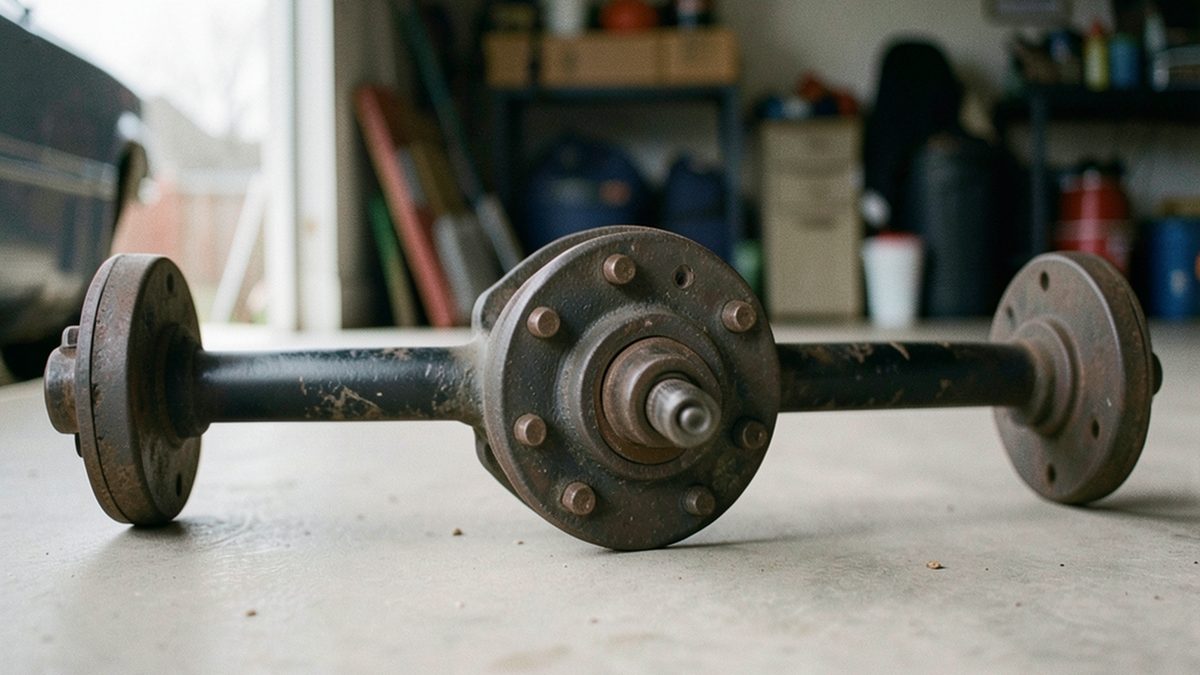
Somebody is going to sell you a Ford 9 inch this weekend. Maybe it is under a tarp behind a body shop, maybe it is the whole reason a rolling shell is worth hauling home. The trouble is that plenty of rear ends offered as 9 inch housings are nothing of the kind, and a good number of the real ones get walked past because the buyer ran the wrong test. 9 inch Ford identification is not difficult, but the order matters, and the most repeated shortcut on the internet quietly fails on the best cases Ford ever poured.
Here is the sequence that works in a salvage yard with nothing but a deep socket and a tape measure, along with an honest account of what each step can and cannot prove.
Ford built the 9 inch from 1957 through 1986, then replaced it with the 8.8. The name comes from the ring gear, which measures 9.00 inches across. That is the only thing the name describes. It says nothing about housing width, axle splines, gear ratio or the strength of the case, which is why two rear ends that are both correctly called 9 inch Fords can be worth very different money.
What made it the default swap for six decades is the layout. The center section, the third member, bolts to the front face of the housing and lifts out complete with ring gear, pinion and carrier. You can build a spare on the bench, keep it on a shelf, and change your final drive in an afternoon instead of a weekend. The pinion also sits below the centerline of the ring gear rather than on it, which buries more tooth in mesh and is the reason the thing shrugs off abuse that folds lesser axles. That offset costs a little parasitic loss, which is the honest trade, and the reason a 9 inch is not automatically the right answer for a street car chasing economy.
Walk behind the axle and look at the middle. If a stamped steel cover is bolted to the back of the housing, you are not looking at a 9 inch, and you are not looking at an 8 inch either. That cover is the signature of the 8.8 that replaced it, and of most GM and Mopar rear ends. A 9 inch has no rear cover at all. The back of the casting is smooth.
That one glance kills most of the misidentified rear ends in any given marketplace listing, and it costs nothing. What it does not do is get you to a 9 inch. It gets you to a family of two.
This is where most guides go wrong, and it is worth being blunt. A removable third member does not identify a Ford 9 inch. The Ford 8 inch drops out exactly the same way, from the front, retained by the same ring of ten studs, with no rear cover behind it. Stand the two in poor light and they read as the same silhouette.
Several pages ranking for this exact question list the drop out center section as the defining 9 inch trait and stop there. They are describing something both axles do. The tell those same pages go on to publish, the socket test, exists only because removability settles nothing. Nobody would need a go and no go gauge if the shape of the housing answered the question.
A removable center section does not make it a 9 inch. The 8 inch drops out too, which is precisely why the socket test had to be invented.
Take a deep socket and try to drop it over the two bottom retaining nuts on the center section. On a Ford 8 inch the socket clears and you can spin those nuts off. On a 9 inch the casting crowds them and the socket will not seat, which is why anyone who has pulled a few 9 inch centers keeps box end wrenches in the bag for that job alone. Speedway Motors publishes this test, and in the field it is the fastest reliable one going.
That gets you past the 8 inch, but one rare Ford lookalike remains. The 9 3/8 inch removable carrier also crowds the lower nuts, so check its curved upper rib and tag before calling the axle a 9 inch. Our parent Ford rear end identification guide covers that final split.
The nodular iron center section is the one everybody wants. Nodular iron takes shock loading that ordinary grey iron does not, and the desirable castings carry a pair of vertical ribs across the middle in a two by two pattern, with an N cast into one of the squares. Look for the N is the advice on practically every forum thread and parts blog covering the subject.
It produces false negatives, and it produces them on exactly the cases worth having. Ford did not begin casting the N into these housings until the middle of 1969, and it went on as a convenience for the people handling them in the plant rather than as a metallurgy stamp. The early big bearing C4AW-B castings are nodular whether or not they wear the letter. So are the C2AW-A and D0OW-B castings. A pre 1969 nodular case with no N is not a lesser part. It is the same part from before somebody decided to label it, and it gets passed over every weekend by buyers running a test that did not exist when the case was poured.
The fix is the one that works on every other identification job we run here. Read the casting number, not the badge. It is the same lesson as big block Chevy casting numbers, where the number in the block identifies the casting and not the engine that left the factory wearing it.
The reverse error deserves naming too. Thirty one spline hubs and shafts are a strong hint that you are holding an N case, but they are not proof, because axles get swapped and carriers get rebuilt by people who had a reason and left no note.
Two carrier bearing sizes were used, and the difference decides what you can do later. Small bearing cases are limited. Big bearing cases, the ones running the common 3.062 inch bearing caps, will accept a 31 spline carrier or a spool. Some 28 spline carriers are big bearing and some are small bearing, so spline count on its own does not tell you which is bolted up in front of you. Pull the third member and measure the caps when the answer matters, and it starts to matter the moment you plan on real power.
Axle splines themselves are the easy part. Count them on the end of the shaft. Twenty eight spline axles came in the volume cars and are perfectly happy behind a mild small block. Thirty one spline is the upgrade, and it is the number most people building for traction end up wanting.
Ford built the 9 inch in seven housing widths, running from roughly 57 and a quarter inches to 69 and a quarter across the axle flanges. That range covers everything from a compact to a full size wagon, so a correctly identified 9 inch can still be completely wrong for your car. Measure flange to flange before money changes hands, then measure each side separately from flange to pinion centerline, because most applications run one axle longer than the other around an offset center section.
If a stamped tag has survived under one of the third member nuts, it names the original application and the ratio the axle left with. Treat that as history rather than proof, the same way you would treat any factory tag. It tells you what the axle was, not what is inside it now, and on a part that has been opened as often as this one that gap is usually the entire story. If you are still working out which ratio you actually want, our guide to rear end gears covers the trade between acceleration and highway revs, and the same paperwork discipline runs through every code in the Big Block decoder.
None of this is academic. A 9 inch under a Mustang is a good axle. A 9 inch where the tag, the casting number and the bearing size all agree with each other is a known quantity, and that is the one worth paying for.
Look at the back of the housing first. A 9 inch carries no rear cover, so the center section comes out the front. Then drop a deep socket over the two bottom center section nuts. If the socket clears them, it is a Ford 8 inch. If the casting blocks it, inspect the upper rib and tag next, because a 9 3/8 inch carrier can pass the same socket test.
Ford produced the 9 inch from 1957 through 1986, when the 8.8 took over. That is close to a thirty year run across cars, trucks and wagons, which is why donor housings are still findable today, and also why the widths vary so widely between applications.
The classic marker is an N cast into one of the squares formed by the two by two ribs on the center section, but it is not reliable alone. Ford only began casting that N in mid 1969. Check the casting number instead: C2AW-A, C4AW-B and D0OW-B are nodular with or without the letter.
Under shock loading, generally yes. The pinion sits below the ring gear centerline and carries more tooth in mesh, and the axles are held by bearing retainers rather than C clips. The 9 inch gives up a little efficiency to that offset, so a 12 bolt can still be the better street answer.
The muscle world, every morning. Auctions, builds, reveals. Free.