Ford Rear End Identification: The Cover Tells First
Start with the housing, not the door code, then use the tag and the hardware to separate Ford's five rear axle families without buying the wrong gears.
Start with the housing, not the door code, then use the tag and the hardware to separate Ford's five rear axle families without buying the wrong gears.
Ford rear end identification usually begins with a dirty metal tag, a door sticker, or somebody saying the axle came from a Mustang. Begin with the housing instead. One look at the back tells you whether the gears come out through a rear cover or leave with a complete front carrier. That split removes half the wrong answers before a code chart can send you chasing a ratio the axle no longer contains. It also exposes a mistake repeated by the current page-one guides: the famous bottom-nut socket test does not always prove that a drop-out axle is a 9 inch.
Ford used several rear axle families across cars and trucks, and fifty years of swaps have broken the link between many housings and their original vehicles. The safe order is architecture, housing shape, physical size, tag, then internal inspection. Paperwork belongs near the end because it records how an axle was built, not necessarily what is inside it today.
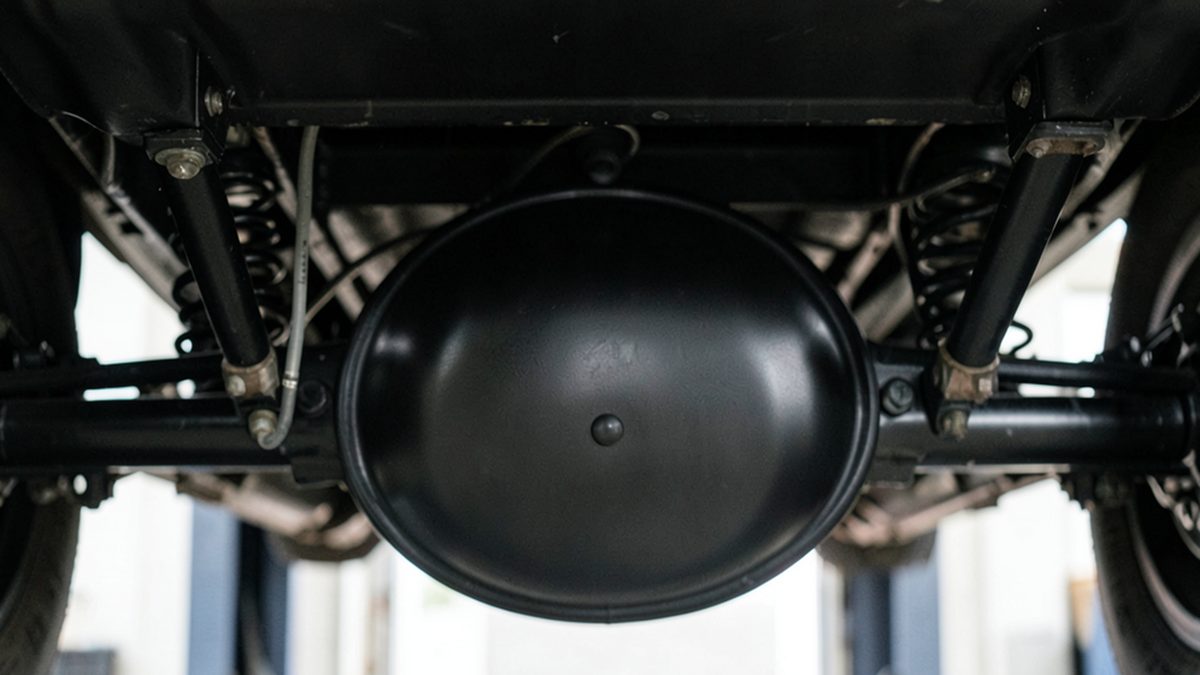
Stand behind the axle and look at the center. A Ford 8 inch, 9 inch, and 9 3/8 inch has no removable rear inspection cover. Its smooth stamped housing is welded shut at the back, while the gearset, differential, pinion support, and front casting leave together as a third member. Ford's 1971 shop manual calls this the removable-carrier type.
A Ford 7.5, 8.8, and Sterling 10.25 or 10.5 has a bolted cover facing the rear bumper. The carrier stays inside the housing when that cover comes off, which Ford's manual calls an integral-carrier axle. This is the hinge in the whole family history. The classic drop-out design made ratio swaps easy. The later integral design reduced mass and manufacturing complexity, then spread across Fox Mustangs, Rangers, Explorers, F-Series trucks, and other lines.
Do not identify an integral axle by bolt count alone. The 7.5 and 8.8 both use ten cover bolts. The Sterling uses twelve, but a twelve-bolt cover is only the opening clue because Ford trucks also used Dana axles. Carrier design gets you into the right branch. Shape and size finish the job.
The 8 inch and 9 inch are the close call most buyers face. Both have a front-loading third member held to the housing by ten nuts. Both show a smooth welded back. On the smaller axle, a socket reaches every retaining nut. On the 9 inch, the casting crowds the two lowest nuts, so they normally require a box wrench. Our dedicated Ford 9 inch identification guide walks that check and the nodular-case trap in detail.
Housing shape adds a second check. The 8 inch is flatter across the top and bottom of the center bulge. Most later 9 inch housings have a rounder bulge with a raised central hump. Never use donor-car folklore as proof. A six-cylinder compact could have been upgraded, a V8 car could have received a smaller replacement, and an aftermarket housing may imitate factory dimensions without carrying any factory history.
The socket test separates the 8 inch from Ford's larger drop-out family. It does not, by itself, prove a 9 inch.
Here is the correction that changes the buying decision. Ford also built a 9 3/8 inch removable-carrier axle for heavy passenger cars and trucks. It looks close enough to a 9 inch that a smooth rear housing and blocked lower nuts can produce a false identification. One current guide ranking first for Ford rear end identification calls the blocked-nut test proof of a true 9 inch, then omits the 9 3/8 entirely.
Read the face of the third member. On a 9 3/8 casting, the upper horizontal rib curves downward at the left side, instead of running across like the familiar 9 inch rib structure. A surviving tag may print the ring-gear size as 9.3, and these assemblies used 31-spline axle shafts. Ford clearanced the housing opening for the larger ring gear, so ordering ordinary 9 inch gears from silhouette alone can leave you with parts that do not match what is on the bench.
The tag is corroboration, not a verdict. Tags move when third members move, and these axles were built around the convenience of swapping a complete center section. Confirm the curved rib and, when money depends on it, open the housing and measure. That same discipline applies to every classic Ford part number: a code identifies what Ford marked, while the hardware tells you what survived.
The 8.8 arrived in 1983 model-year trucks and became Ford's broad replacement for the 9 inch. Its rear cover has ten bolts and reads nearly square, with rounded corners and a broad flat area across the upper half. The axle appeared in both 28-spline and 31-spline forms, which is why the housing name cannot settle shaft strength. An Explorer donor and a Mustang donor can both be 8.8s while carrying different widths, brakes, spline counts, and mounting brackets.
The 7.5 also uses ten bolts, but its cover is smaller, narrower, and more oval. That makes count-the-bolts advice incomplete even when the count is correct. Measure the cover and compare its outline to a known pattern before ordering a gasket. Then count splines with a shaft removed if the build depends on them. Exterior brackets can identify an application, but they are poor family tests because fabricators relocate spring pads and control-arm mounts during swaps.
Do not call every 8.8 a limited-slip axle, either. Traction-Lok was an equipment choice, not part of the 8.8 definition. A ratio test can tell you how many driveshaft turns correspond to a wheel turn, but it cannot positively identify the housing family. If you are choosing the ratio after the identification work is done, the rear end gears guide explains the acceleration and highway-rpm trade.
The Sterling family belongs under heavy Ford trucks, not under the muscle-car branch, but it appears constantly in broad searches and salvage listings. The 10.25 and later 10.5 use a large integral housing with a twelve-bolt rear cover. Ford Performance's own Super Duty cover instructions confirm that twelve-bolt pattern. Scale is the other tell: next to an 8.8, the Sterling center is visibly larger and its axle tubes, brakes, and hubs are built for truck loads.
A protruding hub identifies a full-floating version because the vehicle's weight rides through the hub rather than the axle shaft, but not every Sterling is full-floating. Semi-floating variants exist, so the absence of a protruding hub does not erase the twelve-bolt Sterling clues. Also resist the shortcut that every big Ford truck axle is a Sterling. Dana 60, 70, and 80 axles served beside it. Count, shape, tag, and hub design must agree.
A metal tag normally sits under a third-member nut on a drop-out axle or a cover bolt on an integral axle. Ford formats changed, but the lower line commonly carries the original ratio, differential type, ring-gear size, and build date. A ratio written 3L50 means 3.50:1 with a locking differential. A spaced 3 50 means the same ratio with an open differential. The size field may read 88 for an 8.8 or 9 for a 9 inch.
Ford's current support page correctly sends owners to the AXLE box on the Safety Compliance Certification Label to learn original ratio and limited-slip equipment. That answer is dead on intent for an intact modern vehicle and nearly useless for a loose axle at a swap meet. Door codes are application and year specific, and the door describes the car as built. It cannot report a later housing swap, a changed carrier, or replacement gears.
The reliable buying sequence is simple. Photograph the back and front, decide removable or integral carrier, count cover or third-member fasteners, compare the housing outline, read any tag, measure flange width, and inspect the internals before ordering gears or axles. That order turns Ford rear end identification from a guessing game into evidence. It also keeps the family-level answer distinct from our Mustang coverage, where the axle still has to be matched to a specific year and body. The cover image is a representative in-house illustration, not a photograph of a specific Ford axle.
Look for a rear cover first. No cover means the 8 inch, 9 inch, or 9 3/8 removable-carrier family. A ten-bolt cover points toward the 7.5 or 8.8, while a large twelve-bolt cover suggests a Sterling. Confirm with housing shape, tag data, measurements, and internal inspection.
A Ford 8.8 has a removable ten-bolt cover on the back of its cast center housing. A 9 inch has a smooth welded back and a complete third member that unbolts from the front. The difference is carrier architecture, so it remains visible even when tags and donor-car paperwork are gone.
Yes, a surviving factory tag records the original ratio and whether the axle was built with a locking differential. For example, 3L50 means 3.50:1 with a locking unit. Treat it as build history until inspection confirms the gears and carrier have not been changed during a later repair or swap.
Both are front-loading removable-carrier axles, but the 9 3/8 uses a larger ring gear and a distinct third-member casting. Its upper horizontal rib curves downward on the left, and a correct tag may show 9.3. The ordinary bottom-nut socket test does not reliably separate these two larger Ford axles.
The muscle world, every morning. Auctions, builds, reveals. Free.