Ford Engine Casting Numbers: What the Iron Can Actually Prove
The code cast into a Ford block can narrow the search, but the family, date, bore, stroke, and vehicle evidence decide what the engine really is.
The code cast into a Ford block can narrow the search, but the family, date, bore, stroke, and vehicle evidence decide what the engine really is.
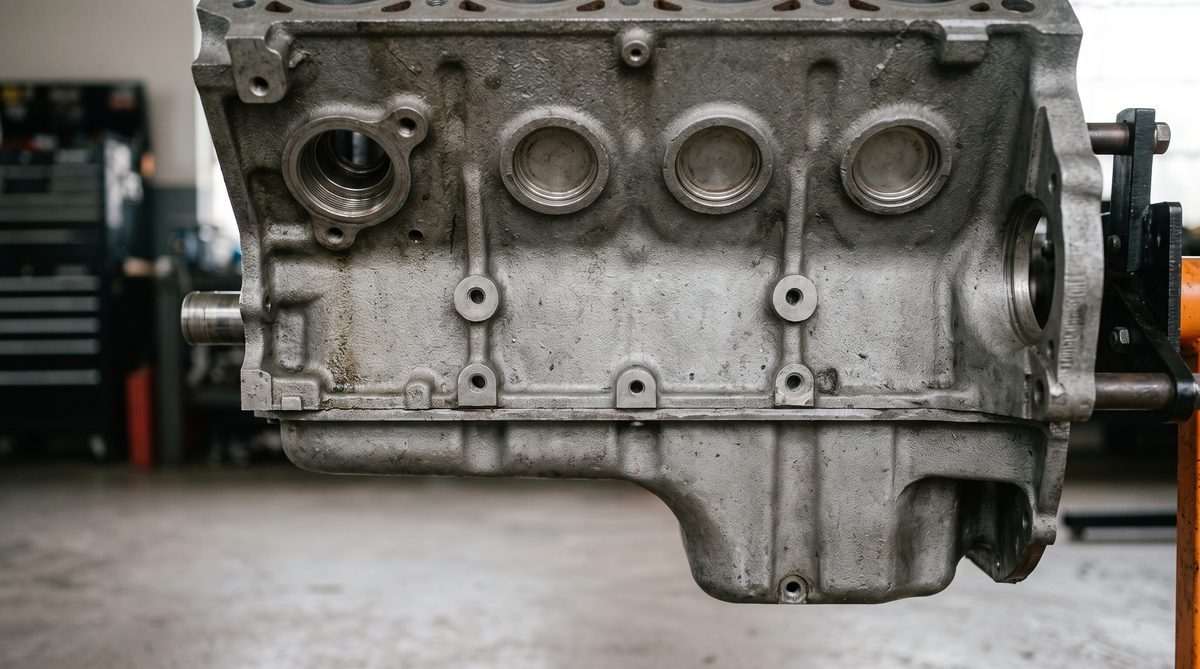
Ford engine casting numbers look wonderfully decisive when the block is sitting on a tire at a swap meet. Four characters, a dash, a suffix, and suddenly a seller is calling gray iron a 428 Cobra Jet or a Boss 302. The problem is that Ford cast engineering identity into parts, not a complete biography of the engine that finally reached a car. The number is evidence. It is almost never the verdict.
That distinction matters because Ford reused designs, mixed parts across car lines, sold service replacements, and built entire engine families whose displacements share external marks. A C6ME-A block can appear in current charts as both a 390 and a 428. Many FE blocks carry a large 352 mark no matter what crank and bore they actually received. The only honest method is to read the casting first, then make the rest of the iron agree.
A familiar Ford block number has a four-character prefix, a basic number, and a suffix. In C6ME-6015-A, C points to the 1960s, 6 points to a 1966 engineering release, M identifies the vehicle line that sponsored the design, E identifies engine engineering, 6015 is the familiar cylinder-block basic number, and A is the first design level. Our Ford part number decoder covers that grammar in full, including the crucial difference between an engineering number cast into a part and a service number printed on a parts box.
The trap is the second character. It dates the engineering release, not the day the foundry poured the individual block. Ford could keep a successful casting design in production for years, so a C6 prefix does not make every example a 1966 block. The separate casting date does that narrower job. Nor does the third character prove the engine came from that car line. It identifies the program that originated the part, and Ford moved useful parts wherever they fit.
A Ford casting number is a boundary around the possibilities, not a biography of the engine.
Location changes by engine family. Small-block Windsor numbers are commonly low on the block near the starter or above the oil-pan rail, where grime and installed hardware can hide them. Cleveland and Modified blocks also put useful marks low on the casting. FE numbers may appear on the passenger side near the front and oil-pan rail, but some 1968-72 FE blocks omit a useful side number altogether. The absence of a neat code is not proof that the block is wrong.
Clean with solvent and a nylon or brass brush rather than grinding the surface bright. Photograph the number straight on, then look for a shorter date code nearby. The common date format uses a year digit, a month letter, and one or two digits for the day. A code such as 7M20 reads December 20 in a year ending in 7, with the casting prefix and vehicle era settling the decade. A casting date later than the car's assembly date disqualifies the block as original. An earlier date only makes it possible.
Before chasing displacement, identify the family from architecture. A Windsor small block uses a separate timing cover carrying the water pump and routes coolant through the intake. A Cleveland puts the thermostat in the front of the block and uses a flat timing plate. The 351M and 400 resemble a Cleveland above the deck but use the larger 429 and 460 bellhousing pattern. The FE has a deep skirt and an intake manifold that extends under the valve covers. The 429 and 460 belong to the separate 385 series.
This is where physical evidence beats a copied chart. Deck height separates a 302 from a 351 Windsor even when heads and accessories have moved. Bellhousing pattern separates a 351 Cleveland from a 351M or 400. Main caps must be inspected before anyone promises a two-bolt or four-bolt block, because the same casting family can be machined more than one way. The block-level checks in our Windsor versus Cleveland guide exist for exactly this reason. Heads move. The bellhousing and deck do not.
Ford Performance's published engine dimensions show how decisive measurements become. A 302 uses a 4.000-inch bore and 3.000-inch stroke. A 351 Windsor keeps the 4.000-inch bore and stretches the stroke to 3.500 inches, with a 9.480-inch deck in 1969-70 and 9.503 inches from 1971. A 428 FE uses a 4.130-inch bore and 3.980-inch stroke. Those dimensions identify the rotating package in front of you. A prefix cannot.
The FE family is the cleanest proof that Ford engine casting numbers cannot always name displacement. The live number-one chart lists C6ME-A once as a 1966 390 and again as a 1966-70 428 police block. Another long-running FE reference notes that the same engineering number can cover a 390, 410, or 428. That is not necessarily a contradiction in the iron. It is a warning that the casting was shared while the bore, crank, machining, and application changed.
The large 352 cast into many FE blocks is even more famous and even less useful. It appears on engines larger than 352 cubic inches because that portion of the mold survived as the family evolved. To separate common FE combinations, measure. A 352 uses a 4.00-inch bore and 3.50-inch stroke. A 390 uses a 4.05-inch bore and 3.78-inch stroke. A 410 keeps the 4.05-inch bore and adds the 3.98-inch crank. A 428 combines a 4.13-inch bore with that 3.98-inch stroke.
That hierarchy comes alive in Omar Ramirez's garage comparison of a 390 and two 428 FE blocks. Ramirez checks engine-mount holes, casting dates, rear mold scratches, side ribs, water-jacket marks, crank identification, and finally stroke. He repeatedly warns that individual clues overlap. His most decisive installed-engine test is measuring piston travel through the spark-plug holes, because a seller is unlikely to remove heads and a pan for a driveway inspection. The video had nearly 78,000 views at our live pull and remains a useful demonstration of evidence stacking.
One explanation attached to Ford block identification needs a correction. The Ramirez video says a 1968 federal law required passenger-car partial VINs on the rear of the engine block. NHTSA's own history of Federal Motor Vehicle Safety Standard 115 says otherwise. The standard took effect January 1, 1969 and required a VIN permanently visible through the windshield near the left pillar. It did not require every engine to carry a partial VIN.
That does not make a partial VIN found on a Ford block fake. Ford stamped some engines before and after the rule for its own warranty and production purposes, with high-performance applications more likely to carry one. It means the federal-law story cannot be used to declare every unstamped 1968-up block a replacement. Ford stamping was not universal enough for absence to prove anything. This is the same proof limit behind our broader numbers-matching guide: a matching derivative can connect a block to a car, while a missing derivative may simply leave the question open.
Start with the family, then record the casting prefix, complete suffix, foundry marks, and separate date code. Check that the date is plausible for the claimed vehicle. Inspect the bellhousing pattern, deck height, core-plug arrangement, engine-mount bosses, and main caps. For an FE, treat every 352 mark, rear scratch, rib, and water-jacket numeral as supporting evidence rather than a verdict. Measure bore and stroke before paying for rare displacement.
Then separate engine identity from vehicle originality. A correct casting and date can support a period-correct engine. Only a credible partial VIN, original paperwork, or a documented chain can tie that block to one car. A service replacement may be perfectly valuable and mechanically correct without being factory-installed. The Mustang hub gathers the model-specific verification pieces, but this order of operations works on any Ford: architecture first, casting second, measurements third, vehicle evidence last.
Sources checked for this guide include Ford Performance's engine and block specifications, NHTSA's official history of VIN rules, current EngineLabs and FE casting charts, and Omar Ramirez's filmed 428 comparison. The cover is a representative in-house illustration of an FE-style block side, not a photograph of a specific numbered casting or claimed original engine.
Read the four-character prefix as decade, engineering year, vehicle program, and engineering group. Then read the basic number and revision suffix. Use the separate casting date for the individual pour date. The prefix dates the design release, not necessarily the block in front of you.
The location varies by family. Windsor, Cleveland, and Modified blocks commonly carry useful numbers low near the starter or oil-pan rail. FE numbers may sit on the passenger side near the front, although some blocks lack a useful side number. Clean gently and inspect before assuming a mark is absent.
Sometimes it narrows displacement, but it is not universal proof. Ford reused castings and FE blocks can share numbers across 390, 410, and 428 applications. Identify the family, then measure bore and stroke and inspect the crank and machining. Those physical facts settle combinations that a chart leaves open.
No. Ford's partial VIN stamping was selective and inconsistent, especially outside high-performance applications. The federal VIN rule that took effect in 1969 concerned a vehicle VIN visible through the windshield, not mandatory stamping on every engine. A matching stamp is strong evidence, but an absent one may be inconclusive.
The muscle world, every morning. Auctions, builds, reveals. Free.