Oldsmobile Engine Casting Numbers: Read the Whole Block
A raised number can identify the iron, but the casting date, engine-unit stamp and VIN derivative are what turn an Oldsmobile block into evidence.
A raised number can identify the iron, but the casting date, engine-unit stamp and VIN derivative are what turn an Oldsmobile block into evidence.
Oldsmobile engine casting numbers look like the shortest route from a grimy V8 to an exact year, displacement and application. They are not. The large raised number identifies a block casting, while a nearby figure or letter identifies a family. A casting date says when the raw block was made. A stamped engine-unit number records an assembly sequence, and a partial VIN can connect the finished engine to one car. Treat those marks as interchangeable and a perfectly readable block can still produce the wrong answer. Read them as a stack of evidence and the same block begins to tell a defensible story.
That distinction matters because Oldsmobile reused castings, changed identification practices and built several displacements around two closely related V8 architectures. Decades of rebuilds add another complication. Cranks, heads, intake manifolds, oil filler tubes and even complete short blocks move between cars. The method below starts with the iron itself, then adds the marks that narrow production date and vehicle identity. It also corrects a specific error in the identification chart currently leading this search.
On the familiar 1968-and-later Oldsmobile small-block, begin at the top front of the block around the timing-cover area, just behind the water pump and near the oil filler tube. Clean only enough grime to expose the raised characters. A typical 350 presents a large figure 2 with the raised part number 395558. Photograph the full area before chasing individual digits. Rust, thick paint and accessories can hide a leading digit or make one casting boss look like part of the number.
Do not confuse those raised characters with a stamp made after machining. Cast marks stand proud of the surface because they were formed with the block. Stamped marks are impressed into a machined pad or component later. On later Oldsmobile blocks, especially the lightweight castings introduced for 1977, displacement markings also appear prominently on the side of the block above the center core plug. Location and style therefore matter as much as the characters you copy.
A block casting could remain in production across more than one model year. The number tells you which casting family the foundry produced, not the day the engine entered a car. That is why published ranges for the same number can disagree. The 395558 block is a useful example: different enthusiast references give different end years, while the factory 1971 engine assembly manual establishes one fact beyond argument. Oldsmobile used casting 395558 with identification figure 2 for a production 350 cylinder block in 1971.
The organic result currently ranking first contains a consequential transcription problem. Its table pairs figure 2 and a 350 with casting 381917 in one row, even though the same table also assigns 381917 to a figure-1 330. The factory 1971 table instead pairs figure 2 with 395558. The responsible correction is not to invent a new all-years production range. It is to use the factory document to prove 1971, then use the casting date and VIN derivative to narrow the individual block.
A casting number identifies the iron Oldsmobile poured. It does not identify every part later bolted inside it.
First, record the raised casting number and the large family figure or letter near it. Second, find the cast date, commonly recorded near the distributor on these engines. Oldsmobile references describe that date as a Julian day of the year, so a three-digit value needs the rest of the evidence before anyone assigns a calendar year. Photograph the characters under angled light rather than sanding them flat. The surface texture and original paint edges can become useful evidence later.
Third, inspect the oil filler tube. Oldsmobile's 1970 service information says the V8 engine-unit number was stamped on that tube, with an engine-code tape placed above it. It describes the complete engine number as the code followed by the seven-digit unit number. The tube is removable, however, and the tape is often missing or reproduced. Both can support an identification, but neither should overrule the block.
Fourth, inspect the machined VIN pad. For 1968-and-later engines, the partial VIN is normally stamped at the front of the block on the driver's side, below the cylinder head. Its division digit, model-year digit, assembly-plant letter and six-digit sequence should agree with the car. Our Oldsmobile VIN decoder explains what the vehicle VIN itself can prove. Fifth, compare the casting date with the car's build evidence. The sequence should be plausible, not merely numerically similar.
A blank pad needs context. It may indicate a service-replacement block, a damaged or decked surface, or an engine from before the partial-VIN practice. Conversely, a visible matching sequence is not an automatic verdict. Compare font, depth, alignment, pad finish and the surrounding dates. The broader numbers-matching guide explains why one convincing stamp cannot authenticate an entire drivetrain.
Oldsmobile's 260, 307, 330, 350 and 403 belong to the small-block family, while the 400, 425 and 455 belong to the big-block family. On many pre-1977 engines, the large raised family character is a fast first sort: numbers are associated with small-block castings and letters with big-block castings. It is a useful clue, not permission to stop. A figure 2 points toward the 350 family, and an F is associated with a 455 block, but production details and transplanted internal parts still require corroboration.
Do not identify an Oldsmobile 350 as a Chevrolet 350 simply because both displace 350 cubic inches. They are unrelated engine families with different blocks, heads, oiling details and accessory arrangements. The Oldsmobile front oil filler tube and Oldsmobile-specific raised casting marks are better starting points than orange paint or a seller's description. Paint can be stripped and reapplied in an afternoon; foundry marks are part of the block.
The same caution applies within the Oldsmobile family. A 425 and a 455 share the same nominal bore, with displacement changing through stroke and the rotating assembly. A bare casting can therefore identify the block family without proving what crankshaft is now inside. If the pan is off, measure bore and stroke. If it is not, record the block, heads, intake and stamped identifiers and describe the conclusion at the confidence level the evidence supports.
If you uncover 395558 beside a large figure 2, you have strong evidence for an Oldsmobile 350-family block. You also have direct factory documentation that this combination was used in 1971 production. You do not yet have proof that the engine was born in a 1971 car, that it retains its original internals, or that it belongs to the vehicle around it. Those are separate claims with separate evidence.
Next, record the cast date and partial VIN without cleaning away the machining marks. Decode the year and assembly plant in the derivative, then compare its final six digits with the vehicle VIN. Check whether the dates precede the car's assembly in a sensible order. Finally, inventory the cylinder-head codes, intake casting, carburetor number and distributor number. Agreement across independent components is far more persuasive than any single magic number.
A 455 casting does not prove a 442, and it certainly does not prove a W-30. Start with the vehicle, using its VIN and the year-specific rules summarized on the Olds 442 hub. Then ask whether the engine's partial VIN matches that car. Only after those two steps should you compare the application-sensitive pieces: block date and family, cylinder heads, intake, carburetor, distributor, exhaust manifolds and supporting paperwork.
High-value claims deserve this layered standard. The W-30 identification guide covers the package-specific evidence and the traps created by easily swapped components. A correct casting is necessary for many restorations, but it is rarely sufficient. Write down what each mark proves, what it merely supports and what remains unknown. That discipline protects buyers from paying for a story and protects honest sellers from making a claim their photographs cannot sustain.
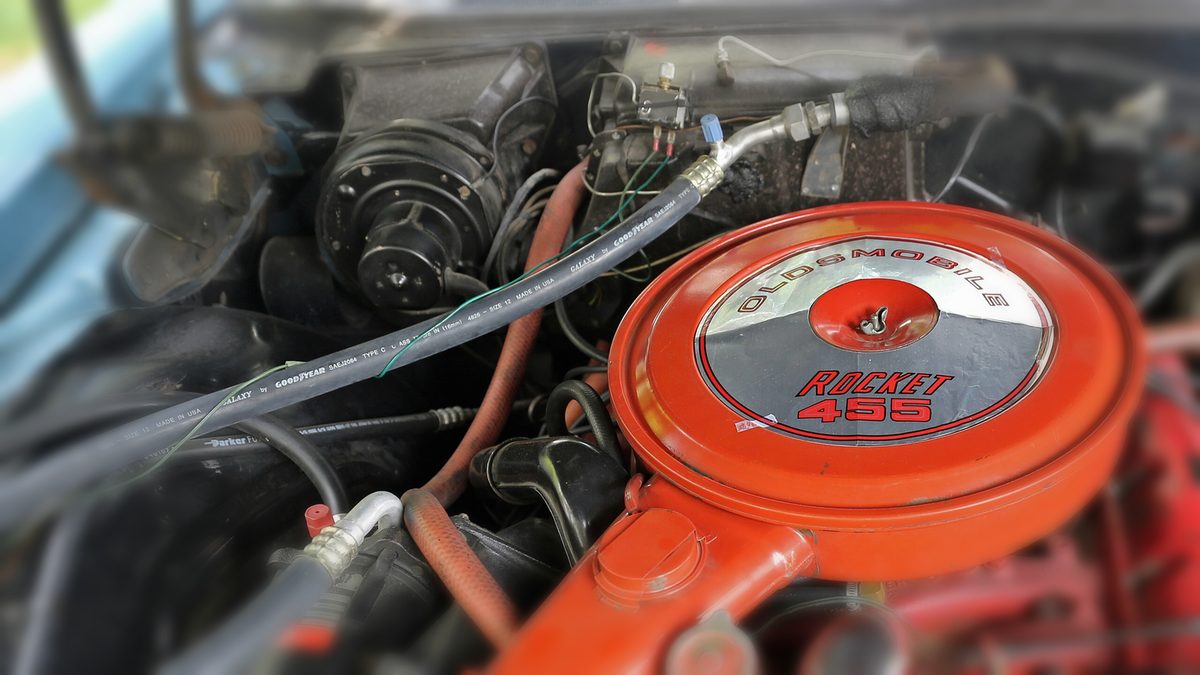
Sources and image credit: Big Block Magazine consulted Oldsmobile Division's 1970 service information, its 1971 Engine Assembly Manual and the current Olds FAQ block chart. Cover photograph: 1968 Oldsmobile Rocket 455 by Mr.choppers via Wikimedia Commons, cropped, blurred outside the focal plane and color-graded by Big Block Magazine under CC BY-SA 3.0.
On many 1968-and-later Oldsmobile small-blocks, look at the top front of the block around the timing-cover area, behind the water pump and near the oil filler tube. Later lightweight blocks can also carry a large displacement mark on the side above the center core plug. Record location and characters together.
They are different engine families despite sharing a displacement. Look for Oldsmobile's front oil filler tube, Oldsmobile-specific block shape and the raised family figure and casting number at the front timing area. Do not rely on paint, valve-cover decals or the seller's description, since all three are easily changed.
Paired with a large figure 2, casting 395558 identifies an Oldsmobile 350-family block. A factory 1971 manual confirms that exact combination for 1971 production. It does not by itself prove the individual block's model year or original car. Use its cast date and partial VIN to make those narrower claims.
No. A casting can establish that the block family is compatible with a W-30 application, but the package requires vehicle identity, a matching partial VIN, plausible dates and application-correct heads, intake, carburetor, distributor and exhaust. Original paperwork and known history provide additional support when the mechanical evidence agrees.
The muscle world, every morning. Auctions, builds, reveals. Free.