Oldsmobile VIN Decoder: The One Year It Can Prove a 4-4-2
Thirteen digits settle the 4-4-2 question for exactly four model years, and the chart ranking third for this search leaves the car out of its tables altogether.
Thirteen digits settle the 4-4-2 question for exactly four model years, and the chart ranking third for this search leaves the car out of its tables altogether.
There is a moment in every Oldsmobile deal where the conversation stops being about paint and starts being about paperwork. The seller says it is a real 4-4-2. You walk to the driver's side, look down through the base of the windshield at the little stainless plate riveted to the dash, and read thirteen characters. What happens next depends entirely on which year is stamped in the middle of them.
Those thirteen characters answer the question completely for four model years. For every other year Oldsmobile put a 4-4-2 badge on a car, they do not answer it at all. None of the charts ranking for this search tell you which years are which. The one sitting third on the page is worse than unhelpful: it cannot decode a 1970 4-4-2 at all, because the car is missing from its tables.
From 1965 through 1971 Oldsmobile used the standard thirteen character General Motors format, and every character has exactly one job. The first is the division, and for Oldsmobile it is always 3. Characters two and three are the series, which is the closest thing the VIN has to a model name. Characters four and five are the body style. The sixth is the model year, running 5 for 1965 up to 1 for 1971. The seventh is the assembly plant letter. The last six are the sequence number, which is just the order the body came down the line.
Work a real one. Take 344870M194672, a 1970 car. The 3 is Oldsmobile. The 44 is the series. The 87 is the body style. The 0 is 1970. The M is Lansing, Michigan. The remaining six digits are sequence. Only two of those fields tell a buyer anything worth money, and they are the series and the body style. Everything else is bookkeeping.
For 1968 through 1971, and for those four years only, the 4-4-2 was a model in its own right rather than an option box. It got its own series, the 4400 series, so the VIN opens 344. After that the body style follows: 67 for the convertible, 77 for the pillared Sports Coupe, and 87 for the Holiday hardtop coupe. A 1970 4-4-2 hardtop therefore starts 34487, and cars listed publicly on Classic.com include 344870M209095, 344870E138294, 344870M129948 and 344870M206001 sitting there in plain sight.
Now open the PDF that Google currently ranks third for this exact search, titled Oldsmobile VIN Decoder 1965-1972 and hosted by the parts seller Rubber The Right Way. Its series list for 1965 to 1971 runs 31, 32, 33, 34, 35, 36, 38, 42, 48, 52, 54, 56, 58, 64, 66, 84, 86, 94 and 96. It never reaches 44. Its body style list runs 07, 17, 27, 35, 36, 37, 39, 55, 56, 57, 65, 66, 67 and 77. It never reaches 87. Feed it any of those four real cars and it fails on the second character and again on the fourth. The single most searched classic Oldsmobile is simply absent from the chart.
The same page also assigns code 77 to two different bodies on consecutive lines, calling it a Holiday coupe once and a Club coupe the next time. On a 4-4-2 that distinction is money. 77 is the pillared Sports Coupe and 87 is the Holiday hardtop, and the hardtop is the one collectors pay for. A chart that cannot keep 77 straight across two adjacent lines is not a chart you should be authenticating a car with.
Here is the trap that costs people real cars, and nothing on the first page of results mentions it. On 1968 and 1969 cars the VIN and the Fisher body tag on the cowl can legitimately disagree. Oldsmobile built 4-4-2s on ordinary Cutlass bodyshells, so a car carrying a correct 344 VIN frequently left the plant with a 336 body plate. Lansing cars in particular did this as a matter of routine.
A buyer who has been told to check the cowl tag reads 336, decides the car is a dressed up Cutlass, and walks away from a real one. A seller in the same position assumes the car has been faked and prices it accordingly. Both are wrong. The body tag records the shell. The VIN records the car the dealer actually ordered and paid for, which is precisely why Oldsmobile could not be loose with it, and it is the VIN that governs.
The body tag and the VIN can disagree on a factory 4-4-2, and it is the VIN that counts.
For 1972 General Motors rebuilt the whole thirteen character scheme and Oldsmobile moved with it. The 3 stays. The second character becomes a series letter rather than two digits, with D and F for the F-85, G for the Cutlass, J for the Cutlass Supreme and K for the Vista Cruiser. Characters three and four are the body style. The fifth character is brand new and it is the engine. The sixth is the year, the seventh the plant, and the last six the sequence.
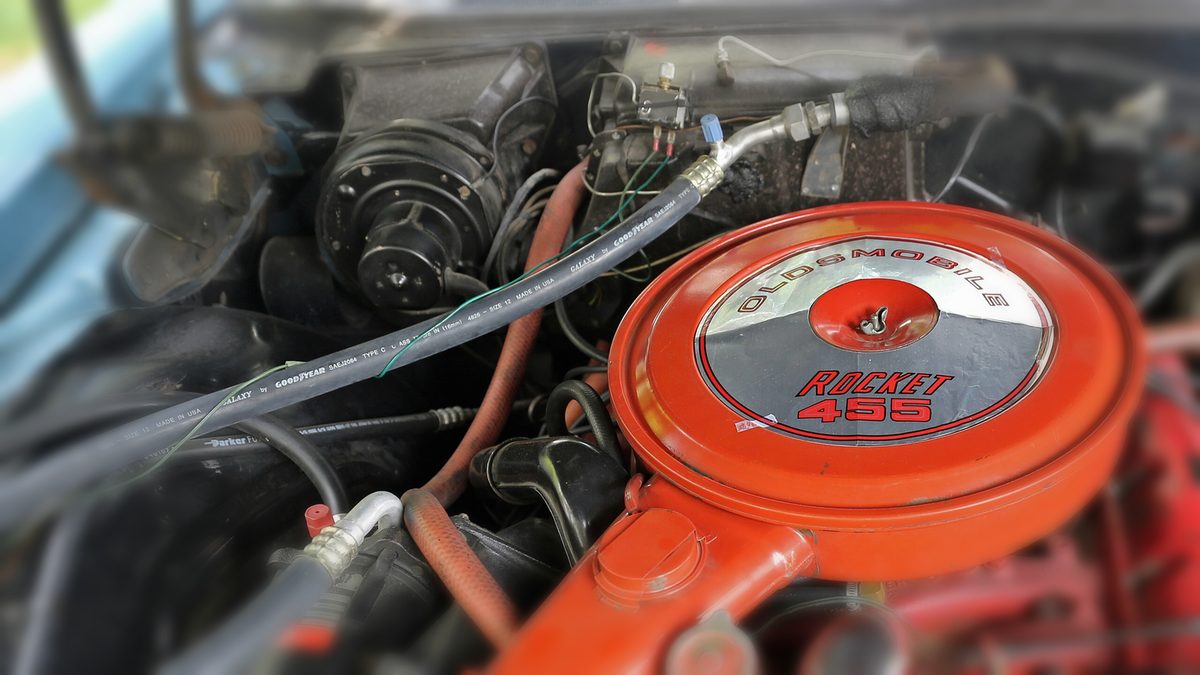
That fifth character is a genuine gain. For the first time an Oldsmobile VIN states what was bolted between the fenders, with H, J, K and M covering the various 350s and U, V and X covering the 455. The loss arrived in the same stroke. For 1972 the 4-4-2 stopped being a model again and went back to being an option, order code W-29, available on the Cutlass and Cutlass Supreme. The series field can no longer say 4-4-2 because there is no longer a 4-4-2 series to say. This is the same 1972 hinge that catches Pontiac buyers out, and anyone who has read our Pontiac VIN decoder will recognise the shape of it straight away.
There is one exception, and it is a good one. In 1972 the engine code X denotes the 455 in W-30 tune, rated 300 horsepower on the new SAE net standard. The W-30 could not be ordered on its own. It came with the 4-4-2 package underneath it, which means an X in the fifth position proves the engine and the 4-4-2 at the same time. It is the only combination in the model's entire run where the VIN alone settles the argument, and it exists purely by accident of the order sheet.
The catch is scale. Oldsmobile built 772 W-30 cars for 1972 against 9,845 cars carrying the W-29 4-4-2 package, made up of 8,674 hardtop coupes and 1,171 convertibles. So the VIN closes the case on roughly one 1972 4-4-2 in thirteen and has nothing whatsoever to say about the other twelve. If the fifth character is anything other than X, the thirteen digits on your dash cannot confirm or deny a 4-4-2, and anybody telling you otherwise is guessing. There is more on the package itself in our piece on the W-30 and what it actually bought you.
Put the two eras side by side and the inversion is almost funny. From 1968 to 1971 the VIN proves the model and is completely blind to the engine, because those years carry no engine code at all, so a genuine W-30 and a base 4-4-2 read identically. In 1972 the VIN can prove the engine but has lost the ability to prove the model. Oldsmobile never once gave you both in the same year.
A Hurst/Olds is invisible to the VIN in every year it was built, because those cars were finished outside the Oldsmobile assembly process and nothing in the thirteen characters records it, a quirk we went into at length in our look at the Hurst/Olds loophole. Colour, interior, transmission, axle ratio and every W-code option are equally absent.
Be careful with the plant letter too. That same third place chart lists K and X together as Kansas City, Kansas. They are two different plants in two different states: K is Leeds, on the Missouri side of Kansas City, and X is Fairfax, on the Kansas side. The same list also mixes single VIN letters with three character Fisher body codes such as FRA, LAN and BF, which cannot possibly occupy a field that is one character wide. Somebody merged a VIN table and a body tag table and never noticed.
What does settle a car is documentation: the build sheet, the Protect-O-Plate, the window sticker, the dealer invoice, and the engine serial stamped on the pad below the driver's side head, which should track the VIN sequence. That is the honest answer, and it is the same one we reach every time we work through the 4-4-2 story. The VIN is where authentication starts. It is almost never where it finishes.
Read it by position. On 1965 to 1971 cars, character one is the division, two and three are the series, four and five are the body style, six is the model year, seven is the assembly plant and the last six are sequence. From 1972 the second character becomes a series letter and the fifth character becomes an engine code, which the earlier years do not carry at all.
A factory 4-4-2 built between 1968 and 1971 starts with 344, where 3 is Oldsmobile and 44 is the 4400 series. The next two characters give the body: 67 convertible, 77 pillared Sports Coupe, 87 Holiday hardtop coupe. Those four model years are the only ones in which a 4-4-2 carries its own unique VIN series.
Only if the fifth character is X. That code is the W-30 455, and the W-30 always included the 4-4-2 package, so it proves both at once. For 1972 the 4-4-2 was otherwise the W-29 option on a Cutlass, and a VIN does not record options, so any other engine letter leaves the question wide open.
On 1968 and later cars it sits on a plate at the driver's side top of the dash, readable from outside through the base of the windshield. On 1965 to 1967 cars look instead at the left front door hinge pillar, where the plate is only visible with the door open. Cars from both eras also carry a separate Fisher body tag on the cowl.
The muscle world, every morning. Auctions, builds, reveals. Free.