The Buick VIN Decoder That Admits What It Cannot Prove
Every Buick chart online prints the same flat table, and not one of them tells you the model year where it quits.
Every Buick chart online prints the same flat table, and not one of them tells you the model year where it quits.
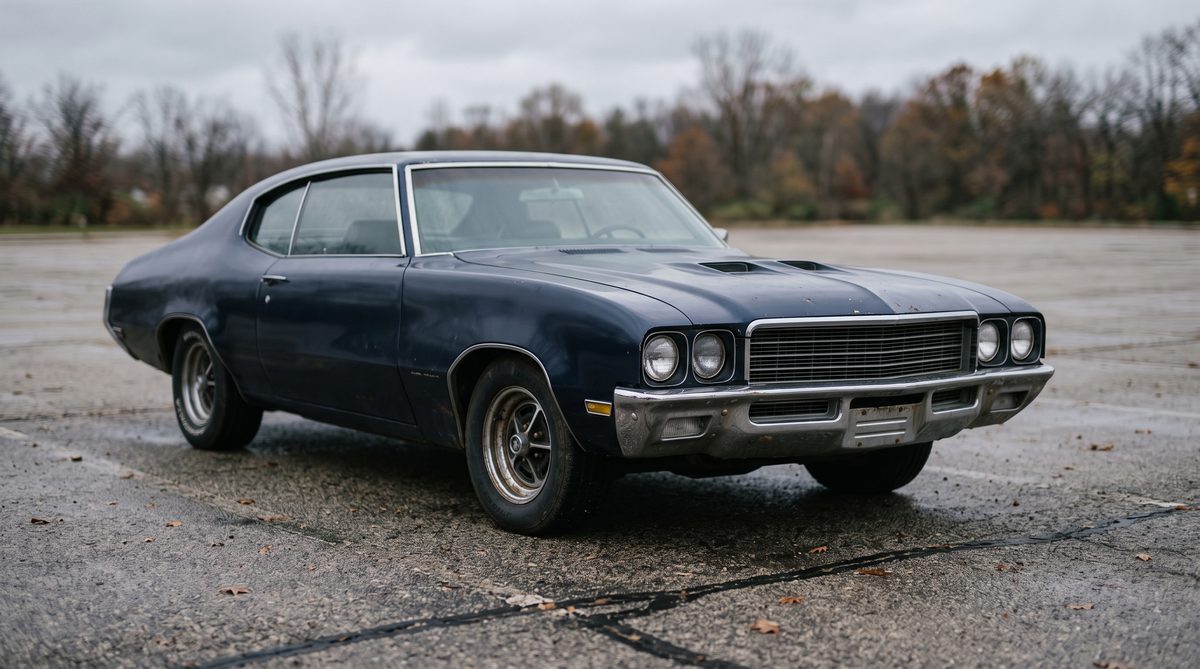
Type a 1970 Buick's thirteen characters into any free Buick VIN decoder on page one and you get an error, a blank box, or a request for four more digits. The tool is not broken. The Buick VIN went to seventeen characters in 1981, and nearly every decoder online was built for the cars that came after. The classic charts that do exist were typed up by hobbyists years ago, and line three of them up and they disagree.
So this is the version that tells you where the number stops working. What those thirteen characters carry, which model year changes the layout underneath you, and the point where the VIN can no longer answer the question you are actually asking.
Buick used a thirteen character VIN from 1965 through 1980, on a small stainless plate at the driver's side of the dash top, read through the windshield. Thirteen characters is the whole story. No check digit, no world manufacturer code, and no room for the equipment lists modern lookups spit out.
That single fact explains the search result you just came from. The federal decoder near the top of the page states plainly that it covers model year 1981 and forward, because that is when the seventeen character standard became mandatory. The commercial VIN report sites promising factory specs and engine details run on the same 1981 floor. Feed any of them a Skylark, a Gran Sport or a Riviera and they have nothing to give back.
What the classic number does carry is division, series, body style, model year, assembly plant and a build sequence. From 1972 it adds one more field, and that year matters more than any other in this system.
For the first stretch, the layout runs like this. Position one is the division, and Buick is always 4. Positions two and three are the series. Positions four and five are the body style. Position six is the model year. Position seven is the assembly plant. The last six digits are the sequential build number, and they are the closest thing the car has to a fingerprint.
The model year digit is the easiest to read: 5 for 1965 through 9 for 1969, then 0 for 1970 and 1 for 1971. The series digits are where the interesting cars live. 34 covers the Special, the Special Deluxe, the Skylark and the GS 350 with a V8. 43 and 44 cover the Skylark. 46 is the one people hunt, the Gran Sport series carrying the GS 400 and the GS 455. 94 is the Riviera.
Body style follows the usual GM pattern. 37 is the two door hardtop coupe, 67 is the convertible, 27 is the two door post coupe, and the sedans and wagons fill in the rest. Put it together and a 1970 GS 455 hardtop begins 44637, which reads as division 4, series 46, body 37. The same car as a convertible begins 44667. Our own decoder tool carries the GM tables if you want to work through your plate alongside this.
Plant letters on a Gran Sport are H for Flint, G for Framingham, Z for Fremont and X for Fairfax. Across the wider range you also get B for Baltimore, C for South Gate, D for Atlanta and V for Pontiac, Michigan.
In 1972 the layout shifted, and it is the most useful thing to know about this system. Position two became a series letter: D is Skylark, F is Sportwagon, G is Gran Sport, H is Skylark Custom. Positions three and four became the body style. Position five became an engine code. Six is still the year, seven the plant, and the last six the sequence.
Read a real one and it clicks. A 1972 Gran Sport hardtop with the Stage 1 engine starts 4G37V2: Buick, Gran Sport, two door hardtop, 455 Stage 1, 1972. Add the plant and you get 4G37V2H for Flint, 4G37V2G for Framingham, 4G37V2Z for Fremont. That year's engine letters run H for the 350 two barrel, J and K for the 350 four barrel, U for the 455 four barrel and V for the Stage 1.
That arrangement carried through the rest of the thirteen character era, so a 1973 through 1980 Buick reads the same way. The consequence is blunt. If your car is a 1971 or earlier, the VIN contains no engine information at all. Every position is spoken for by something else.
Line the popular classic Buick charts up and they contradict each other. One widely circulated PDF, the one that keeps surfacing on the first page and gets republished on document sites, puts the 1972 engine code at position five with body style at three and four. Another well ranked classic GM decoder puts the engine code at position three and pushes body style out to four and five. They cannot both be right, and real VINs settle it: 4G37V2H and 4G37K2H are documented 1972 Buicks, and the engine letter is unmistakably the fifth character. Work from the second chart and you will read a body style digit as your engine.
The plant letters have their own problem. That same PDF lists letter C as South Gate, California in its 1965 to 1971 table and as South Gate, Michigan in its 1972 table, two paragraphs apart on the same page. South Gate is in California and always was. The same chart gives V as Bloomfield, Illinois, a plant GM never had. V is Pontiac Central Assembly in Pontiac, Michigan.
None of this is an argument against those charts. They are the only classic Buick tables anyone bothered to publish. It is an argument for checking any single character against a second source before you write a cheque, the same discipline we apply in what numbers matching actually means.
For 1971 and earlier, the Buick VIN has no engine code at all. Every position is spoken for by something else.
This is where most Buick VIN questions really start. Somebody is looking at a Gran Sport and wants to know whether the Stage 1 badge was earned in Flint or added in a driveway. For 1970 and 1971 the VIN cannot tell you, and no chart changes that. Stage 1 was an option box on a GS 455, not a separate series, and option codes never lived in the classic GM VIN.
The GSX is the same story wearing brighter paint. It was a package layered onto the GS 455, so a 1970 GSX and a plain GS 455 hardtop start with identical VIN characters. Saturn Yellow paint and a rear spoiler are not proof of anything a VIN can confirm, which is why the market pays for documentation on those cars. We walk the full hardware check in how to tell a real Stage 1 from a story.
Then 1972 arrives and quietly solves it. Because that year put the engine in position five, a V in the fifth character proves the car left the factory with the 455 Stage 1. It is the one Gran Sport year where the VIN alone answers the question, which makes 1972 cars far easier to verify than the more valuable 1970s. Registry figures put 728 Stage 1 hardtops in 1972, split across Flint, Framingham and Fremont, so the plant letter is worth reading too.
When the VIN runs out, the engine takes over. Buick stamped two separate things on its V8s and people mix them up constantly. There is an engine serial number, which ties the engine to the car, and a two letter production code, which says what the engine is. On the 400, 430 and 455 from 1968 on, the serial sits between the two front spark plugs and the left exhaust manifold, and the production code sits between the two rear plugs and that same manifold. On the 350 through 1971, the serial is on the front of the left cylinder bank and the code is between the left manifold and the two front plugs.
That production code settles arguments. A 1972 Stage 1 carries WS. The standard 455 four barrel that year is WF, and the 350s run the W codes below them. Read the code, then the transmission, then the paperwork, in that order. A build sheet or the original invoice closes the loop, and the wider GM option system behind it is laid out in our guide to GM RPO codes.
The body plate on the cowl adds body style, paint, trim and build date, useful for confirming colour and timing but silent on your engine. Together the VIN, the block codes and the paper give you a complete answer. Alone, on a pre 1972 car, the VIN gives you a series and a promise.
Read it as thirteen characters. Position one is the division, and 4 means Buick. Positions two and three are the series, four and five are the body style, six is the model year, seven is the assembly plant and the last six are the build sequence. From 1972, position two becomes a series letter and position five becomes the engine code.
Because they were built for the seventeen character VIN that became mandatory in 1981. The federal decoder states outright that it covers model year 1981 and forward, and the commercial report sites work from the same floor. A 1965 to 1980 Buick carries thirteen characters, so those tools have no record to return.
Only for 1972 and later. That year Buick put an engine code in the fifth position, and a V there means the 455 Stage 1 left the factory in the car. On 1970 and 1971 cars, Stage 1 was an option on a GS 455 rather than a separate series, so the VIN takes you to Gran Sport and no further.
On a small stainless plate at the driver's side of the dash top, read through the windshield. A 1970 GS 455 hardtop begins 44637 and the convertible begins 44667. Check that against the body plate on the cowl and the engine codes on the block before treating any of it as settled.
The muscle world, every morning. Auctions, builds, reveals. Free.