Carburetor Identification: Find the Right Parts
The body gets you to the right family, the assembly number gets you to the right parts, and neither earns an originality premium by itself.
The body gets you to the right family, the assembly number gets you to the right parts, and neither earns an originality premium by itself.
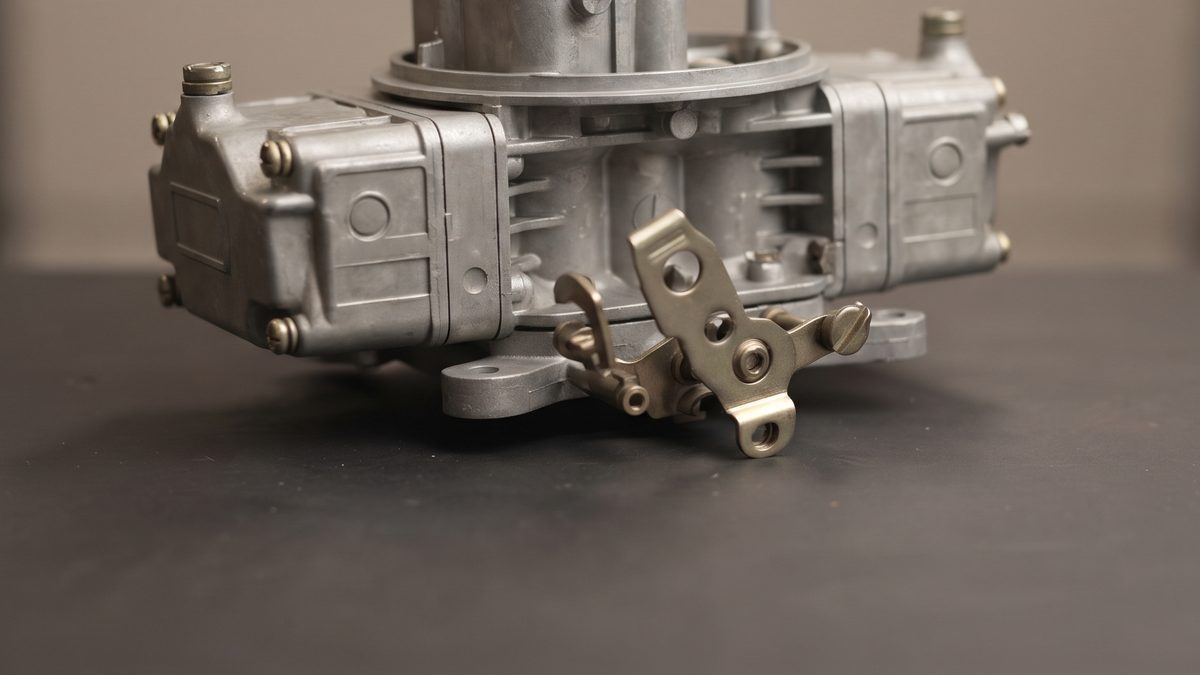
The swap-meet seller calls it a factory four-barrel. The air cleaner says something else. Underneath, the carburetor has a number nobody can find in a catalog. Carburetor identification starts by separating those three stories: what the casting looks like, what the complete assembly was built as, and what car the seller says it belongs on. Get them confused and you'll buy the wrong rebuild kit, or pay an original-equipment premium for a perfectly ordinary replacement. Start with the hardware. Let the paperwork catch up.
This is a guide to the carburetor on a classic American car, or loose on a workbench. It isn't a small-engine lookup, and the badge on the valve cover doesn't decide the answer.
Count the throttle bores, then look at the fuel-bowl arrangement. On a traditional Holley 4150 or 4160 four-barrel, separate bowls hang from the front and rear of a central body. An AFB-style Carter carries its fuel chambers within a broader body beneath the top casting. A Rochester Quadrajet has small primary bores and much larger secondaries, with an air valve above the secondary pair. Those are routes into a family, not final part numbers.
A spread-bore layout doesn't automatically mean Quadrajet. Carter's ThermoQuad is another spread-bore design. Nor does a Carter name automatically mean AFB. Carter manufactured Quadrajets for GM, too. Camaro Research Group's original carburetor photographs show the Carter manufacturing mark and the Quadrajet name on the same body. Read the architecture before assigning the family.
For a visual cross-check, Walker Products' identification drawings put Carter, Ford-Motorcraft, Holley and Rochester families alongside their tag and stamp locations. Compare the complete silhouette, linkage side and bowl arrangement. One familiar-looking choke housing isn't enough.
A raised number belongs to the casting. A shallow number struck into a machined surface may identify the carburetor assembly, but you still need to establish which numbering system you're reading. Dates, revision letters and component numbers can live close together. Photograph every line before deciding which one matters.
Early Quadrajets expose a problem with universal location charts. Mike's Carburetor Parts' general identification page describes Rochester tags under a bowl screw. Yet early Quadrajets used a round disc pressed into the side of the bowl. Looking only beneath screws can make an identifiable carburetor appear anonymous.
The year boundary isn't absolute either. The Carburetor Shop's Rochester page assigns the round-tag Quadrajet to 1965 through 1967. Its broader identification guide includes some early 1968 units, and Camaro Research Group photographs one. Later bodies carry a vertical roll stamp near the secondary throttle shaft. Treat 1968 as a transition to investigate, rather than a rule that disqualifies a round tag.
For a traditional Holley four-barrel, start at the choke tower. Holley's own list-number location sheet shows the 4150 and 4160 identification on the air-horn flange, while other Holley families put it elsewhere. Copy the complete identifier, including its revision suffix. A number molded into a bowl isn't a substitute for that assembly identity.
Once you've found it, use the Holley carburetor identification guide for list revisions, date codes and the limits of an application match. That is a separate job from recognizing a loose carburetor's family. A catalog number is a starting specification, not an inventory of everything a previous owner changed.
Carter requires a different search. Depending on the AFB version, identification may be on a tag, the flange edge or another body location. The Carburetor Shop's Carter research also documents tag-only AFB units. Don't condemn one simply because you can't find a second stamping. In Carter's traditional numbering system, the S denotes an assembly, and a following letter records an engineering change. S and SA aren't manual-versus-automatic transmission codes.
The right number gets you into the catalog. The hardware still has to agree with what the catalog says.
Ford-branded carburetors deserve their own stop in the inspection. Walker's drawings place a removable identification tag on the 2100 and 2150 two-barrels and on the 4300 and 4350 four-barrels. A familiar two-barrel shape can put you in the right neighborhood. It doesn't recover the exact application when that tag has disappeared.
Record the entire tag before removing anything, then compare the body and linkage with the corresponding parts listing. Don't shorten a Ford-style identifier to its year-looking prefix and call the job done. Photograph the choke arrangement, throttle lever, fuel inlet and vacuum connections as well. These give a supplier something to check when a tag is missing, damaged or attached to a carburetor assembled from several donors.
A shiny aluminum four-barrel described as a 600 is still only partly identified. Edelbrock's manufacturer tuning guide lists both the 1405 and 1406 at 600 CFM. Their factory primary calibrations differ: the 1405 has .100-inch jets and .070 by .047-inch rods; the 1406 has .098-inch jets and .075 by .047-inch rods. The listed step-up springs differ, too.
That is why appearance and airflow can't choose the tuning chart. Find the complete model identity and use its own baseline. On a used carburetor, opening it may reveal different jets, rods or springs from those in the book. Record what is actually installed before trying to correct a stumble with parts ordered for the seller's remembered description.
Keep fit separate from identity as well. Edelbrock lists adapters for putting its square-bore carburetors on Quadrajet and ThermoQuad spread-bore manifolds. Finding a carburetor bolted to a factory manifold therefore doesn't establish that it is the factory type. Look underneath for an adapter before drawing conclusions from the engine bay.
Ask the seller for four useful photographs: directly above, each side, and the underside if the carburetor is already off the engine. Add a close-up of every tag and stamped line. A glamorous air-cleaner photograph answers almost none of the questions that decide whether you can service the thing.
For a driver, the useful purchase is an identifiable, serviceable assembly with the correct connections for your installation. For a restoration, there is another layer: application, production date and agreement among the major components. As with numbers matching, a convincing identifier supports a specific claim. It doesn't establish the complete history of the car or the parts attached to it.
If identity remains uncertain, don't order by the car's year alone. Send the photographs and measurements to the kit supplier, who may need to compare the pump, needle and seat, and gasket patterns. Keep removed parts together until the replacements agree. Then decide whether rebuilding this assembly makes sense beside the alternatives in our carb versus EFI guide. A seller who can't document a rare application hasn't supplied a reason to pay for one.
Start with barrel count, bowl arrangement, linkage and choke layout to establish the family. Then check that family's other identification locations. Photograph the top, both sides and any surviving stamps. If the assembly number is gone, a specialist may need internal dimensions and gasket patterns before selecting parts.
Usually not. A raised casting number identifies a component casting, while an assembly identifier points to the complete carburetor's specification. Several assemblies can share castings. Use the manufacturer-specific tag or stamp for the lookup, and retain revision suffixes rather than searching only the largest or clearest number you can see.
No. Carter produced several carburetor families and also manufactured Quadrajets for GM. A Carter-built Quadrajet can carry Carter manufacturing lettering alongside its Quadrajet identity. Establish the physical family first, then read the assembly number. The maker's name alone doesn't select an AFB rebuild kit or establish the original application.
That can narrow the search, but it doesn't identify a carburetor that has been swapped or modified. Use the complete carburetor assembly number whenever possible, then confirm the kit against the hardware present. Without a reliable number, send photographs and measurements to the supplier before ordering by vehicle application alone.
The muscle world, every morning. Auctions, builds, reveals. Free.