Ford C6 Identification: Read the Case Before the Code
The 17-bolt pan confirms the family, but the bellhousing, service tag, date clues, and vehicle paperwork decide whether a C6 actually belongs in your Ford.
The 17-bolt pan confirms the family, but the bellhousing, service tag, date clues, and vehicle paperwork decide whether a C6 actually belongs in your Ford.

Ford C6 identification is easy until somebody asks what the transmission came from. Seventeen pan bolts and an integral bellhousing can confirm that the greasy aluminum case on the floor is a C6. They cannot tell you its model year, original engine family, internal calibration, or whether it belongs to the car beside it. That second job takes the bell pattern, the metal service tag, the assembly date, and sometimes the partial VIN. Read those clues in the wrong order and a genuine C6 can still become a very expensive wrong part.
Ford introduced the heavy-duty three-speed automatic for 1966, when the company needed a lighter replacement for its earlier iron units behind high-torque engines such as the 390 and 428. The C6 then spread through Ford, Mercury and Lincoln cars, trucks, Broncos, vans and industrial equipment. That long life is why a bare case can look familiar and still be completely wrong for a muscle-era application.
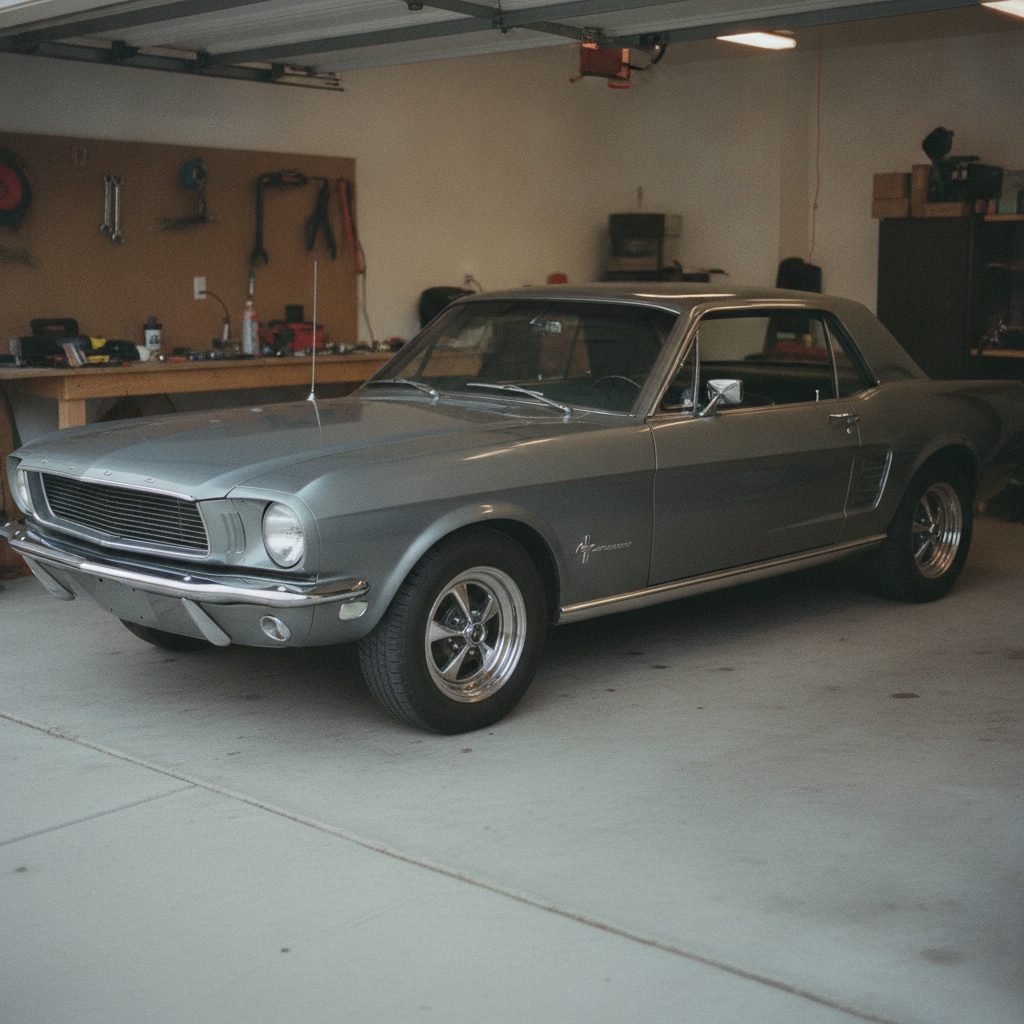
Lead image: a Grabber Green 1970 Ford Torino Cobra photographed by MercurySable99, used under CC BY-SA 4.0. The Torino Cobra is a representative period C6 application. The photograph does not document the transmission fitted to this specific car.
Get under the unit and count every fastener around the fluid pan. A C6 uses 17 bolts. Its broad pan is almost rectangular, but the passenger-side rear edge takes a distinctive inward step. Just above that area on the case sits the round vacuum modulator. Together, the bolt count, stepped outline, and modulator position make a much stronger visual fingerprint than any one feature alone.
The integral converter housing is the second fast check. Ford cast the bellhousing and main case as one aluminum piece. The company's own service description says the converter housing and the fixed low-reverse clutch splines are cast integrally into the case. A C4 has a detachable bellhousing, while an FMX combines a separate aluminum bell with an iron main case. That distinction keeps a lot of small automatics from being advertised as C6 units.
Do not stop at the pan. A later E4OD is a much larger four-speed overdrive relative built from C6 architecture, with a 20-bolt pan and electronic controls. An AOD uses 14 pan bolts. Oil pans can also be replaced, dented, or fitted with aftermarket drain plugs, so a drain plug is not an identity test. Use the pan to name the family, then move to the part of the case that cannot be swapped.
The bellhousing pattern matters because it is permanent. Unlike a C4, the C6 cannot accept a different bolt-on bell. Ford made distinct cases for distinct engine families, and a transmission that bolts to an FE big block will not suddenly fit a 429 just because both engines are called big blocks.
Most classic-car shoppers will meet three patterns. The small-block pattern served the 289, 302, 351 Windsor, 351 Cleveland and 300 inline-six family. The FE pattern served engines such as the 390, 427 and 428. The 385-series pattern served the 429 and 460, and also the related 351M and 400. A rare early MEL pattern and a later diesel pattern exist too. Neither should be treated as interchangeable with the common gasoline cases.
This is the same family problem covered in our Windsor versus Cleveland guide. Ford moved cylinder-head ideas across families, but the bell pattern still reads the block. Compare the top bolt spacing, starter pocket, dowel locations and lower contour with the engine or a known separator plate. The bell pattern tells you what engine family the case fits. It still does not name the donor car.
Once the case passes the visual test, look on the passenger side at the intermediate servo cover. Ford attached the thin metal identification tag beneath the lower front servo-cover bolt. It is easy to lose during fifty years of rebuilds, cleaning and repainting, which explains why so many used C6 listings begin with no tag at all.
A period Ford service manual explains the hierarchy. The first line gives the transmission model prefix and suffix. A number added after that suffix marks an internal production change, because service parts can differ even when the base model code remains the same. The remaining fields identify the service assembly and build date. That is the information a parts supplier needs before selling a rebuild kit, valve-body piece, servo or hard part.
The pan tells you it is a C6. The tag tells you which C6 Ford assembled. Neither clue, by itself, proves the transmission belongs to the car.
Do not decode only the first four characters as though every raised number were the answer. Our Ford part number decoder explains the difference between engineering prefixes, basic part numbers, suffixes and service numbers. On the C6 tag, the whole model code and revision matter. Photograph both lines before cleaning, then decode against a Ford Master Parts Catalog or a year-specific application table.
Raised characters on the aluminum case identify castings and engineering releases. A prefix such as C8AP can place the design in the 1960s Ford numbering system, but it does not mean the complete transmission was assembled in 1968, installed in a specific model, or filled with one particular set of internal parts. Cases remained in service after their first engineering release, and rebuilders have mixed cases, pumps, drums, servos and tailhousings for decades.
A true assembly date is a separate clue. Ford tag dates commonly use a year digit, a month letter, a day number and sometimes a shift character. The decade has to come from context, because the year digit repeats every ten years. A casting date that falls after the vehicle's scheduled build can disqualify originality. A plausible earlier date only says the timeline works. It cannot prove the unit was born in that car.
Tailhousings and outputs complicate the picture further. Passenger cars, trucks, four-wheel-drive applications and industrial equipment used different extension housings, output shafts, yokes, mounts and linkage. Those pieces can be changed. Treat them as configuration clues and shopping measurements, not as the identity of the main case. Record overall length from the bell face, output-spline count, mount position, speedometer-drive location and shifter style before buying anything.
The car's door plate or certification label can confirm which transmission type Ford scheduled for that vehicle, but only when the correct model-year chart is beside it. This is where the web's flat lookup tables create another trap. They print one letter next to C6 and quietly erase the date range.
Ford's own 1970 to 1971 Shop Tips code chart assigns U to the regular C6 and Z to the special or police C6 in those passenger-car years. Later Ford service literature uses K for the C6 in some 1988 applications. The transmission did not change identity. The vehicle-label vocabulary changed. A year-blind chart can therefore reject the right automatic or confirm the wrong one.
The door code is also paperwork evidence, not a stamp on the transmission. It proves how the car was ordered or certified. It does not prove the C6 currently under the floor is the factory-installed case. The same caution applies to a Marti Report, window sticker or build sheet. Those documents can establish that the vehicle was born with a C6, but the hardware still needs its own evidence.
Start with the 17-bolt stepped pan and integral aluminum bellhousing. Confirm the bell pattern against the engine family. Find and photograph the servo-cover tag, then read its full model code, revision, service number and date. After that, record every casting, the tailhousing, output, mount and linkage. This order keeps replaceable pieces from overruling the case and keeps a generic casting prefix from overruling the assembly tag.
If originality affects the price, inspect the upper rear case for a partial VIN derivative on applicable muscle-era units. A readable stamp matching the car is strong evidence because it connects that case to that vehicle. Its absence is weaker evidence. Ford stamping was not perfectly consistent across every plant and application, and machining, corrosion or a replacement case can erase the trail. Our numbers-matching guide explains why a missing Ford stamp cannot automatically convict a transmission.
Finally, buy the C6 in front of you, not the story attached to it. Check fluid for burnt odor and debris, inspect the bell and case for repaired cracks, verify converter pilot and flexplate compatibility, and price the correct rebuild parts by tag. If the seller cannot provide a clean pan photo, bell-face photo and tag photo, the mystery belongs in the price. A correctly identified case is the starting point, not the finish line. The same rule applies when identifying the Ford rear axle behind it.
Count 17 fluid-pan bolts, look for the stepped passenger-side rear corner, and confirm that the aluminum bellhousing is cast in one piece with the main case. Then find the metal tag beneath the lower front intermediate-servo cover bolt. The tag is needed to identify the exact assembly and revision.
A C4 has a smaller 11-bolt pan and a detachable bellhousing. A C6 has a larger irregular 17-bolt pan and an integral bellhousing cast with the main case. Check both features together. Aftermarket pans and drain plugs can change, but the one-piece C6 case cannot.
Ford placed the thin metal service tag under the lower front bolt of the intermediate servo cover on the passenger side. Its first line carries the transmission model prefix and suffix, with any following revision number. The other fields carry service and build information needed for correct parts identification.
It depends on the case. Ford made separate integral bellhousing patterns for small-block and 300 six engines, FE engines, and the 351M, 400, 429 and 460 family, plus rarer MEL and diesel versions. The patterns are not universally interchangeable, so identify the bell before buying the transmission.
The muscle world, every morning. Auctions, builds, reveals. Free.