Small Block Chevy Casting Numbers: Read the Rest
The number behind the driver-side head narrows the iron, but the stamps, date, and internals decide what you actually found.
The number behind the driver-side head narrows the iron, but the stamps, date, and internals decide what you actually found.
Small block Chevy casting numbers look like answers. Scrape the grease from the ledge behind the driver-side cylinder head, find seven raised digits, and a chart appears ready to name the engine. That is where expensive mistakes begin. The casting number identifies a block casting family. It does not, by itself, prove the finished displacement, the original car, the horsepower rating, or even whether the main caps beneath the oil pan use two bolts or four.
The current search results are crowded with long charts and short instructions. Several tell readers that the casting number reveals displacement, year range, application, and main-cap count. Yet those same page-one references list popular castings as serving multiple displacements or being machined in both 2-bolt and 4-bolt form. A useful identification has to reconcile the casting number with the assembly stamp, suffix code, casting date, VIN derivative, and physical hardware.
A casting number is formed in the mold, so its characters stand proud of the rough iron. Chevrolet could use one basic mold for blocks that were later machined, assembled, and installed in different ways. The number can place a block inside a family of possibilities. It is excellent for rejecting an impossible claim and often useful for narrowing a period. It is much weaker at confirming the sales story attached to an engine.
This is the same discipline that applies to big block Chevy casting numbers. A block number identifies the casting, not the rotating assembly hidden inside it. Bore and stroke create displacement. Main-cap machining is below the oil pan. Pistons, crankshaft, camshaft, heads, intake, and carburetor can all change after the block leaves the foundry. None of that hardware is encoded by seven raised digits alone.
A chart is still valuable, but only as a map to the next check. If the number is outside the claimed model year, the story has a problem. If it spans several engines or years, the number has done all it can. Stop asking it for a more precise answer and move to the stamped evidence.
On a traditional Chevrolet small block, the block casting number is usually at the rear of the engine on the driver side, on the bellhousing flange just behind the cylinder head. With the engine installed, the firewall, wiring, grime, and the head itself can hide part of it. A small mirror, inspection camera, and angled light are safer than guessing from three visible digits.
Clean the area with solvent and a nylon brush. Do not grind, sand, or aggressively wire-wheel an identification surface. Photograph the whole number straight on, then take a second image with light raking across the characters. Cast 3, 5, 6, 8, and 9 shapes are easy to confuse when paint bridges their openings. Search the complete number, not a fragment that happens to return a familiar 350.
The engine assembly stamp is somewhere else. On most muscle-era small blocks it sits on the machined pad at the front of the passenger-side deck, ahead of the cylinder head. The GM Heritage vehicle information kits repeatedly describe the V8 engine number at the front right side of the cylinder block. Raised rear characters and stamped front characters answer different questions, so record both before opening a chart.
The casting number tells you which iron Chevrolet started with. The stamps and the hardware tell you what Chevrolet finished.
Casting 3970010 is the perfect warning against one-number decoding. One page-one chart identifies it as a 1969 302 Z/28 block. Chevrolet's own 1970 Corvette information lists 3970010 for the 350 in 300, 350, and 370 horsepower form. Other current charts extend the casting through later 350 applications and describe both 2-bolt and 4-bolt versions. The shared number cannot choose among those engines for you.
That matters around valuable cars. A 3970010 block is compatible with the story of a late-production 1969 Z/28, but it does not turn an unknown short block into a DZ 302. The assembly suffix, casting date, VIN derivative, deck condition, bore, stroke, and main caps must support the claim. Our 1969 Camaro Z/28 guide explains why the package is more than a famous casting.
Casting 3914678 exposes a different chart problem. The live number-one result gives it a 1968 to 1979 range, while another page-one list restricts it to 1968 and assigns it to 302, 327, and 350 applications. Chevrolet's 1968 Camaro archive identifies 3914678 with the 327 and 350. Those ranges do not reconcile, and the factory page does not authorize an eleven-year blanket claim. The honest answer is to date the individual block rather than choose the widest table.
The assembly stamp on the front pad carries a plant character, an assembly month and day, and an engine suffix. A stamp such as V0426DZ reads as a Flint-assembled engine built April 26 with suffix DZ. The suffix is the application code, but it must be decoded inside the correct model year because Chevrolet reused codes. A familiar pair of letters without a verified year is another shortcut, not proof.
Factory Chevrolet information shows what the suffix was meant to do. A 1969 passenger-car example separates regular 307 applications from L48 350 applications by transmission and carburetion. The suffix connects an assembled engine to a production configuration in a way the raw casting cannot. Record every character, including a third suffix letter on later engines, and do not silently complete a weak stamp from the answer you hoped to find.
The pad itself deserves inspection. Original machining commonly leaves broach marks running across the surface. A glass-smooth pad, characters that wander in height, or a stamp cutting through fresh paint deserves more examination, but no single visual clue proves fraud. Decking during legitimate machine work can erase an original stamp. Document first, then ask an experienced Chevrolet engine judge before making an accusation.
A casting date is normally close to the casting number at the rear of the block. It uses a letter for the month, digits for the day, and a final digit for the year. The single year digit needs context because it does not identify the decade. The date must precede engine assembly and vehicle assembly by a plausible interval. It cannot be treated as a universal promise that every original block was cast a fixed number of weeks before the car.
For engines carrying a VIN derivative, compare it character by character with the car. Chevrolet typically stamped the division, model-year digit, final-assembly plant, and vehicle sequence near the assembly code, although exact placement and completeness vary. A matching derivative connects that block to that car more directly than a casting number ever can. A period-correct block with the wrong derivative may be an excellent replacement, but it is not the born-with block.
Then settle the 2-bolt versus 4-bolt question by looking at the main caps. This is the clean correction to a claim repeated in current results. A casting-number guide may list the possible machining, but the casting itself cannot reveal which version is inside your engine when the same number appears in both forms. Remove the oil pan or use reliable documentation from a known teardown. Do not price a 4-bolt block on a chart alone.
Start with photographs of the rear casting number, nearby casting date, front assembly stamp, and any VIN derivative. Write the characters down independently before searching. Next, compare at least two references and note every disagreement rather than averaging them into one answer. Favor period factory material for the specific model and year over a catch-all chart copied across decades.
Build the conclusion in layers. Casting family comes first. Casting date makes the year plausible or impossible. The suffix names the intended application for that year. The VIN derivative addresses block-to-car identity. Bore, stroke, main caps, heads, intake, and other hardware confirm the physical assembly. Our broader numbers-matching guide explains why period correct and original are different claims.
If money changes hands, put the evidence in the description. Say 3970010 casting, four-bolt caps visually confirmed, V0426DZ stamp, and matching VIN derivative, if that is what was actually checked. Do not compress five observations into numbers matching or real Z/28 block. Specific language protects the buyer, the seller, and the next person who has to understand the engine after another decade of swaps and rebuilds.
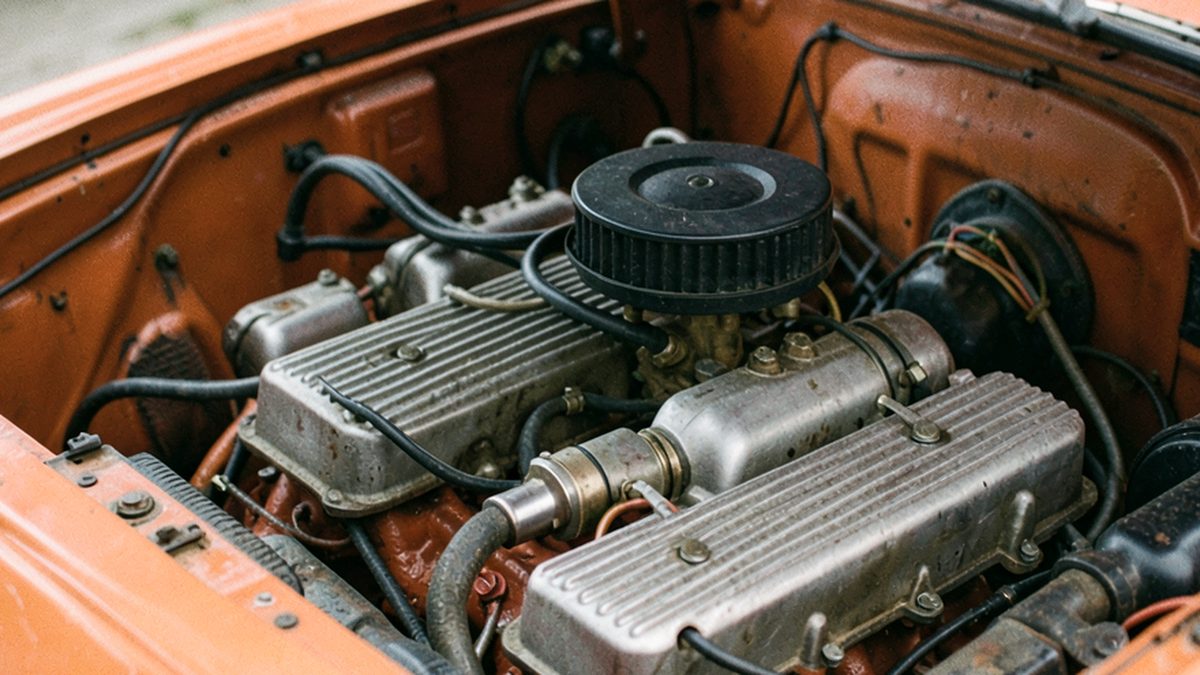
Image note: The lead image is a representative in-house illustration of a vintage American V8 engine bay. It is not presented as a photograph of a specific Chevrolet block or car.
The block casting number is usually raised on the driver-side rear bellhousing flange, just behind the cylinder head. The engine assembly code is stamped on a separate machined pad at the front of the passenger-side deck. Record both because they provide different parts of the identification.
Not always. Chevrolet used some block castings across more than one displacement and application. The casting narrows the possibilities, while the assembly suffix, casting date, bore, stroke, and internal parts settle the answer. A 3970010 number alone, for example, does not distinguish a 302 from every 350 application.
No. Current references list 3970010 blocks in both 2-bolt and 4-bolt form. The shared casting number describes the basic iron, not the final main-cap machining. Confirm the cap count by inspecting the engine with the oil pan removed or through trustworthy teardown documentation.
A plausible casting and suffix can show that a block is correct for the car's year and application. Where Chevrolet stamped a VIN derivative, that stamp must match the vehicle's plant and sequence to tie the block to the car. Correct type means period correct, not automatically original.
The muscle world, every morning. Auctions, builds, reveals. Free.