The Cowl Tag Decoder Guide to What a Tag Can't Prove
A cowl tag decoder reads every field on the plate, but on a classic GM car the answers worth money were never stamped there.
A cowl tag decoder reads every field on the plate, but on a classic GM car the answers worth money were never stamped there.
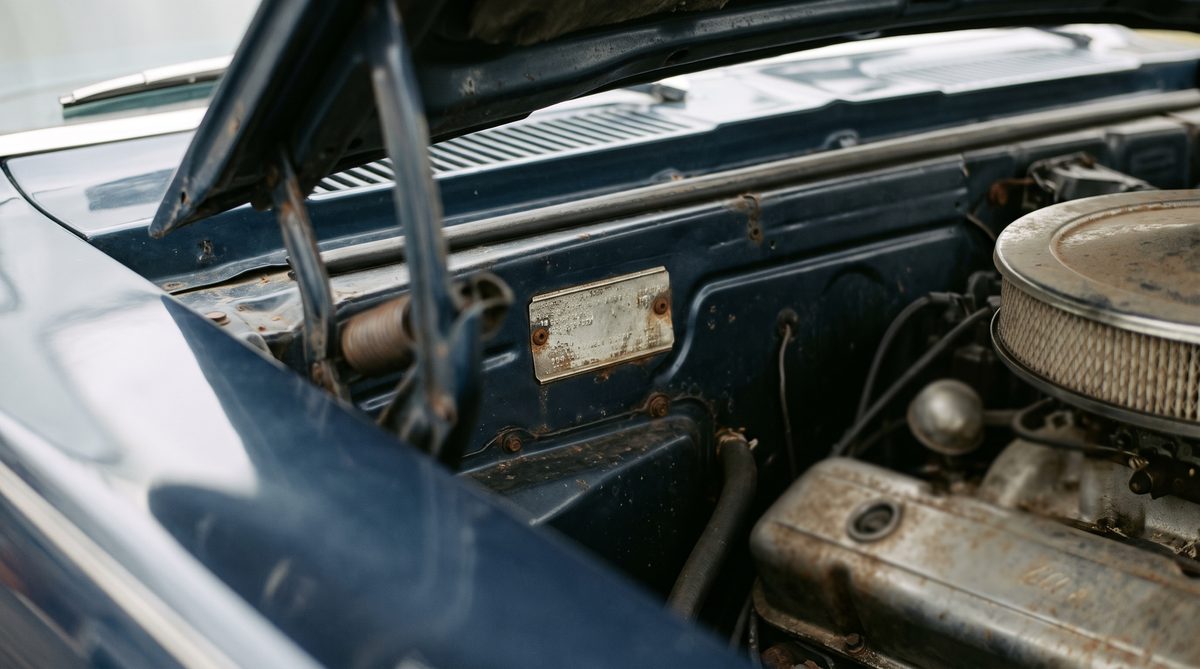
Every cowl tag decoder on the internet makes the same quiet promise: type in the codes from that little stamped plate on the firewall and it will tell you what the car is. It will tell you a lot. It will give you the paint, the interior, the body style, the plant and the week the shell was built. What it will not tell you, on almost any 1955 to 1972 General Motors car, is the engine, the SS, or even whether the car left the factory with six cylinders or eight. That gap is where bad purchases start.
Page one for this search is forum threads, Facebook posts, a 2010 answer-site reply and model-specific charts. They read the fields. None says what a tag can and cannot prove, or which charts get the format wrong. This guide does both.
The cowl tag is a small aluminum plate riveted to the firewall or cowl of a GM car, usually stamped BODY BY FISHER across the top. Hobbyists call it a cowl tag, a trim tag or a body tag, and they all mean the same plate. It was Fisher Body's work order for the shell. Fisher built bodies for Chevrolet, Pontiac, Oldsmobile, Buick and Cadillac, and the plate told the line workers how to paint and trim the body they were looking at.
That origin explains everything that follows. The engine, transmission and axle were the car division's job at final assembly, so they mostly never reached the plate. Location moved too. The Full-Size Chevrolet Research Group puts the 1964 Impala tag on the passenger side of the firewall and later ones on the driver side near the brake booster, and Novas switched sides for 1968. Check both sides before deciding a tag is missing.
Time built. Two digits for the month and a letter for the week, A for the first week through E for the fifth, so 02B reads February, second week. It is the date Fisher scheduled the body, not the day the car left the line, and on 1969 and 1970 Impalas it moved below the trim code.
Style. ST, the two-digit model year, then the Fisher style number. The first digit is the division (1 Chevrolet, 2 Pontiac, 3 Oldsmobile, 4 Buick, 6 Cadillac), the middle digits are the series and the last two are the body. 37 is a two-door hardtop, 27 a pillared coupe, 67 a convertible, 69 a four-door sedan. So 12437 on a 1969 tag reads Chevrolet, Camaro, coupe.
Plant and body number. A Fisher plant abbreviation such as NOR for Norwood, LOS for Los Angeles, ATL for Atlanta or KAN for Kansas City, then a body number. That number counted bodies through the Fisher plant and will never match the VIN sequence. Classic Industries notes that on 1969 Camaros it was assigned when the order was accepted, not when the body was built.
Trim and paint. TR and a three-digit interior code for color, material and seat type, then the paint code, lower body first and upper second. A letter in the second slot usually means a vinyl or convertible top color. Chevrolet used letter paint codes through most of the sixties and switched to numbers for 1969.
Accessory codes. Some years and plants added numbered groups with a letter in each. They are real, but they vary by plant and are the easiest thing to add to a reproduction plate.
Here is the rule that settles most swap meet arguments. On a U.S. built GM car from this era, the cowl tag carries no engine code, whatever the division. Whether the shell got a 250 six or a 396 was decided at final assembly.
Cylinder count is what catches people. Chevrolet's VIN series really does split six from V8, but the tag mostly doesn't. The Full-Size Chevrolet Research Group says the tag style is typically stamped in V8 format even on a six, that only some plants stamped a six-cylinder style, and that you should always go by the VIN. Our Chevelle cowl tag decoder walks through the same trap on a 1965 Malibu SS, where most plants stamped 13837 whether the car was a six or a V8.
The cowl tag tells you what Fisher Body built. The VIN tells you what the division sold. They are allowed to disagree.
The SS and similar packages are the same story. From 1969 the SS396 was an option, Z25, not a series, so neither a Chevelle tag nor its VIN carries it. On a GTO the plate is silent in 1964, 1965 and 1972, the years the GTO was an option rather than its own 242 series, as our Pontiac cowl tag decoder lays out year by year. When the package is the question, the answer lives in the build sheet, the original Protect-O-Plate, the dealer invoice or the window sticker.
Google's AI summary for this search pulls from the charts below it, and in three places it gives an answer the tag cannot support.
1. The style number does not reliably tell you V8 or six. The summary says the body style code identifies the series or engine family, V8 versus six-cylinder. One of its own sources, the Full-Size Chevrolet Research Group's Impala page, says the opposite for the tag: most plants stamped a V8 style regardless of engine, and the VIN is the document to trust. Read a V8 style number on a tag as a V8 car and you will overpay for a six.
2. Plant codes are not one system. The summary offers B for Baltimore, K for Kansas City and VN for Van Nuys as if they were the same scheme. The single letters come from a 1955 to 1957 Chevrolet decoder. By the late sixties Fisher tags used abbreviations, and the Camaro Research Group and Classic Industries both show 1967 and 1968 Camaro tags reading NOR or LOS, with Van Nuys switching from LOS to VN only in the middle of the 1969 model year. A 1967 tag stamped VN is a problem, not a variant. That same 1955 to 1957 decoder even lists L as Los Angeles in its VIN table and Lansing, Michigan in its trim tag table, and Lansing was Oldsmobile's home.
3. Z22 is not stamped on a Camaro cowl tag. The summary gives Z22 as an example accessory code for the Rally Sport. Z22 is the RPO, the order code. On a 1967 tag the Camaro Research Group shows the Rally Sport as a Fisher accessory letter inside a numbered group, L in group 3, never the RPO itself. On a 1969 Norwood tag it is worse: the X11, X22 and X33 codes mark a car with the Z21 style trim group, which came with the Rally Sport but was also sold on its own, so the plate cannot tell an RS from a style trim car at all. Our 1969 Camaro trim tag decoder covers the X-codes in full.
Plenty of people searching for a cowl tag decoder own something else, and their plate is a different document. That cuts in their favor.
Chrysler's version is the fender tag on the inner fender. On a 1969 and later car the bottom line carries an engine sales code (E74 is the 426 Hemi), a transmission code and the VIN, so it says something about the drivetrain a Fisher tag never does, though the codes shift by year. Our Mopar fender tag decoder reads it from the bottom line up.
Ford's equivalent is the door data plate on the driver door, and it repeats the full VIN, whose fifth character is the engine code. Below that sit the body code (65A for a Mustang hardtop with standard interior), color, trim, a date code, the district sales office, and the axle and transmission codes. The date reads day first and then a month letter, so 13A is January 13. Of the three systems, the Ford plate says the most about the drivetrain and the GM plate the least.
Reproduction plates exist for nearly every popular GM car, many sold honestly as restoration parts. Trouble starts when one lands on a car it never belonged to. Start with the rivets, which Hagerty notes are what experts check to see whether a plate has been replaced. Fresh drill marks or paint under the tag that doesn't match the paint around it deserve questions.
Then cross-check. Year, division and body should agree with the VIN, the plant should be one that built that model that year, and the paint should be a color offered that year. A tag carrying a convenient option code nobody else's plate shows is the one to slow down on. None of these checks proves a tag is original. Each one can prove it isn't.
A cowl tag tells you how Fisher Body built the shell: model year, division, series and body style, the assembly plant, a body sequence number, the interior trim code, the paint code and the week the body was scheduled. On many cars it also lists body accessory codes. On a 1955 to 1972 GM car it does not list the engine.
Usually not. On U.S. built cars the tag carries no SS code, and in years when the SS was an option rather than its own series, the VIN cannot show it either. A build sheet, an original Protect-O-Plate, a dealer invoice or a window sticker is what proves an SS. Canadian built cars are a partial exception.
No. The body number on the cowl tag is Fisher Body's own count of shells through that plant, and it will not match the VIN sequence. On some 1969 cars it was assigned when the order was accepted. The two numbers come from different companies inside GM, so a mismatch between them is normal and expected.
On most GM cars from this era the tag is riveted to the upper firewall under the hood, but the side changed by model and year. A 1964 Impala carries it on the passenger side, later Impalas on the driver side near the brake booster. Early Novas use the passenger side, 1968 and later Novas the driver side.
The muscle world, every morning. Auctions, builds, reveals. Free.