The Oldest Muscle Car Is Not the GTO
Every argument about the first muscle car comes down to which test you use, so here is the whole field in date order and a verdict with the reasoning shown.
Every argument about the first muscle car comes down to which test you use, so here is the whole field in date order and a verdict with the reasoning shown.
Ask a room full of muscle car people what the oldest muscle car is and you will get four answers and one long argument. Somebody says the 1964 Pontiac GTO, because that is what the magazines have repeated for sixty years. Somebody else says the 1949 Oldsmobile Rocket 88, and they are not wrong either. Then two more people bring up a Chrysler and a Rambler, and everybody talks past each other until the cooler runs dry.
The reason nobody ever wins is that the question hides a second question inside it. The oldest muscle car depends entirely on which test you apply, and hardly anybody says their test out loud before they start arguing. So here is the whole field in date order, what each car actually was on paper, and then a verdict with the reasoning shown instead of hidden.
There are only two honest tests, and they produce two different winners. The first is the recipe test: which car first dropped an oversized, modern, high output V8 into a body lighter than the one that engine was designed to move. The second is the intent test: which car was first built and sold on purpose as an affordable performance model aimed at young buyers, rather than backing into the role by accident. Cars that pass the first test showed up fifteen years before the car that passed the second.
Our breakdown of what actually makes a car a muscle car lays out the four part formula, and the short version matters here: a mid-size or lighter body, a big V8 borrowed from a heavier car, rear wheel drive, and a price a working person could reach. Every candidate below passes part of that and fails part of it. Which failure you are willing to forgive decides your answer, so pick your test first and the argument gets a lot shorter.
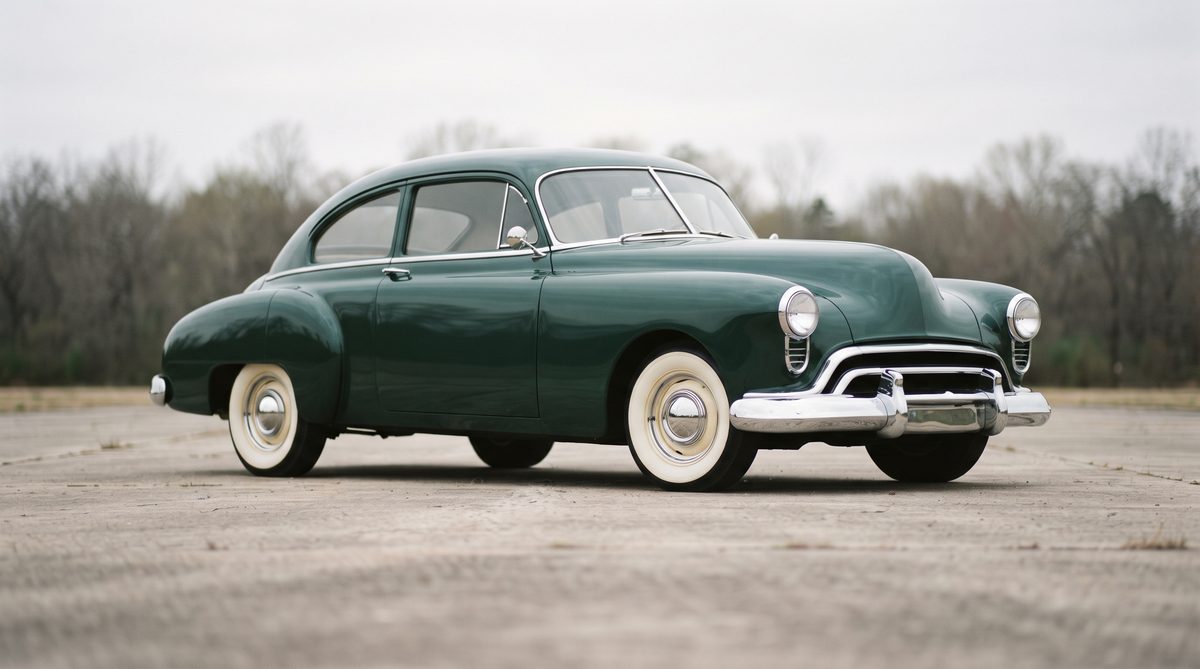
The Rocket 88 is the oldest car with a serious claim, and the claim is structural rather than sentimental. Oldsmobile had developed a new overhead valve, high compression V8 of 303 cubic inches rated at 135 horsepower, intended for the big 98. Then it put that engine into the smaller, lighter 76 body shell and called the result the 88. Big engine, small car, deliberately. That is the recipe, written down in 1949.
The proof arrived at the race track almost immediately. The 88 won six of the nine NASCAR races run in its division in 1949, then ten of nineteen in 1950. For two seasons it was simply the quickest thing an ordinary American could buy off a showroom floor, which is the exact claim every muscle car of the 1960s would later build its advertising on.
The objection is fair enough: 135 horsepower reads like nothing today, and the 88 was still a full-size car by modern eyes. But horsepower has to be read against its own decade. In 1949 the flathead sixes and straight eights it ran against were making well under 110, and the 88 weighed less than the car its engine had been built for. Judged inside its own moment it is the muscle car formula, arriving six years before Chevrolet even had a small block.
Six years later Chrysler managed something no American manufacturer had: a production car advertised at a flat 300 horsepower. The C-300 used a 331 cubic inch Hemi V8 rated at exactly that, and it backed the number up, running 127.58 mph in the Flying Mile and winning on the NASCAR circuit against cars built for nothing else.
So why does almost nobody name it the oldest muscle car? Price and size. Only 1,725 were built, and each one cost around 4,100 dollars new, which was luxury money in 1955. The C-300 was a fast, expensive, full-size grand tourer for wealthy buyers who wanted the quickest thing in the country and could write the check. It fails the part of the formula that matters most, which is that a muscle car has to be attainable. Call it the first American performance car. It is not the first muscle car.
The Rebel is the candidate that should be famous and somehow is not. American Motors took the light 108 inch wheelbase Rambler four door hardtop and installed a 327 cubic inch V8 rated at 255 horsepower. That is a mid-size body with a big V8 in it, which is the GTO recipe exactly, seven years before the GTO.
It was genuinely quick, too. The carbureted version ran 0 to 60 in 7.5 seconds, which in 1957 put it near the top of anything sold in America at any price. AMC also listed a Bendix Electrojector fuel injection option at 395 dollars that would have taken the engine to 288 horsepower, but cold start problems killed it before it shipped. Only pre-production cars ever received the system and none reached the public, so all of the roughly 1,500 Rebels built that year left the factory with a four barrel carburetor.
AMC being AMC, the car came only as a four door hardtop in a year when performance meant two doors, and the company had no marketing budget to make anyone care. That pattern repeated for the next twenty years, as our history of the AMC Javelin lays out. The engineering was right and nobody noticed.
The Rocket 88 arrived at the formula by accident. The GTO arrived at it on purpose. That single sentence is the entire argument.
Two years ahead of the GTO, Chrysler backed into the same idea from the racing side. The 1962 Dodge and Plymouth full-size line was downsized onto a 116 inch wheelbase, roughly 350 pounds lighter than the cars it replaced. Buyers hated the styling and the sales numbers showed it. Drag racers, on the other hand, loved the scale, because the lightest of these cars left the factory at a shipping weight of about 3,185 pounds.
Into that body went the 413 Max Wedge, rated at 410 horsepower with 11.0 to 1 compression and 420 horsepower with 13.5 to 1. The next year the same idea grew to 426 cubic inches and 415 or 425 horsepower. On raw numbers alone, a 1962 Savoy with a Max Wedge under the hood is a more extreme machine than anything Pontiac would sell in 1964, and it is a genuinely mid-size car.
The reason it rarely wins this argument is that it was never really a street model. Plymouth sold fewer than 200 Max Wedge cars in 1962. It was a homologation special aimed squarely at Super Stock classes, sold to people who already knew exactly what they wanted and had no interest in a warranty. Nobody was cross shopping one against a family sedan, which is the whole point of the category.
Which brings us to the car that gets the credit. General Motors had a corporate policy capping its A-body intermediates at 330 cubic inches. John DeLorean, Bill Collins and Russ Gee noticed that the rule governed models rather than option packages, and that general manager Pete Estes could sign off on an option without asking anyone upstairs. So the 389 cubic inch V8 went into the Tempest LeMans as a 295 dollar option box instead of a model, rated at 325 horsepower, or 348 with Tri-Power.
Pontiac's own sales manager forecast 5,000 of them. The GTO sold 32,450 in its first year. That gap is the real reason 1964 is the date everyone remembers, not because the engineering was new, but because the market answered so loudly that every other division spent the next two years copying the homework. GM kept playing the same rules game for years afterward, which is exactly how the Hurst Olds got around the 400 cubic inch limit in 1968.
The GTO was also the first of these cars sold as an identity instead of a spec sheet. It had a name lifted from Ferrari, its own badging, and advertising written for teenagers rather than their fathers. Everything that followed across the classic muscle car field, from the Chevelle SS to the Road Runner, is downstream of the marketing Pontiac ran in 1964 as much as the engineering underneath it.
Apply the recipe test and the answer is the 1949 Oldsmobile Rocket 88, with the 1957 Rambler Rebel as the first to pull it off in a genuinely mid-size body. Apply the intent test and the answer is the 1964 Pontiac GTO, with nothing else close. Both answers are correct, because they are answers to two different questions that happen to sound identical when spoken out loud.
Our position: the Rocket 88 is the oldest muscle car and the GTO is the first muscle car. Those are two separate titles, and this argument only stays alive because people keep trying to hand both of them to the same car. If you want the oldest, go back to 1949 and give Oldsmobile its due. If you want the one that created the category as something you could walk into a showroom and ask for by name, 1964 is the year and the case is closed.
One note on the photograph above: it is an illustration produced in house to show the 1949 body style, not a photograph of a specific surviving car.
It depends on the test you use. The 1949 Oldsmobile Rocket 88 was first to put a big new V8 into a lighter body, so it is oldest by recipe. The 1964 Pontiac GTO was the first built and marketed on purpose as an affordable performance model, so it is first by intent. Both claims are defensible.
The 1955 Chrysler C-300 was the first American production car rated at 300 horsepower, using a 331 cubic inch Hemi V8, and it won in NASCAR. But only 1,725 were built at roughly 4,100 dollars each, and it was a full-size luxury coupe. That makes it the first American performance car rather than the first muscle car.
Oldsmobile, if you date the formula to the 1949 Rocket 88. Pontiac, if you date it to the 1964 GTO, which John DeLorean, Bill Collins and Russ Gee developed as an option package to sidestep a General Motors rule limiting intermediates to 330 cubic inches. Most published histories credit Pontiac and 1964.
No. The Mustang arrived in April 1964, the same year as the GTO, but it launched with sixes and small V8s in a compact body built around style and price rather than displacement. That formula defines the pony car instead. The Mustang only became muscle car material later, once the big block cars arrived.
The muscle world, every morning. Auctions, builds, reveals. Free.